Questions for Head of Governance Candidates

Hello,

Here is the set of questions that we’re asking all of the final Head of Governance candidates to respond to. I’ve asked them to submit their answers to me initially, so that they don’t bias one another’s answers. Once I’ve received all of the answers, I’ll post them all together here. Community members are welcome to review and respond to these responses, here or on the AMA that we’re planning with all of the finalists late next week.

The candidates have one week, until 23:59 New York time on Thursday, Oct. 9 to respond.

Big thank you to everyone who contributed to these questions including core team, partners, and community members. Putting this together was very much a team effort!

Essay questions

We expect responses to these questions to be 400+ words each.

  1. As the Near House of Stake scales, you’ll need to increase our operational capacity without compromising the principles of decentralized governance. Today, many DAOs struggle to scale without a single influential party (Foundation/delegate/service provider/etc.) or significant support from the core team. Please describe your strategic vision for this challenge. How would you design a framework that balances the need for accountability, legal compliance, operational structure, and efficiency with the decentralized nature of our community? Do you rely on service providers, subDAOs/committees, contributors, sub-entities, incubated companies, or something else? Please support your answer with specific examples from DAOs or other relevant organizational structures.

  2. The NEAR ecosystem is complex. In addition to the NEAR proof of stake blockchain, there’s also NEAR Intents, Chain Signatures, and AI infrastructure products, and there will likely be other product offerings in the future. One way of describing House of Stake is as the “central bank of the NEAR ecosystem,” in the sense that HoS is intended to manage economic policy not just of the core NEAR protocol but, in fact, of all of these other products as well. This includes things like blockchain issuance/inflation, the current 0.5% subsidy that flows into the treasury.near community treasury contract, or turning on a “fee switch” for other NEAR products. The initial House of Stake treasury contains ~3.5M NEAR (~$10M USD present value). What’s your vision for the use of these funds and how budgeting should occur, and, more broadly, what’s your vision for how HoS can achieve economic sustainability through acting as a “central bank,” along the lines described here? What sort of economic policy should NEAR target, and how can HoS help us achieve this?

  3. Please review the HoS design, and our stated mandate. Do you believe that this design accomplishes our goals/mandate? Why or why not? What would you change if you could? Do we have all of the necessary checks and balances in place? What additional checks and balances, if any, would you implement among NEAR Foundation, the House of Stake Foundation, the screening committee, the endorsed delegates, the security council, and token holders/delegates? Bear in mind that: 1. The House of Stake Foundation cannot bloat with hiring and become a second NEAR Foundation; 2. The system must empower experts with long term budgets who can see the execution of work through multiple iterations to enable optimization; and 3. Delegates cannot be made to vote on policy without context and funding decisions without clear objectives.

Short form questions

We expect responses to these questions to be < 250 words each.

  1. DAOs often fail to put the right decision-makers in charge of key decisions. How would you design a governance system that ensures specialized knowledge is weighted correctly for critical decisions, while still upholding the principles of decentralized consensus?

  2. In this role, how would you balance your personal principles with the NEAR Foundation’s value of pragmatism over perfection? Please give a real-world example of how you’ve made a pragmatic concession to achieve a greater goal.

  3. What is your single most important quantitative or qualitative metric for determining whether House of Stake is successful? How would you use this metric to prove to the community that HoS is working as intended?

  4. For House of Stake, growing the amount of locked veNEAR is absolutely critical to success. How would you encourage large NEAR holders to delegate their tokens?

  5. Do you believe the voices of small holders should carry the same weight as those of large holders, or should decision-making naturally prioritize major stakeholders? In concrete terms, how should we balance these two groups?

12 Likes

Hey there!

I applied for the Head of Governance role at House of Stake last August and you can see my public application here with details on my background and motivation for this role.

Since I was invited to answer these challenge questions, I took the opportunity to drill down deeper into the history and context of House of Stake up to the present day and by answering these questions I believe I crafted a vision for what I think should be prioritized going forward.

I hope it is an interesting read.

These are my answers below.

Essay Answers

Please allow me to start answering in a different order than the one proposed, since my answer to the third essay question about the current governance design and mandate influences every other answer of mine.

Third essay question

Short answer is no.

I don’t believe this design is the best to accomplish the stated goals in the recently shared mandate. But that’s mostly an issue with the recent mandate than with the governance design proposed by @Gauntlet some 15 months ago.

1. My critiques of the proposed governance design

Vote escrow governance models were originated and conceptualized to be applied in DeFi protocols like Curve Finance, Balancer, and more recently in Velodrome, where long-term stakeholder alignment is essential to foster long-term liquidity pools. Vote Escrow is not a governance model that has ever been applied successfully to a L1 blockchain like NEAR (maybe it can be argued that Polkadot’s conviction voting is a kind of vote escrow, but that’s the only example I can think of), and more importantly, I don’t think it incentivizes a power distribution that is healthy for a multipurpose ecosystem like NEAR.

In vote escrow governance systems, the largest stakeholders that can afford to lock their tokens for longer timeframes become way larger over time, that’s the design goal of vote escrow, and in the specific case of the proposed design for NEAR, they would become 3 times larger after 4 years of locking. This means that with vote escrow, the most powerful stakeholders today, will probably be the most powerful stakeholders in 4 years as well by capturing most of the yearly inflation rate allocated to these rewards, and for an ecosystem like NEAR, that has so many different moving parts, and products, and verticals (Intents, Chain Signatures, NEAR AI), it is not really smart to enshrine the same handful of stakeholders as the ones with the most power that would be able to almost unilaterally decide on all of these very different things in the future. We need a governance design that would allow for the most powerful decision makers to change over time, in tandem with the future priorities of NEAR. We need to have that flexibility to avoid complete capture from a few powerful entities.

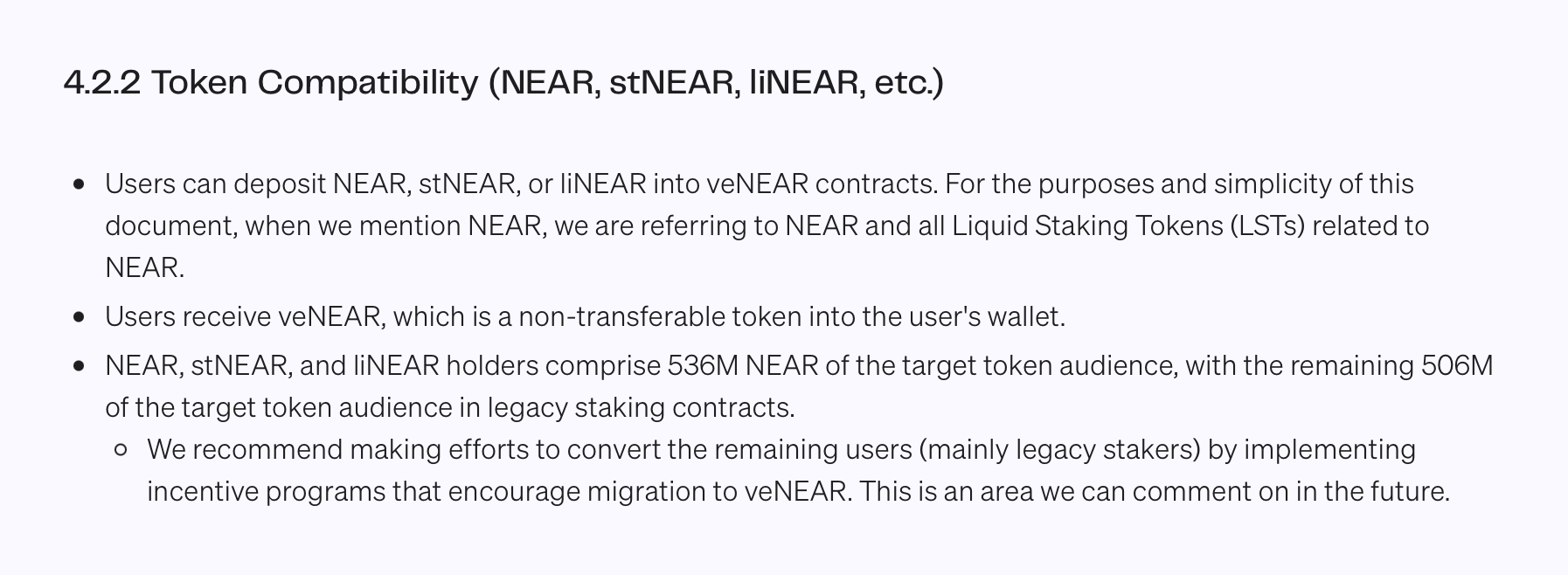
The other issue with vote escrow is that it needs a source of revenue to fund its rewards, and as it is pointed out in the proposed governance design by Gauntlet, those rewards will inevitably divert $NEAR rewards from other currently existing token sinks, like the validator staking mechanism, which this proposal ominously refers to as “legacy staking”.
As it says in the original Gaultlet proposal:

“We recommend making efforts to convert the remaining users (mainly legacy stakers) by implementing incentive programs that encourage migration to veNEAR. This is an area we can comment on in the future.”

And as the main solution to this challenge, Gauntlet proposes:

I think this is the biggest flaw of this governance design when applied to a proof of stake sharded blockchain like NEAR. If we run this system for long enough, we might get into a situation where we will be running 2 major competing staking mechanisms, one for veNEAR governance, and another one to secure the proof of stake network with its validators. Between allocating rewards into one or the other, I think it is preferable to prioritize the one that keeps the NEAR blockchain running fast, and in an ever more decentralized way.

Despite the fact that there are additional plans to include the ability for $NEAR stakers to also lock their tokens and then choose a validator, like Illia mentioned publicly here, this is not included in the original Gauntlet proposal. To my knowledge this is the last public update from Gauntlet regarding this crucial issue.

I believe the legitimacy of House of Stake hinges on the amount of NEAR that is used for governance. With this proposed veNEAR design, it is going to be really hard to engage token holders to participate in governance and achieve sufficient legitimacy in this governance architecture, or even worse, we might be able to bribe them into getting veNEAR at a huge financial cost to cover the rewards, and huge network security cost by decreasing incentives to validators.

Also, such a high amount of native, almost risk-free yield from these proposed veNEAR rewards, makes it really hard for a competitive DeFi ecosystem to flourish in NEAR, and that might actually be the biggest risk of this proposal design.

Another critique I have on the proposed design is that it is very heavy-handed in enshrining a set of Endorsed Delegates, that were initially unilaterally chosen by the Screening Committee, which in itself was unilaterally chosen by the NEAR Foundation. This design nukes very needed legitimacy at the start of our governance journey. In my view, there should be no distinction between delegates, and every single one of them should be able to compete on a level playing field to attract more $NEAR to be delegated to them, which doesn’t look like it’s going to be the case in the current implementation of the proposed design.
I think the Endorsed Delegates body is an example of a “check” in this governance design that is not proportional to what I think is needed in the context of NEAR right now. It feels like an overreaction to the challenges that plagued the open nature of the NDC and I understand why it was proposed, but it’s a very heavy “check” with no recourse for “balance”.

Also, the Screening Committee should also not be able to veto proposals for going up for a vote, that’s an emergency power that should belong to the Security Council, and only be enacted after and if a vote passes. This is actually what is specified in the proposed governance design by Gauntlet, but I’m not sure if that’s what’s going to be actually implemented in practice. All proposals should be able to proceed for a vote requiring a 75% super majority support, and the ones that would be favorably screened by the Screening Committee would proceed for a vote requiring only a 50% majority support. Also, I think the screening committee members should be paid for this work, and if so, a commitment of the Screening Committee being able to screen, favorably or not, a proposal under 24 hours, should be explicit and a contingency on their payment.
Also, I think that the Screening Committee members should be elected by the community, and they should have a term limit and be replaced every 6 months or 1 year.

This way, we wouldn’t need a screening committee to be appointed by the NEAR Foundation at the start of the House of Stake DAO or an unfair distinction between Endorsed Delegates and Non-endorsed delegates. We could start with a minimum support threshold of 75% for all proposals in the first 6 months/1 year, ensuring that only proposals that have large support and alignment would pass, and then once the community is already participating in governance and has passed proposals successfully for 6 months to 1 year, we would do elections for the Screening Committee members to be able to lower the support threshold for the proposals that are favorably screened by the elected Screening Committee.

Something like this:

Then in the future, once the legitimacy of this process is undisputed, the delegates could also elect the Security Council members, with a term limit of 1 year or more.

Another critique I have about the proposed governance design is that point 5.1.4 Evaluation and Removal of Bad Actors is completely impossible to enforce without onchain mechanics that are anti-ethical to the spirit of decentralization and censorship resistance.

I agree we should have a process to exclude elected members from governing bodies (like the Screening Committee and the Security Council) via a community wide onchain vote of no confidence, but never allow blacklisting of delegates and force token holders to re-delegate. This is unheard of in any serious DAO governance setup.

Additionally, I think there is another body that should be part of this process in the future and have specific checks and balances on its powers, and that is the Head of Governance, but only when it becomes accountable to the community by being directly employed by the DAO, aka, as an employee or director of the House of Stake Foundation. Specifically if its mandate is to be a more presidential one, like it’s framed here. Of course, that the legitimacy for this person to have special powers can only exist if there is a fair election for this role, and if it is truly accountable and has to answer to the community, like I meme’d about here when I initially applied for this role. I’m not sure if this is still an option for this hiring process right now, but I would be comfortable with either approach. Both by being hired directly by the House of Stake Foundation after a successful DAO election, or by the NEAR Foundation, in the interim, until the governance process of the DAO gets up to speed and legitimate enough to elect a “president”.

Despite all of these concerns with the proposed governance design by Gauntlet, I think we can still make the necessary changes, for it to be a suitable design for NEAR if:

  1. there’s a very simple way to use $NEAR already staked to the proof of stake validators, in House of Stake governance. maybe something like what was attempted last June for this reduced inflation vote. $NEAR staked in validators is the most legitimate decision-making body in the whole NEAR ecosystem right now, by far, and the clunky participation (validators had to vote from the CLI with a specific command) in the vote above kind of proves it.
  2. we reduce significantly the rewards for veNEAR locking, or start with zero rewards and reassess if they are even needed at all to incentivize governance participation.
  3. eliminate any distinction and preferential treatment between delegates, aka, no more endorsed delegates appointed by the Screening Committee. That undermines legitimacy.
  4. dissolve the current NEAR Foundation nominated Screening Committee and organize elections for a new one, that can only fast-track proposals into a 50% majority support vote (instead of the initial 75% majority support vote), some 6 months / 1 year down the line or once we have sufficient legitimacy and governance activity in the DAO.
  5. do not engage in any attempt to blacklist delegates from onchain voting, and definitely do not encode this functionality in the governance smart contracts.
  6. clarify the responsibilities, duties, liability, approach, and transition of authority/powers (if any), to the individual in the Head of Governance position.

2. My concerns regarding the recently shared mandate

Despite all my critiques above, regarding the proposed governance design, my main overall concern is about the recently shared mandate.

Specifically, this anti-mandate:

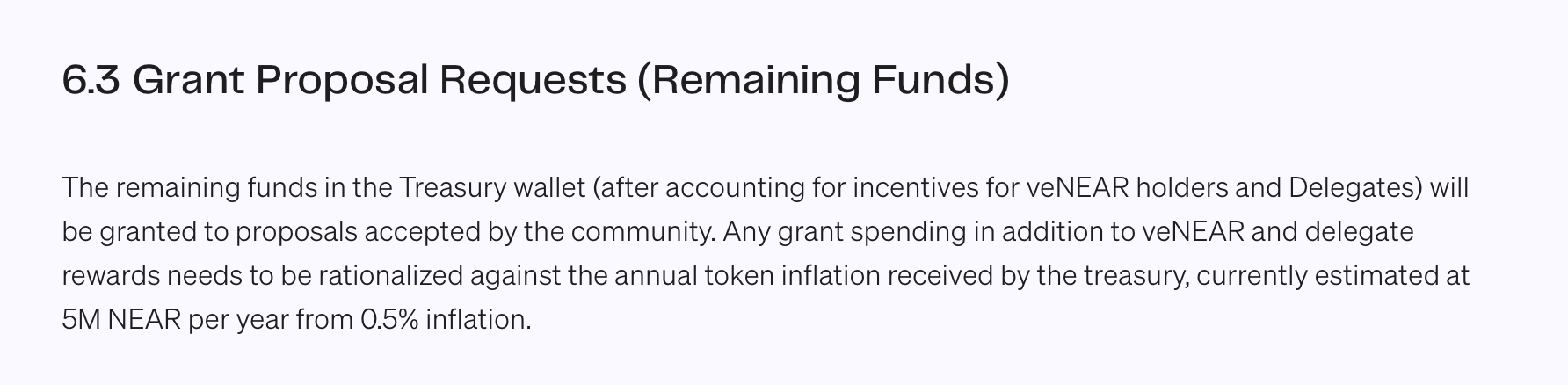
Gauntlet’s proposal enshrines point 6.3 Grant Proposal Requests as the only mechanism for spending funds in the treasury.near wallet, in addition to the spending for 6.1 Incentives to veNEAR holders and for 6.2 Incentives to Delegates.

So, to start, this anti-mandate is already contradictory to the goals and governance design specified in the initial Gauntlet proposal.

But I think the main issue here is one mostly about legitimacy and growth, which are the third and fourth stated goals in the mandate, making this anti-mandate contradictory to the mandates themselves:

For starters, the idea of a top-down mandate/anti-mandate from the Foundation to the DAO feels… unusual, to say the least.
In a DAO, the only legitimate constituency that should be able to define a top-down mandate (or if there should be a mandate/anti-mandate to begin with) is the body of token holders, or a representative elected by them.

I understand the need for focused seasons and increasing levels of authority and control and resources being gradually released from the NEAR Foundation to the DAO, but potentially enshrining in the constitution (even if it’s an interim one) an anti-mandate regarding grants in the first season of the DAO, is a sure fire way to guarantee that the community engagement with the DAO, and the ecosystem health, gets nerfed from the get-go. We can accomplish the same goals of gradual control transition via other means.

This is especially critical right now, because when we eventually launch House of Stake, hopefully soon, we need all the hype and incentives we can get to convince NEAR holders to participate in governance. To put it simply, veNEAR rewards alone will not attract the right crowd, one that is able to decide on future protocol issues related to economic and technical governance. A grant program, however, if structured correctly, will attract builders and founders that will create the next drivers of growth for NEAR, and if they are committed to build in the NEAR ecosystem for the future, they will be the most aligned cohort of stakeholders possible, so they will obviously participate in the governance of the blockchain they are personally invested in.

This is specially concerning since, as stated in the recently shared transition plan:

If there isn’t even the potential for grants in House of Stake, from its inception, our ability to attract the best builders and founders to the NEAR ecosystem, gets severely diminished, and the success of the House of Stake launch and its legitimacy goals would be definitely compromised.

Regarding the 2 main goals in this mandate, the ones for economic and technical governance, I also think they are the right ones to focus on at the moment since they are the kind of decisions that really need to be made in a decentralized way, both from a legitimacy point of view, but also from a regulatory and security risk point of view.

I agree that economic governance should be the priority in the beginning of the DAO given that there are already several attempts of specific proposals for protocol inflation reduction for example, but I also think we should be wary of reducing protocol emissions before having reliable revenue streams or reliable demand for NEARs block space. $NEAR token price is obviously an important thing to be worried about, but simple tactics to artificially increase it might backfire as well.
Also, reducing protocol emissions would also reduce the available budget for House of Stake’s treasury, which following the Gauntlet proposal should be allocated to veNEAR incentives, Delegate incentives and grants.

Regarding technical governance, I think there are some decisions that also need to be made in a decentralized and legitimate way, and those should be prioritized as well. Specifically because, with the current regulatory environment where potentially the CLARITY Act in the US might get approved, NEAR should work towards achieving a mature status of technical decentralization, which necessarily will require complying with all 7 criteria specified in the Clarity Act, where the System Governance criteria and the Impartial System criteria are the ones where a healthy DAO with a truly decentralized decision-making ability is definitely needed.

To summarize, my main concerns with the current mandate and the governance design proposed by Gauntlet are:

  1. the proposed governance design and mandate contradict each other, especially in regard to funding grants
  2. the anti-mandate against grants should be removed from the current mandate
  3. the veNEAR mechanics proposed might be detrimental to a fair distribution of power in future NEAR governance
  4. the veNEAR incentives proposed will be a huge strain on the House of Stake treasury and will negatively impact validators and therefore network security
  5. the governance architecture in the proposed design is too centralized to start, which undermines legitimacy in the system

Second essay question

I believe that a sound economic policy should be a main priority for any healthy DAO, and, in short, I believe that we should focus more on increasing DAO revenue than in cutting DAO expenses. Ideally, for every approved proposal that spends DAO funds, we should pass 2 proposals that aim at increasing revenue for the DAO. This is obvious easier said than done, and in a decentralized DAO we can’t really control the outcome of proposals that spend funds, but we can do our best effort possible to highlight and show current spending, with transparent and live treasury dashboards. This was indeed one of the priorities I highlighted in my application post 6 weeks ago:

I believe we should enforce proposers to meticulously detail and breakdown the costs for every proposal that requests funding, and to also specify financial KPIs and targets for the initiative being proposed, specifically in terms of potential additional revenue it could bring to the DAO. This could be socially enforced with a proposal template that requires proposers to include this kind of financial analysis in each proposed initiative.

Also, I think one of the first initiatives we should invest and facilitate, is a collaborative effort to define a holistic budget for the DAO, where we would have socially agreed spending caps per theme, per quarter, and in building a treasury dashboard where the community could see in real time the socially agreed available budget available for each main theme. This exercise would also have the additional benefit of bringing more transparency into the financials of the DAO for everybody to see, bringing economic sustainability to the forefront of the community concerns as well. For example, even for Arbitrum DAO (where I’m currently a delegate in) which has a diversified treasury of $1.5 Billion USD, we can see that in the worst case scenario, the DAO runway is only 7 years. These type of dashboards are exactly what we should invest in, so that financial transparency and awareness is top of mind in every delegate when they are voting for spending precious DAO resources.

Another priority should be to diversify the treasury into different assets, not just $NEAR, which could also become a good example of showcasing the NEAR Intents technology. Traditionally, DAO treasury management companies require assets to go offchain to be able to manage them faster and with more autonomy, which compromises security, transparency and complicates subsequent reporting of treasury management operations. I believe we have the opportunity to harness the power of NEAR Intents for on-demand cross-chain swapping so that we can have an actively managed and diversified treasury that edges against the potential volatility of the $NEAR price, and generates yield for the DAO. Ideally, all DAO expenses would be covered from the yield of putting treasury assets to work without the need to ever spend the principal, kind of like traditional university endowments work. Also, we should have a dedicated stablecoin balance for quarterly budgeted DAO expenses, whose conversion from $NEAR into stablecoins is done carefully and in a way that minimizes $NEAR price impact.

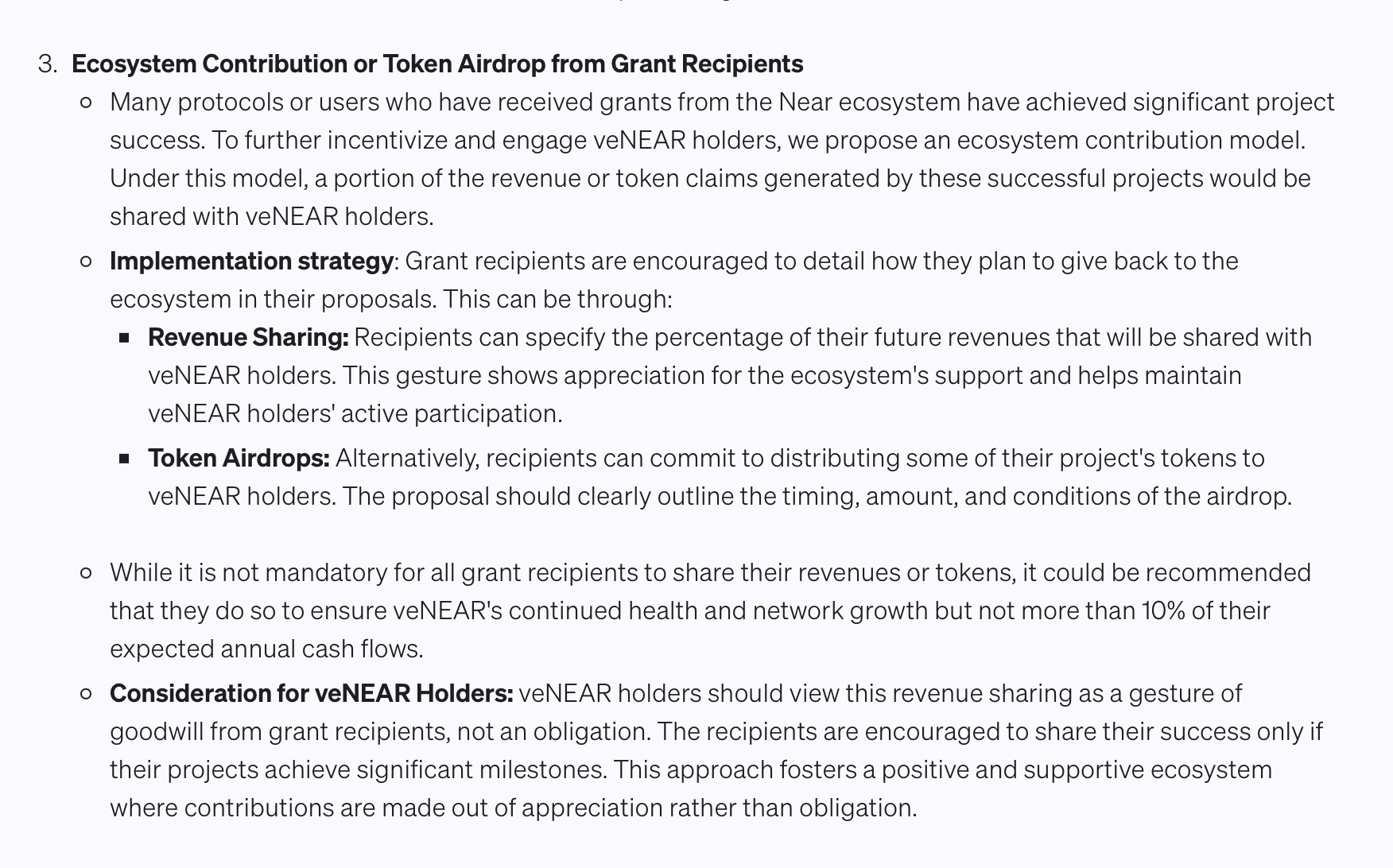
On the revenue side, we should increase and also diversify the sources of revenue and direct them to the DAO treasury. For example, switching-on a fee for NEAR Intents sounds like a tempting possibility, since it is one of NEAR’s offerings that has clearly achieved product-market fit, but maybe it is still too early to do that, in my opinion. Other sources of revenue for the DAO might include requiring NEAR nodes to participate in a revenue-sharing program, similar to what is suggested in the original Gauntlet proposal:

Currently, the only sources of funding for House of Stake DAO are the old NDC Community Treasury that holds roughly 3.5M NEAR (and whose legitimacy and legal grounds to be used for House of Stake is apparently still being debated), and most importantly, the treasury.near wallet that gets 10% of the protocol’s 5% yearly inflation, and currently holds roughly 28M NEAR, as is specified in the Gauntlet proposal. At today’s prices, that’s a little bit shy of $100M USD in total.
As a comparison, Arbitrum DAO’s Treasury Management Program, started almost 1 year ago to this day, has $89M USD currently under management and has accumulated $1.5M USD mostly from RWAs and ETH and ETH correlated yield, as it can be seen in this dashboard.

In summary, I believe we should follow a conservative economic policy, where:

  1. we don’t spend more than what we earn and try to keep the principal of the initial endowment intact
  2. we engage the community in collaborative budget setting processes
  3. we invest in active treasury management that brings data to the forefront of delegates minds to inform their every vote
  4. and we sensibly invest the assets in our treasury in reliable strategies so we can fund our DAO operations mostly from that yield

First Essay Question

I think that the challenge of the “need to increase our operational capacity without compromising the principles of decentralized governance” is a false dichotomy. In my opinion, increasing operational capacity is not in tension with decentralized governance, in fact, a properly decentralized organization can have way bigger operational capacity than a centralized organization of the same size that is designed so that the leader has to participate in every decision. This is an organizational design issue, that should be solved with organizational design solutions, and it’s actually the main reason why I got into DAOs in the first place, back in 2016. Then, when I was in RnDAO, we deeply researched these issues and had sessions with the world’s most influential minds in organizational design, that can be seen in RnDAO’s youtube channel. The first session was with Doug Kirkpatrick, an expert in self-management methodologies, about scaling a self-management organization, and whose founding work in Morning Star, is one of the examples of how an organization can scale to achieve huge operational capability (Morning Star is the world’s largest tomato processing company that operates without managers, bosses, or titles) by relying on thoughtful organization design and self-management methodologies.

In the DAO world, I think the most effective model we’ve seen is the subDAOs/working groups one, where membership is voluntary and composed of multidisciplinary talent, where the group gets formed with an explicit and well-defined and concrete mission, and is by its very nature, a temporary arrangement. SubDAOs should have to compete with other SubDAOs for funding and the individuals that compose them should be accountable to the whole DAO. Individuals in those SubDAOs should be autonomous and in equal standing to each other, and should never be forced to make commitments they don’t want to make. But when an individual commits themselves with doing something, they do so in a public and accountable way. If they fail a public commitment they’ve made, that information should be tracked and recorded to inform future funding decisions. This is why financial transparency is essential in a DAO, and why I’m a very loud advocate for it. That’s why I publicly disclose all the earnings I receive that have originated from the Arbitrum DAO treasury, here. I believe that individuals that work for DAOs and occupy positions of power should comply with the same level of disclosure as real world politicians.

Where I think most DAOs fail while trying to scale their operations is regarding transparency and concentration of power. It’s very common for DAO service providers to become more and more sticky and monopolize their position and authority in the DAO, after an initial minimally successful engagement. In my experience, this is mostly a failure of lack of competition and behind closed doors’ procurement practices. As a DAO, we need to be able to attract and nurture the best talent possible and the best way to do that is to offer them an environment to work that is fair, transparent, and publicly accountable.

Service providers are also an integral part of scaling operations, and one practice that is not as wide spread as I think it should be in DAOs is the practice of launching public Request for Proposals (RFPs) where service providers can apply in the open and compete to be selected for the job. ZK Sync is a good example on this front nowadays.

(to be continued…)

3 Likes

And the core team should focus on treating governance as a product, by setting up processes and methods similar to traditional product development, and defining the requirements for what the DAO needs, based on research and data, to launch RFPs that service providers can respond to and to recommend areas of research and work that working groups can focus on. One example of a working group model that worked fairly well was the second version of the Arbitrum Research and Development Committee (ARDC V2) in Arbitrum DAO. It was setup in a very specific way where service providers were accountable and progress was reported to the whole DAOs very transparently. Their data repository can be checked here and the final report of their operations can be seen here. The organizational setup of this working group is evident in the original proposal that formed it, that can be seen here.

In summary, I believe we should operate with transparency as the main guiding principle to set up the organizational design of the House of Stake DAO, by doing open RFPs, setting up working groups, and keeping service providers publicly accountable and record everybody’s commitments and deliverables.

Short form questions

Please allow me again to answer in a different order than the one proposed.

First Short Form Question

As I was hinting at in the previous essay question, I believe dedicated subDAOs/working groups should be setup to research specialized issues and that work should be funded with clear expectations and deliverable. The output of those working groups should be a well researched proposal that gets put forward for the whole DAO to vote on, and approve or not. The setup of that working group should be seeded by the governance team that would recruit the initial talent that would compose that working group and set up the incentives, deliverables and expectations for it. The funding for these working groups should be approved by the DAO in a proposal written by the governance team, detailing the working groups that make sense to set up every quarter according to the priorities and organizational design needs of the DAO at that moment.

So in summary, specialized talent should be funded, as a working group, to produce recommendations for a particular problem, which should then be used to craft a well researched proposal for the whole DAO to vote on, guaranteeing that there is still decentralized consensus and legitimacy for that particular decision regarding specialized knowledge.

Third Short Form Question

Quantitative metrics around governance participation are always the ones I gravitate towards to demonstrate the health of a decentralized community. Number of proposals voted on, delegation rate (hopefully increasing) over time, delegate voting participation with reasoning, time to achieve quorum, average quorum buffer, diversity of proposals, forum engagement, number of active delegates, among others. We should have live dashboards for all of these quantitative governance metrics and tailor made open-source governance tolling that can be customized to improve these engagement metrics.

Regarding qualitative metrics, we should conduct anonymous feedback surveys regularly about the several initiatives, so that we can gauge community sentiment and adjust accordingly. Here’s an example of an anonymous feedback survey I created in Arbitrum DAO, about the current Delegate Incentive Program, that informed a proposal I put forward last week for a new and improved Delegate Incentive Program called Arbitrum Double Dip.

A mix of quantitative and qualitative metrics should be used to prove that House of Stake is working as intended, and as a trained User Researcher and Product Designer with over 15 years of professional experience, I have a natural intuition to rely on both kinds of metrics to inform my design decisions and iterate until the data starts pointing up and to the right.

Fourth Short Form Question

As I detailed in my first essay answer above, I believe that veNEAR rewards for stakers are an expensive way to do it. I think a better way is to incentivize Delegates to get more delegation themselves and reward them for increasing, and not decreasing, their delegation size. This is actually the type of incentive I’ve designed for the Arbitrum Double Dip proposal I put forward last week, where big delegates get rewarded for voting, with a reason, proportionally to their voting power, which is similar to what Gauntlet proposes for Delegate Incentives in their original design, but in this case for House of Stake, I think we should design an algorithm for delegate rewards that has a bigger than 1 multiplier proportional when a delegate increases their delegation in each month, and a smaller than 1 multiplier when a delegate decreases their delegation each month. This way, the delegates themselves would be motivated to constantly get more delegation and get $NEAR locked into the governance contracts, so that they get more voting power and bigger delegate incentive rewards. And extreme version of this idea, would be to institutionalize a method for delegates to share a kickback of the incentives they receive with their delegators, in the same way I’m doing with my personal delegator kickback program in Arbitrum DAO.

Fifth Short Form Question

Token weighted voting is still the GOAT in DAO governance, so no, for DAO wide decisions, I believe the weight of each holder’s voice should be proportional to their voting power. Small holders should find ways to contribute to the DAO by either joining a working group and shaping the policies, proposals and initiatives of the DAO, while getting paid for their time and effort, and building their reputation. Of course that this is dependent on the power concentration of the largest holders, but since we still don’t know what that discrepancy is going to be, there’s really no fairer way than token-weighted voting.

From my experience, small voices that constantly participate and accumulate context about the organization, usually have a different kind of social capital that is really valuable and offsets the discrepancy that their token holding would show when compared to the largest token holders. For example, I’ve been an active delegate in Arbitrum DAO for a little more than a year, and throughout that time the biggest delegate in Arbitrum DAO had 400 times more voting power than me, but in most calls and chats, delegates would answer my questions and consider my ideas, suggestions and opinions, in the same as they would the biggest delegate in the room. In a DAO, if the processes are open and fair, small holders can quickly have outsized influence.

Second Short Form Question

Can I be a little bit cheeky on this answer, just to wrap it up?
If you’ve read all of this, you might have noticed that I have very strong opinions about DAO governance. And since I’ve been obsessing over NEAR’s House of Stake recently, I have a lot of critiques about the current governance design, mandate, lack of transparency in processes, etc. But… I’m still here. Dedicating a huge amount of time and effort to answer these challenge questions, putting myself out there and competing in the open for this position. I confess I have strong ideals, and I am sometimes a purist about certain principles, especially in crypto. But I’m not a perfectionist on my work. Most of my work in the past year was designing, building and shipping proposals.app, in the open, with very little resources and in short timelines, while reporting every step of the way, in 4k video format. The other part of my work, for the last year, was spent in the trenches, participating daily in the most decentralized and biggest DAO in the world, as a small delegate that recently became not so small anymore. In Arbitrum DAO, I’m literally known as the annoying guy that always asks questions in every call, every forum proposal, every deliverable report. You can check it all here.

So honestly, I feel that every day, both as a DAO governance product builder, and as a delegate in the trenches, I’ve been compromising, conceding, negotiating, finding middle grounds, every step of the way, in order to achieve the greater goal of fair, scalable and efficient decentralized governance. I believe that DAOs are to corporations what democracy was to monarchy. And in this day and age, as a species, we are in desperate need for better governance, since governance is the endgame of humanity and DAOs are our petri dish.

Wrap up

Thank you for reading all of this. Please drop any additional questions, comments, ideas below. Thank you all! =)

4 Likes

I’m going to post the responses that @AK_HoG and @eleventh19 previously shared, in the interest of time, so that the community has time to review them before the AMA call later today.

Angela

PDF format: angela responses.pdf (280.4 KB)

Angela Kreitenweis

08.10.2025

Essay questions

We expect responses to these questions to be 400+ words each.

Response Q1/Essay – Angela Kreitenweis

Q1:
As the Near House of Stake scales, you’ll need to increase our operational capacity without compromising the principles of decentralized governance. Today, many DAOs struggle to scale without a single influential party (Foundation/delegate/service provider/etc.) or significant support from the core team. Please describe your strategic vision for this challenge. How would you design a framework that balances the need for accountability, legal compliance, operational structure, and efficiency with the decentralized nature of our community? Do you rely on service providers, subDAOs/committees, contributors, sub-entities, incubated companies, or something else? Please support your answer with specific examples from DAOs or other relevant organizational structures.

Thanks for asking these great questions!

Before diving in, I’d like to ground this conversation in a few shared definitions. These definitions are based on what I know at this stage and might evolve as I learn more, but they help make sure we’re all speaking the same language about what we’re building and why.

What is our shared North Star?

The goal of NEAR is to be blockchain for AI, the platform powering the agentic future. NEAR is the execution layer for AI-native apps—enabling agents to own assets, make decisions, and transact freely across networks. For the rest of this discussion, let’s take that as our collective North Star. Every governance mechanism, incentive structure, and funding decision should be judged by one simple question: Does this get NEAR closer to that North Star future?

What is the House of Stake (HoS)?

The House of Stake is the parliament of the NEAR ecosystem, the place where all stakeholders come together, where power is exercised transparently, with accountability, and toward long-term alignment.

At its core, HoS is how we transform individual perspectives into collective intelligence. It’s built on:

  • Mechanisms to aggregate stakeholder input toward the best possible collective choice,
  • Checks and balances to ensure no single group can dominate, and
  • Technical security and incentive alignment to protect against malicious or misaligned actors.

Together, this is how we decide, in Illia’s words, “if some action gets you (us) closer to that North Star or not, and out of all the possible actions you can take and the capacity you can take at any moment, is this the best action?

Who are the NEAR stakeholders?

Let’s define a NEAR stakeholder to be any individual, group, or organization that

a) adds value or capital to the NEAR ecosystem, and
b) has an interest in, or is affected by, the outcomes, decisions, or activities of the ecosystem’s systems, projects, or organizations.

This includes, but is not limited to:

  1. Token holders, investors and stakers (individuals or entities that provide financial capital to the ecosystem).
  2. Validators (participants responsible for producing blocks and maintaining network consensus).
  3. NEAR protocol builders (contributors developing and maintaining the NEAR core protocol e.g., the NEAR One team and other contributors).
  4. NEAR product teams, (internal or external teams e.g., NEAR Intents, Chain Signatures, NEAR Mobile) working to advance NEAR’s product-focused strategy.
  5. Product end-users (human or agentic users, institutions, corporates, individuals, who interact with the NEAR core protocol or NEAR products, and user-owned AI systems).

In the context of this work, I define:

Type A Stakeholders (1) as those who add financial capital to the NEAR ecosystem, for example, by buying, holding and staking NEAR tokens.

Type B Stakeholders (2–5) as those who contribute intellectual or operational capital, such as ensuring secure consensus (validators), building and maintaining the protocol and successful products (protocol and product teams), or generating product and network demand (end-users).

Type A stakeholders typically buy and hold (and vote-lock) NEAR tokens, while Type B stakeholders typically receive and spend/sell NEAR tokens. This difference is important because it highlights why we should further develop HoS’ design, as discussed in my response to Question 3/Essay.

What’s the role of the Head of Governance (HoG) at HoS?

The role of the HoG is to build clarity, trust, and capability in how the ecosystem makes decisions. It comes down to four guiding questions:

  • Do voters have the context, data, and information they need to act in NEAR’s best interest - today, in 3, 6, and 12 months?
  • Are stakeholder voices represented in a way that’s clear, proportional, and trustworthy?
  • How can the DAO build and support a reliable community of capable decision-makers - and how can contributors trust the system in return? (This includes safe decision-making mechanisms, robust tools, and aligned incentives.)
  • Finally, how do we measure whether our decisions are working - and improve based on evidence?

With these shared definitions in mind, I’ll now move into my responses to the core questions for Head of Governance candidates.

Q1:

Scaling decentralized governance is one of the hardest (and most exciting) challenges we face in DAOs today. At the House of Stake (HoS) we aim to increase operational capacity without becoming a central point of control. Think of HoS as a living parliament, combining structured operations with open participation.

Here’s how I’d approach it:

Understanding HoS Operations

At a high level, HoS operations let the NEAR parliament run properly. Each workstream, or “mandate”, follows a clear operational cycle:

  1. Understand what is needed by collecting and surfacing stakeholder voices.
  2. Propose solutions through open calls or stakeholder proposals.
  3. Decide on the best action using voting mechanisms to find consensus.
  4. Execute the decision (disburse funds, deliver outcomes or enable third parties to deliver, and evaluate results).

This creates a shared rhythm for decision-making across the different mandates.

Structuring the Mandates

I’d structure HoS operations (and research) around the four HoS mandates:

  1. Economic Governance (managing the NEAR protocol and product-level parameters (treasury, inflation, fee switch, sustainability programs).
  2. Technical Governance (topics like MPC signers for chain signatures, or NEPs escalated to HoS and can’t be resolved purely via GitHub).
  3. Build Legitimacy (growing the amount of NEAR and veNEAR in the system, and ensuring a broad, credible base of participation).
  4. Grow Engagement and Ecosystem Health (activating decentralized participation in governance and across the wider NEAR ecosystem).

Each mandate requires different expertise, involves different risks, and impacts NEAR’s long-term stability in different ways.
So, their degree of decentralization will vary accordingly.

Example 1: Mandate Economic Governance

This is a huge mandate: evolving the NEAR token economy to serve our North Star.

Economic decisions, on the supply and demand side of tokens, can’t be taken in isolation. Many times, they sit at the intersection of two competing goals: growth and stability (see Q3). To navigate this, this mandate needs deep, data-informed expertise.

A good analogy is Open Source Observer’s role for Optimism. They are tasked with providing an open source data pipeline to power the insights behind Retro Funding. Though technically a key contributor, their work is open-source, transparent, and built for the ecosystem. In other words: centralized in practice for capability, decentralized in outcome through openness and replication.

For HoS, I’d take a similar approach, convene stakeholders around 6-12 month goals, open RFPs for proposed solutions, and then vote on the best action and best delivery partner.

If early processes prove too slow, I’m pragmatic: we can start with “good enough” solutions, like a committee to select delivery partners, and gradually decentralize over time. The key is to build momentum without sacrificing integrity.

Example 2: Mandate Engagement & Ecosystem Health

To illustrate, consider Funding the Commons, an initiative focused on public goods infrastructure. They run hackathons, residencies, and ecosystem events, partnering with organizations like Protocol Labs, Filecoin Foundation, Octant, and NEAR Foundation.

For HoS, this kind of partnership model is ideal. To establish NEAR’s presence in the AI sector, we’ll need strategic partners, like AI communities, industry alliances, conferences, and universities. They can do what internal teams cannot: attract talent, grow visibility, and build credibility in the AI community.

If NEAR’s goal is to become the blockchain for AI, then the community must become the home of AI-natives. External partners can help us achieve that more effectively than building large internal teams.

Example 3: AI Governance Tooling

Building AI Governance Tooling is a special case. Here, HoS functions like a product team, building governance infrastructure for ourselves. It’s an in-house effort where the HoS is both the developer and the end user.

In the next 12 months, the goal should be to build MVPs, small, testable components like AI delegates that help scale decision-making. From there, we can iterate toward decentralization: imagine mandate-specific delegates, or multiple AI systems built by different NEAR stakeholder groups competing for trust and adoption.

In a nutshell

HoS operations should be structured, not centralized. Wherever we can decentralize safely, we should. Wherever centralization is required for capability, it must come with transparency, and open paths to decentralization.

Response Q2/Essay – Angela Kreitenweis

Q2:
The NEAR ecosystem is complex. In addition to the NEAR proof of stake blockchain, there’s also NEAR Intents, Chain Signatures, and AI infrastructure products, and there will likely be other product offerings in the future. One way of describing House of Stake is as the “central bank of the NEAR ecosystem,” in the sense that HoS is intended to manage economic policy not just of the core NEAR protocol but, in fact, of all of these other products as well. This includes things like blockchain issuance/inflation, the current 0.5% subsidy that flows into the treasury.near community treasury contract, or turning on a “fee switch” for other NEAR products. The initial House of Stake treasury contains ~3.5M NEAR (~$10M USD present value). What’s your vision for the use of these funds and how budgeting should occur, and, more broadly, what’s your vision for how HoS can achieve economic sustainability through acting as a “central bank,” along the lines described here? What sort of economic policy should NEAR target, and how can HoS help us achieve this?

The idea of the House of Stake (HoS) as a “crypto central bank” managing the NEAR token economy combines the analytical precision of corporate finance and business modeling with the macro-level responsibility of a nation’s FIAT monetary policy. Two worlds that normally don’t meet.
This is genuinely new territory for any crypto ecosystem, and it will likely take years, even a generation, to master. We don’t have all the answers yet, and that’s okay. We can already build on the lessons that DAOs and protocols have learned so far.

A Crypto Central Bank: What We’ve Learned So Far

A useful framing for the role of a crypto central bank comes from Kensuke Ito’s 2024 survey on cryptoeconomics, which outlines two key goals:

  • Building consensus for decentralization: Instead of delegating authority to a few centralized entities, these systems gather and aggregate information from distributed peers and produce a trusted, shared outcome (like NEAR’s Doomslug consensus).
  • Designing token value for autonomy: Network participants act to maximize their expected rewards, but if those rewards come in tokens, then token value and incentive sufficiency become critical on both the supply and demand sides of the economy.

In short: good governance must secure both consensus and confidence. Those two forces are the foundation of any sustainable crypto economy. (I dive into more concrete examples of how this plays out in my answer to Q3.)

Making HoS Sustainable

Like traditional central banks, HoS could aim to fund its operations through the income generated by its monetary activities, and top up the current 0.5% of annual inflation rate.

We could explore models such as:

  • Staking a portion of the treasury to generate yield, similar to how ENS DAO stakes part of its ETH holdings with providers like Lido.
  • Investing a portion of reserves in yield-bearing assets, following models like Frax, which leverages collateral reserves for steady returns.

That said, these models depend on mature token economies like ETH and come with additional risk and complexity. So we need to be careful not to compromise NEAR’s liquidity or take on unnecessary exposure.
Long-term, I’d tie HoS’s financial sustainability directly to NEAR’s success. As NEAR grows, achieves stronger product-market fit, and grows protocol revenues, the HoS operational budget should scale proportionally. It should reflect the health and momentum of the NEAR ecosystem (see also my answer to “What is your single most important quantitative or qualitative metric for determining whether House of Stake is successful?”)

How Budgeting Should Work

Budgeting isn’t just an accounting process, it’s the heartbeat of governance.

  • Budgets should be structured around HoS mandates, since each has distinct priorities, costs, and time horizons (as I outlined in my Q1 answer).
  • More importantly, budgeting should become a key moment of coordination, when the NEAR community aligns on shared goals, tradeoffs, and metrics of success.

DAOs have done an amazing job making it easy for anyone to submit proposals. But what’s often missing is the shared debate, the context-setting moment where we align on the big picture before diving into individual ideas.
In representative democracies, citizens first come together to discuss the bigger questions:
What’s working? What’s broken? Where do we want to go next? (yes, call it North Star).

Only after that they elect delegates to execute the vision and shape the details. Finally, an executional layer makes sure decisions are carried out. That first step, the broad, contextual debate, is what’s missing in most DAOs today. Instead, hyper-detailed proposals appear at random times, and token holders are expected to react without the necessary context or preparation.

I’d like to change that.

Imagine a Governance Day at every NEARCON, a dedicated session where the community reviews progress, debates priorities, and sets high-level budget directions for the next cycle. It would turn governance into something visible, participatory, and tangible.
If we truly believe that decentralized AI can outperform centralized systems, then we should make decentralized governance itself a living experience, one that anyone joining NEAR can see, feel, and be part of.

Response Q3/Essay – Angela Kreitenweis

Q3:
Please review the HoS design, and our stated mandate. Do you believe that this design accomplishes our goals/mandate? Why or why not? What would you change if you could? Do we have all of the necessary checks and balances in place? What additional checks and balances, if any, would you implement among NEAR Foundation, the House of Stake Foundation, the screening committee, the endorsed delegates, the security council, and token holders/delegates? Bear in mind that: 1. The House of Stake Foundation cannot bloat with hiring and become a second NEAR Foundation; 2. The system must empower experts with long term budgets who can see the execution of work through multiple iterations to enable optimization; and 3. Delegates cannot be made to vote on policy without context and funding decisions without clear objectives.

I think the current HoS design is a step in the right direction for NEAR. It clearly incorporates lessons from the NEAR Digital Collective (NDC), particularly around incentives for participation, greater transparency in funding decisions, and more active support for DeFi initiatives to stimulate economic activity. Those are big improvements.

But if I could change one thing, it would be stakeholder coverage.

At the moment, the HoS design focuses primarily on Type A stakeholders: token holders. This makes sense given the system’s veNEAR-based structure. However, it unintentionally leaves out Type B stakeholders, the builders, protocol teams, AI product developers, and even end-users who create enormous value for the ecosystem, but don’t necessarily hold and vote-lock large amounts of NEAR.

That’s not just a fairness issue, it’s a strategic one. Without incorporating these perspectives, HoS risks missing the full picture required to deliver on its economic mandate.

Why this matters

Take a concrete example. In February 2025, NEAR Foundation launched the $20M NEAR AI Agent Fund to accelerate development of autonomous, verifiable AI agents on NEAR. It’s a great start! But to put it in context: Google alone plans to invest around $75 billion in 2025 to expand its AI and cloud infrastructure, and that’s just one branch of its AI stack. The competition is intense, and the window to gain meaningful market share for decentralized AI is short. From the perspective of a product or AI team, this is the “now or never” moment to launch and scale. Every step toward product–market fit will take real persistence, and significant funding. At the same time, there’s a structural challenge: tokens used for early-stage funding often re-enter circulation quickly, which increases supply and can put short-term pressure on the market.

Meanwhile,Type A stakeholders, large token holders and veNEAR participants, may prioritize stability. For them, predictable monetary policy, lower inflation, and mechanisms like token buybacks or fee burns are the ideal path forward, as the proposals here and here suggest. Their logic is sound: 60M+ new NEAR tokens minted annually (under current parameters) can dilute value, and managing supply gives markets confidence.

These two perspectives, growth vs. stability, both serve NEAR’s mission, but they pull in opposite directions. Finding the right balance can’t emerge if only one stakeholder group holds decision-making power. This is especially true for protocol and product teams, NEAR’s interface to end users, who gather most valuable insights into what it takes for NEAR to compete, and win, against centralized players.

The way forward

We don’t need to rewrite the veNEAR contracts or cancel the HoS launch. Instead, we can iterate toward inclusivity. For example: Introduce a Type B “veto” or advisory vote, similar to Optimism’s Optimistic Approvals, ensuring that builders and product teams can flag when a proposal might undermine growth or ecosystem health.

Over time, we can experiment with ways to quantify Type B value creation (define measurable contributions e.g., network usage, agent adoption, protocol innovation), and/or develop Governance AI tools that help surface tradeoffs.

Short Form Questions

We expect responses to these questions to be < 250 words each.

Response Q1/Short Form – Angela Kreitenweis

Q1:
DAOs often fail to put the right decision-makers in charge of key decisions. How would you design a governance system that ensures specialized knowledge is weighted correctly for critical decisions, while still upholding the principles of decentralized consensus?

First, I see a mandate-specific network forming around each HoS workstream, contributors, domain experts, and even AI tools that support decision-making (see Q1/Essay). From there, we can add mechanisms that make sure real expertise drives key decisions, such as

a) Mandate-specific delegates
Delegates should focus on areas they actually understand, economics, protocol upgrades, ecosystem health and so on. We’re better off having five deeply knowledgeable economists vote on HoS monetary policy than a hundred participants guessing. Likewise, core developers should guide technical upgrades, not those unfamiliar with the code. And crucially, these delegates aren’t making decisions in a vacuum. They’re executing on the broad direction and priorities that come out of public debate (see my Q2 answer). That way, their decisions are grounded in community consensus.

b) Incentive alignment
Evaluating proposals takes real time and effort, and it should be rewarded. Delegates who make thoughtful, data-driven calls should share in NEAR’s success, while weak participation or bad calls should have visible consequences.

Response Q2/Short Form – Angela Kreitenweis

Q2:
In this role, how would you balance your personal principles with the NEAR Foundation’s value of pragmatism over perfection? Please give a real-world example of how you’ve made a pragmatic concession to achieve a greater goal.

As a researcher at GovXS, I’ve seen firsthand how fragile governance systems can be when voting mechanisms aren’t designed with rigor. But as a founder of TE Academy, I also learned that sometimes momentum matters more than perfection. At TE Academy, we built a merit-based NFT system to reward contributors, one group being our study group hosts. We needed a fair way to approve achievements so hosts could mint their NFTs. Ideally, we would have built a robust impact-measurement model… but quantifying a study group’s contribution turned out to be incredibly complex. So we made a pragmatic choice for this type of NFTs: we introduced fixed rewards with mutual peer approvals, based on community consent. It wasn’t the most technically elegant system, but it worked, it was transparent, trusted, and fit the scale of our early community. At the same time, we didn’t compromise on what truly mattered for the total system: security and credibility. We took extra time to flesh out our minting process, smart contract design and safeguard the core NFT infrastructure, because that was the foundation of TE Academy’s reputation.
That experience taught me a simple rule I still follow: move fast where it’s safe to iterate, but protect the parts that carry the community’s trust.

Response Q3/Short Form – Angela Kreitenweis

Q3:
What is your single most important quantitative or qualitative metric for determining whether House of Stake is successful? How would you use this metric to prove to the community that HoS is working as intended?

If I had to pick one metric, it would be PMF users, real users due to product-market fit, whether agentic, automated, or human, who interact with NEAR because it genuinely solves a problem for them. That’s the shared North Star across the whole ecosystem. Everything else, TVL, transaction counts, even veNEAR governance participation, should ultimately serve that outcome. We don’t want inflated, artificial numbers. We want adoption that comes from real product-market fit.
veNEAR participation can be a useful sub-metric in the meantime. It tells us whether stakeholders are motivated to engage and help govern the system, especially while user adoption is still growing. But we need to read these signals correctly:

  • User growth without veNEAR increase may indicate users trust the system’s direction. That’s healthy.
  • veNEAR increase without user growth may indicate governance is becoming self-referential. That’s a warning sign.

Ultimately, successful governance should make itself felt in the real economy. User growth should affect the HoS’ budget, funding better operations, research, and long-term capacity. That positive feedback loop is the clearest proof that HoS is working as intended (see Q2).

Response Q4/Short Form – Angela Kreitenweis

Q4:
For House of Stake, growing the amount of locked veNEAR is absolutely critical to success. How would you encourage large NEAR holders to delegate their tokens?
To grow locked veNEAR, we first need to understand what drives, and what blocks, large holders from participating.

For many large investors, it’s not a question of interest but of compliance and risk. Some simply can’t participate in DAO governance under their current legal structures. For others, it’s personally risky to be seen as taking an active governance role. Uniswap recognized this early and launched DUNI, a Delaware-based entity designed to give delegates a legally sound framework for participating in governance. We should take the same approach: evaluate what’s needed, without ideological blinders.

Response Q5/Short Form – Angela Kreitenweis

Q5:
Do you believe the voices of small holders should carry the same weight as those of large holders, or should decision-making naturally prioritize major stakeholders? In concrete terms, how should we balance these two groups?

I don’t think this question is really about small versus large holders, it’s about how well stakeholder perspectives are represented in decision-making. As discussed in my Q3/Essay response, the real challenge is making sure the system reflects the voices and incentive alignment of all key stakeholder groups.
From there, we should iterate on the current HoS design and explore decision- or mandate-specific voting models. For some areas, a one-person-one-vote system could reinforce broad legitimacy. For others, weighted voting or veto rights for specific stakeholder groups might make more sense.
2 Likes

Eugene

PDF format: eugene responses.pdf (220.1 KB)

Long q’s

We expect responses to these questions to be 400+ words each.

  1. As the Near House of Stake scales, you’ll need to increase our operational capacity without compromising the principles of decentralized governance. Today, many DAOs struggle to scale without a single influential party (Foundation/delegate/service provider/etc.) or significant support from the core team. Please describe your strategic vision for this challenge. How would you design a framework that balances the need for accountability, legal compliance, operational structure, and efficiency with the decentralized nature of our community? Do you rely on service providers, subDAOs/committees, contributors, sub-entities, incubated companies, or something else? Please support your answer with specific examples from DAOs or other relevant organizational structures.

Preface

I believe in approaches rooted in progressive decentralization. What do I mean by progressive decentralization? The process of transitioning power from a small group of people, usually those who helped start the project or work closely with them, to the general set of users of said product (or at least a subset of users who care enough to help steward it). There is a project called Exit to Community that has a series of case studies (mostly outside of web3, such as Python and Debian, but includes some web3 ones as well) that highlight where this has worked and how it has gone. Even so, it’s not as though all of these examples followed the same playbook. It will take time, and the gov team and HoS will have to figure it out as we go.

It’s important to call out that projects in web3 have hidden under the banner of progressive decentralization while not supporting it meaningfully, and that’s something we need to avoid. Defining meaningful here is its own challenge - how does a gov team actually gain the legitimacy of its plan for progressive decentralization when such plans naturally begin with centralization? I think culture plays a huge role here, as do inclusive processes, reporting, and consistent communication with the community.

All of this is to say that I understand that answering with progressive decentralization likely raises more questions than it provides answers. So let’s get to some more concrete steps.

Ideas for an initial plan

Overall, I would want to start with understanding what we as HoS are trying to accomplish. I’d want to get clarity on how the central bank/narrowed technical focus mandate resonates across stakeholders. This would be part of a larger mission, vision, values exercise (which I believe is already ongoing or forthcoming). By being clear about what we are trying to accomplish and understanding the various stakeholders working on the goal(s), we can work towards more clarity on:

  • Which tasks should sit with the gov team,

  • Which tasks need to have deliberative components to them (such as co-creation cycles),

  • What is the minimum reporting to gain legitimacy with the community,

  • Who from the community is willing to and has the appropriate skills to support which tasks, and in turn

  • Which will be the first tasks/processes to form committees/subDAOs for (I’m going to keep saying committees, but I’m open to either based on the details of the needs and community interest/capacity)

This isn’t an exhaustive list, but it would be a good start towards creating a more serious plan with concrete commitments and timelines. Alongside this, I would want to get certain docs in place (ranging from the outputs of the above exercises to a code of conduct to a constitution).

As we think about growing the community and welcoming new contributors in, we need to be mindful of how we build external legitimacy, and the above would help. To be clear, I would want to have appropriate docs, such as the constitution, ratified by the community. There would also need to be clear enforcement mechanisms to build and maintain legitimacy.

I think this is crucial to do in order to be able to find the right balance of decentralization/centralization now and in the near future. Without these steps, we will likely have unnecessary issues such as mispend and focusing on less strategically important issues (can take Arb and the evolution to the OpCo and the logic behind it as an example).

In order to prioritize efficiency and being able to make deadlines, I think most of the operations should sit with the gov team at the start. At the same time, there needs to be accountability in the form of:

  • Holding weekly calls with the community,

  • Publishing quarterly goals and/or annual reports, (reports: Uni, Ethereum Foundation; quarterly: Scroll)

  • Providing updates, as often as reasonable.

Accountability would mean including clear enforcement in the constitution, both in terms of the performance of service providers, as well as of the gov team and any other paid contributors. The form of the enforcement can range from vetoing certain gov team decisions to replacing the gov lead, as two examples.

Going back to ops, I think anything with compliance or regulatory aspects should sit with the gov team for liability reasons.

As part of the progressive decentralization, I’d want to start working on the first committees once we clear some of the above tasks. An accountability/ops council makes a lot of sense in my opinion. That would dedicate a few folks approved (or at least not vetoed) by the community to work on setting up dashboards, supporting operations, and generally double-checking work relating to the HoS.

Overall, I am not opposed to working with service providers and I will want to explore how to create opportunities for community members to become paid contributors when their expertise matches current needs.

Conclusion

I hope this gives a sense of how I think about decentralization. I am looking forward to the community call to discuss some of these things more.

One thing to add - I see the role of a head of gov is a bit unique in that it firmly sits between stakeholders. While it clearly reports to one (whether the founders/team or the community), the role of a head of gov is to find the middle ground amongst them all to ensure that the ecosystem has the highest chance of accomplishing its goals. I very much see the head of gov as someone who is in service of the community, and at the same time, must maintain close ties to the founders/team at the beginning to maximize alignment of focus and increase the probability of the protocol and it’s related projects finding product market fit.

  1. The NEAR ecosystem is complex. In addition to the NEAR proof of stake blockchain, there’s also NEAR Intents, Chain Signatures, and AI infrastructure products, and there will likely be other product offerings in the future. One way of describing House of Stake is as the “central bank of the NEAR ecosystem,” in the sense that HoS is intended to manage economic policy not just of the core NEAR protocol but, in fact, of all of these other products as well. This includes things like blockchain issuance/inflation, the current 0.5% subsidy that flows into the treasury.near community treasury contract, or turning on a “fee switch” for other NEAR products. The initial House of Stake treasury contains ~3.5M NEAR (~$10M USD present value). What’s your vision for the use of these funds and how budgeting should occur, and, more broadly, what’s your vision for how HoS can achieve economic sustainability through acting as a “central bank,” along the lines described here? What sort of economic policy should NEAR target, and how can HoS help us achieve this?

I see a few questions as part of this:

  • use of funds/budgeting

  • mission of ‘central bank of NEAR’

  • sustainability as ‘central bank’ & economic policy

Use of funds & budgeting

I see the purview for the use of funds being beyond the focus of the ‘central bank’. I would argue that efforts relating to education (both of community members/delegates and in terms of potential contributors), community, and ecosystem development should also be in scope, even if not day one. I also am a big proponent of supporting public goods, including for NEAR, for web3, and for open source more broadly. Finally, I think some of the budget should be used for improving governance itself, including both research and experimentation.

I’m aware that, based on the mandate (and assuming funding should be spent proportionally to focus), these non-central bank/non-technical issues should get no more than 20% of whatever budget would be put together.

When it comes to budgeting, I would be in favor of doing participatory budgeting exercises with the community. This would entail mapping the set of desired initial proposals/activities and then going through a process of reviewing how we might allocate funds across them and what consensus could be found there.

I would also want the gov team to propose a budget based on the results of initial scoping of goals, that could help set expectations of spend.

Central bank of NEAR

This is one of those missions that means different things to different people. In the pessimistic view of it, it’s a narrowing of scope to managing a few levers (interest rate, interest allocations, fee switches, etc.). On the optimistic side, the economic/incentive angle is a crucial one for the House of Stake’s success and so a logical initial focus area. Working with the community and relevant service providers or contributors to understand the impacts of adjustments, deliberate them, and make revisions as needed should not be seen as a trivial endeavor.

Having a narrowed scope can help focus on experimenting with new ideas, building out a research agenda, sorting out partnerships, etc. The less moving parts there are, the deeper the focus can be on the ones at hand. I do generally think that progressive decentralization is a good idea to ensure that there is adequate clarity of work and an appropriate match of skills to required outputs/outcomes.

Sustainability & Policy

As the original Gaunlet proposal alluded to, the sustainability of the current system is an open question and they proposed a few potential approaches, framed around budget constraints. In short, I’d want to get a working group going and answer some concrete questions to help formulate the plan.

As an example, questions to address could include:

  • What is the existing research on inflation rates across chains and the allocation of inflation

  • What do we know about inflation adjustments in other ecosystems in terms of impacts

  • How have revenue share and getting tokens from future airdrops of grantees gone in other ecosystems

It might make sense to have at least a temporary working group that would have those with strong economics and tokenomics backgrounds to advise us for 3-6 months, at least to start. It would be great to get those with relevant expertise from the community involved as part of this committee, and to create opportunities for wider input from the community (via broad listening, co-creation cycles, etc.).

I would also want to spend time talking to stakeholders at NF and builders in the ecosystem to understand what might be feasible when it comes to fee switches or airdrops. The combination of the working group and coordinating with NF/builders would help see how much more locked NEAR we would be able to get in the first few months, and would provide more clarity on a reasonable course of action.

  1. Please review the HoS design, and our stated mandate. Do you believe that this design accomplishes our goals/mandate? Why or why not? What would you change if you could? Do we have all of the necessary checks and balances in place? What additional checks and balances, if any, would you implement among NEAR Foundation, the House of Stake Foundation, the screening committee, the endorsed delegates, the security council, and token holders/delegates? Bear in mind that: 1. The House of Stake Foundation cannot bloat with hiring and become a second NEAR Foundation; 2. The system must empower experts with long-term budgets who can see the execution of work through multiple iterations to enable optimization; and 3. Delegates cannot be made to vote on policy without context and funding decisions without clear objectives.

Two elements here - the mandate itself and the design/how it supports goals.

Mandate

From my understanding, this mandate was developed independently from (and possibly after?) the HoS design. As such, I would want to spend some time clarifying the legitimacy of this mandate, both with the HoS community and with NF. If this mandate is new, then taking the time to circulate it, get feedback on it, and potentially revise it would help ensure that stakeholders are on the same page in regards to the focus and priorities.

For the economic governance, I would want to understand how ready the community feels when it comes to making decisions on some of those things (or whether there is appetite for setting up Requests For Proposals to get service providers to support), versus feeling it would be better to get more shared data/context/research. Especially if there is an appetite for the latter, that would likely mean there are limited to no proposals on this front for a while. I don’t see that as a negative per se. Getting a clearer sense of the fee switches from NF, on airdrops from builders, more data and modeling on inflation, all of these things could help make better decisions. I’m stressing this here to make sure we’re explicit that these proposals might not come right away, so any active proposals might focus on other domains.

When it comes to technical governance, I would want to get a sense of existing technical knowledge and/or a desire to learn more about the technical sides of NEAR within the community. That would both help inform the initial focus of technical proposals and whether or not it makes sense to have proposals focused on technical education for existing or committed community members.

The other two categories, building legitimacy and growing engagement, both make sense and have ample room for collaboration on proposals. I think building legitimacy, especially the point of getting more NEAR locked, is one of the top initial priorities outside of the policies mentioned in the third bullet and clarifying goals (as I wrote about in previous questions).

While I agree with not doing grants for the sake of grants, there should be some logic when grants might make sense. The important part is to have very concrete outputs, outcomes, and impacts for any potential funding program. I don’t think we should set this as a separate priority initially, but I do think some ideas would emerge from doing the goal-setting and co-creation processes.

Design/how it supports goals

When it comes to reviewing the design in the context of whether or not it maximally supports the goals, I would want to focus on:

  • Experimenting and getting data on how HoS is going

  • Researching and modeling potential improvements and failure modes

I want to get more research/modeling done on interest rates and to have a more serious exploration of fee switches and other sustainability models. This information would really help us make maximally informed decisions.

Aside from that, I am optimistic that we can iterate with this model and find something sustainable for HoS where we can accomplish the goals we set forth. I think staked governance systems have potential and think it’s exciting to try and make it work.

When it comes to the governance architecture, I think it’s important to develop feedback loops to know how to best iterate it. Part of the weekly calls would focus on getting feedback on the process as it starts to ensure there’s at least an informal feedback mechanism to adjust the system, in addition to being able to post on the forum. The feedback mechanism side is crucial, so very open to hearing other ideas on it.

I think there needs to be some kind of accountability (and/or accountability and ops) committee, especially once proposals start getting funded. This committee should be mandated to set up the reporting infrastructure that would ensure that any money spent by the DAO is spent as intended and that the promised outputs are being delivered. This committee would operate at Phase 4 (from Figure 8: NEAR Governance Architecture in the Gaunlet design) and would need to have enforcement rights when it turns out funds are clearly being mispent, though a lot of thought would need to go into defining ‘mispent’ to avoid creating more problems than solutions. This is also an important topic to address as part of clearly articulating the values of the community to minimize the amount of disagreements that arise around what constitutes a mispend in instances of questionable or minor infractions.

I also think that the gov team will have to outline how the screening committee and set of endorsed delegates will expand over time. This will generally be part of developing a decentralization roadmap.

Short form questions

We expect responses to these questions to be < 250 words each.

  1. DAOs often fail to put the right decision-makers in charge of key decisions. How would you design a governance system that ensures specialized knowledge is weighted correctly for critical decisions, while still upholding the principles of decentralized consensus?

One aspect of this relates to the role of committees and having the structures to appropriately engage specialists when needed. Committees help ensure that expertise is matched to priorities, as it’s possible to focus on specialization based on the desired outputs and outcomes of the committee.

Another aspect relates to education and capacity within the community. I think setting up structured pathways for people to gain skills, and then having clear ways of converting those skills to activities within the ecosystem, could ensure both clarity of focus and systems for getting more folks involved. Such efforts do not have to focus on volume and should prioritize going deep with smaller groups instead.

It’s also important to clarify which kind of expertise is needed in the system for it to succeed (both now and in the long run, recognizing they could be different). Part of why I keep coming back to goals and culture is that I strongly believe that focusing on these things helps a) establish trust and legitimacy, both within the community and externally, and b) form a system that can revise the policies and procedures as needed to address its needs.

We can also run experiments where we let the community vote and let a set of experts vote, and see how the results differ. This generally gets into what are the best ways to innovate or answer tough questions, and Reinventing Discovery is a fun read if you’re into that topic/open science.

  1. In this role, how would you balance your personal principles with the NEAR Foundation’s value of pragmatism over perfection? Please give a real-world example of how you’ve made a pragmatic concession to achieve a greater goal.

I see governance and operations as intertwined. To me, governance should, at its core, be about doing things. As such, pragmatic decision-making that involves compromise from various stakeholders is another way of framing governance overall. In Governance as Conflict, Eric Olston talks about the role that healthy, constructive conflict plays in terms of shaping and informing governance. If everyone agrees with everything, we either have a homogenous set of people, or are not ambitious and audacious enough, or a bit of both.

Looking to my most recent work experience, one example relates to taking ownership for the sake of keeping a process on time (while enabling the community to retroactively hold me accountable).

During the last co-creation cycle, we had a step where we got a lot of input. The facilitators asked if we should add more deliberation to accommodate it (which would have set us behind on the committed timelines due to adding sessions). So I made the call to interpret the inputs and propose next steps to not slow things down. From there, there was still a feedback process before going to vote, so everyone had a chance to provide feedback/revise and we were able to deliver the first proposal on the timeline we had committed to.

I will want to strive to do as much research/exploration as possible to drive to ‘perfect’ states, recognizing that the goal is to get as close as possible while doing things, not just designing in theory.

  1. What is your single most important quantitative or qualitative metric for determining whether House of Stake is successful? How would you use this metric to prove to the community that HoS is working as intended?

I can’t help but want to mention the dangers of Goodhart’s law, but will do my best to get at the intention of it.

If I had to pick a single metric by which to judge the success of House of Stake, I’d go for a likert scale (on a scale of 1-5…) survey of all stakeholder groups on the question of ‘do you think the DAO is accomplishing its mission (with a provided definition of the mission).’ I’d want to do the surveys every 3-6 months. The metric of success would be the change in that metric over time. While non-specific, it is one attempt at capturing the general sentiment.

I think this type of qualitative metric is needed if only choosing a single metric, because there is a chance the specific goals set for the HoS evolve in unforeseen ways, so I would not suggest picking a single metric that can be overly limiting in terms of focus (back to Goodhart…). I think a basket of metrics (ranging from total NEAR locked to the % of proposals that make it vote – as in go from an idea all the way through getting voted – to qualitative metrics such as community sentiment on the accountability within HoS, etc.) are needed to get a more complete picture of how things are going.

  1. For House of Stake, growing the amount of locked veNEAR is absolutely critical to success. How would you encourage large NEAR holders to delegate their tokens?

I would start by reaching out to known large NEAR holders to speak/message with them to see if they’re willing to lock their NEAR. If not, why not? This would help understand if the problem is more one of activation (high-touch outreach, better marketing, etc.) or one of incentives (are there fundamental incentive issues that we are not realizing) or a different issue altogether.

I think there is a lot of potential for marketing around HoS as it gets off the ground. It would make sense to do some focused socials campaigns announcing updates and letting people know how they can get involved. I think NEAR has a strong narrative of staying committed to decentralization in a time of gov minimization, maybe framed as a call to delegates to come join, lock NEAR, be part of proving a new model. This would be more focused on attracting lots of smaller tokenholders.

As part of this, there is marketing and outreach both within the existing NEAR-verse, as well as thinking of which other spaces it makes sense to go to in order to attract new contributors to governance.

The bigger holders would need higher-touch interactions. Based on how the initial round of conversations goes, I would come up with a plan of action. It would be good to find out the size of the set of unknown large tokenholders and whether there are any ways to connect with them.

  1. Do you believe the voices of small holders should carry the same weight as those of large holders, or should decision-making naturally prioritize major stakeholders? In concrete terms, how should we balance these two groups?

With HoS, as with most DAOs, having 1m of the token leads to having more power than having 1 token. Given that we do want to incentivize those with more NEAR to be active in governance, it makes sense to give some degree of increase in decision-making power.

At the same time, voting power isn’t the only way to exert influence in governance. By creating processes that are not token-dependent, it is possible to create an environment where ideas can surface and be worked on by anyone, regardless of token holdings. This is why I’m a big proponent of deliberation (and would want to push for AI-aided deliberation) – to be able to get more inputs while adding less of a time commitment to do so. This is where I think things like regular calls/check-ins, arranging occasional convenings at conferences, using processes such as the co-creation cycle, and experimenting with new tools (especially AI ones) to help make it easier to contribute to and generally participate in governance.

This also gets to the ever-present element of power in any social system. I see the role of the head of gov as one that serves the community and works with all stakeholders. As such, the role will always involve doing one’s best to understand these power dynamics, understand the tensions and tradeoffs, and suggest changes that are in the interest of accomplishing our goals.

I’ve also noticed a trend in a number of DAOs where some of the largest tokenholders don’t always provide their logic or engage during deliberation. The gov team needs to be proactive in reaching out to those individuals and seeing how they can make it as easy as possible to engage.

2 Likes

NEAR holders are entitled to vote directly? Without the delegate layer?

As a reminder, this is true today. Delegation is permissionless: you can simply delegate to yourself, and vote directly.

1 Like

yes, that’s usually the case. as for how it will work in House of Stake once the Agora front-end will be launched, is still to be seen.
But my suggestion is not regarding NEAR holders being able to vote directly through self-delegation or not, but about the issue of how Endorsed Delegates will be prioritized in the delegation UI over other non endorsed delegates, which I think is unfair.
I therefore recommend that we get rid of the Endorsed Delegates concept entirely, which would also allow us to start the governance process without a NF chosen Screening Committee (because there would be no need for the Screening Committee to choose the current set of Endorsed Delegates) if we raise the support threshold of passing proposals to 75% until the community elects their Screening Committee themselves which main job is just to fast-track proposals to only need 50% support on onchain voting.

2 Likes

@fiatisabubble @lane - can you share the recording of the AMA here? Thanks.

Great question. We didn’t explicitly ask everyone’s permission to be recorded, so I’m not comfortable sharing without that. I think we could share the transcript instead? Or redact anything not from the two candidates.