Near House of Stake weekly updates
The NEAR Protocol’s House of Stake (HoS) governance framework was introduced with the ambitious goal of placing decision-making power in the hands of the community. It brings forward innovations such as stake-weighted voting through locked veNEAR tokens, with future plans to integrate AI into governance processes.
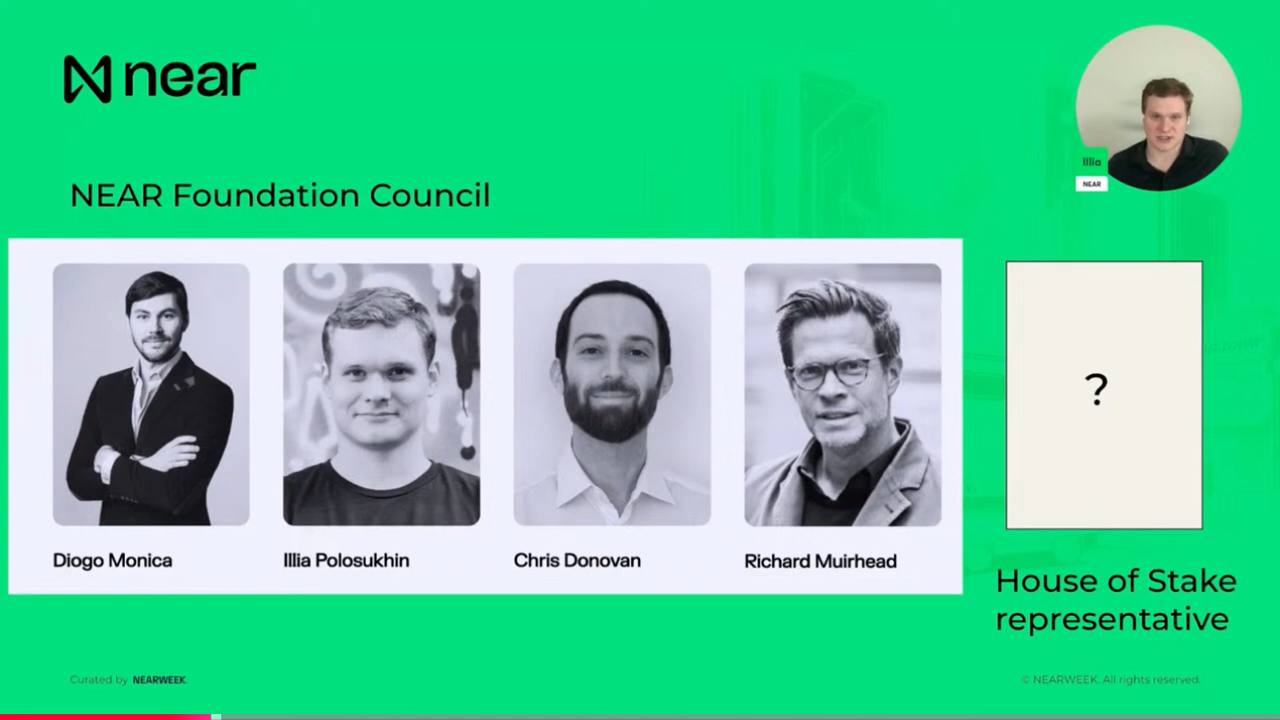
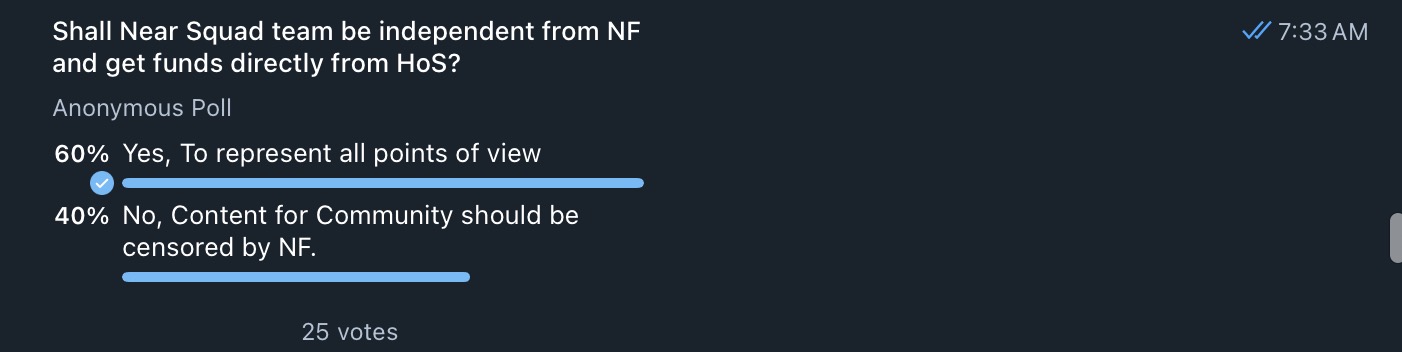
At the same time, the initial rollout has raised questions about how closely practice aligns with the vision of decentralization. A number of key positions remain in the hands of NEAR Foundation (NF) representatives, which has led some community members and ecosystem participants to call for greater clarity and accountability. As HoS moves forward, the community is watching carefully to see whether authority will gradually expand to a broader set of stakeholders, ensuring that the framework lives up to its promise of inclusive governance.
Governance bodies dominated by NF and affiliates
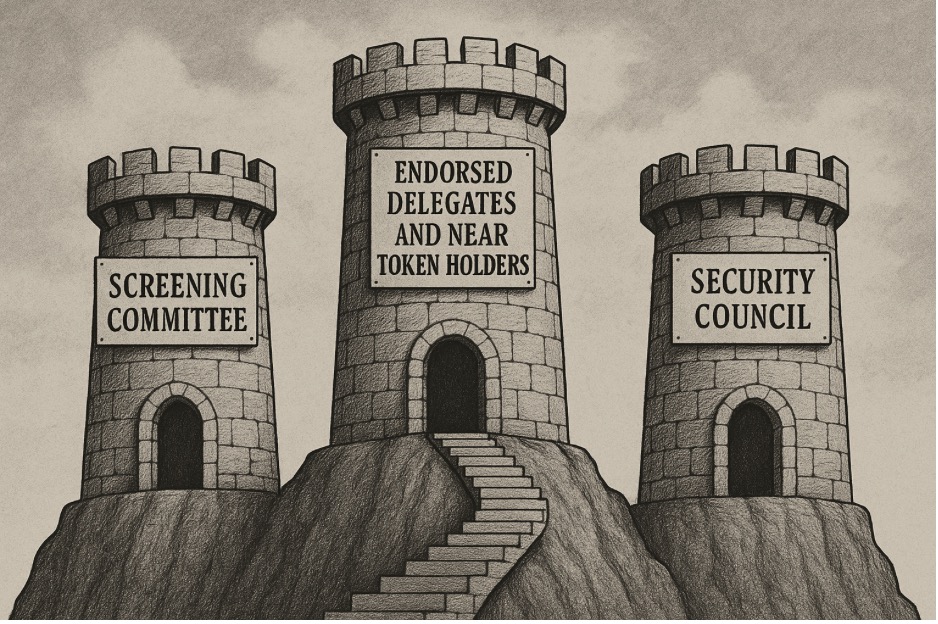
Despite the goal of community-led governance, roughly 75% of HoS’s initial governance seats are held by Near Foundation staff, contractors, or close affiliates. This includes members of the Screening Committee, the Endorsed Delegates, and the Security Council – the three core bodies of HoS governance. Critics argue this supermajority influence undermines the spirit of decentralization. Below is a breakdown of these bodies and their composition:
-
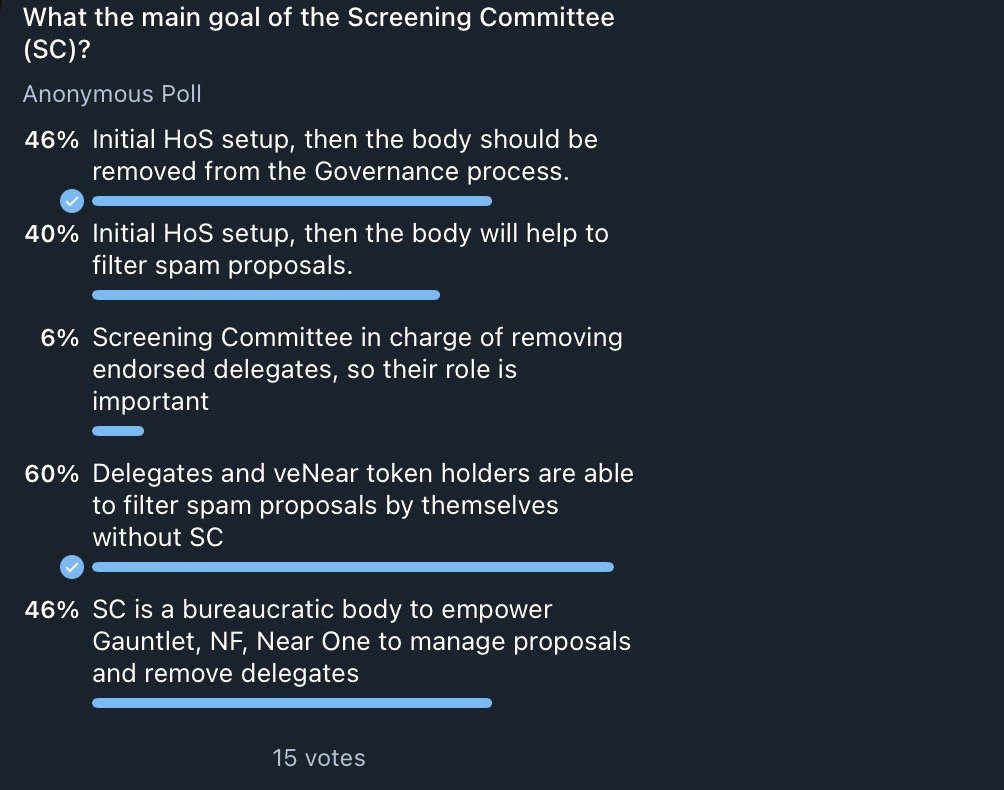
Screening Committee (4 seats) – An interim committee was appointed by NF to pre-screen proposals and select delegates. All four initial members have NF ties: Bianca Guimaraes-Chadwick (NEAR Foundation legal counsel), Lane Rettig (NF’s Head of Research and HoS project lead), Bowen Wang(NEAR Foundation board member, NEAR One team), and Gauntlet (an NF contractor).
-
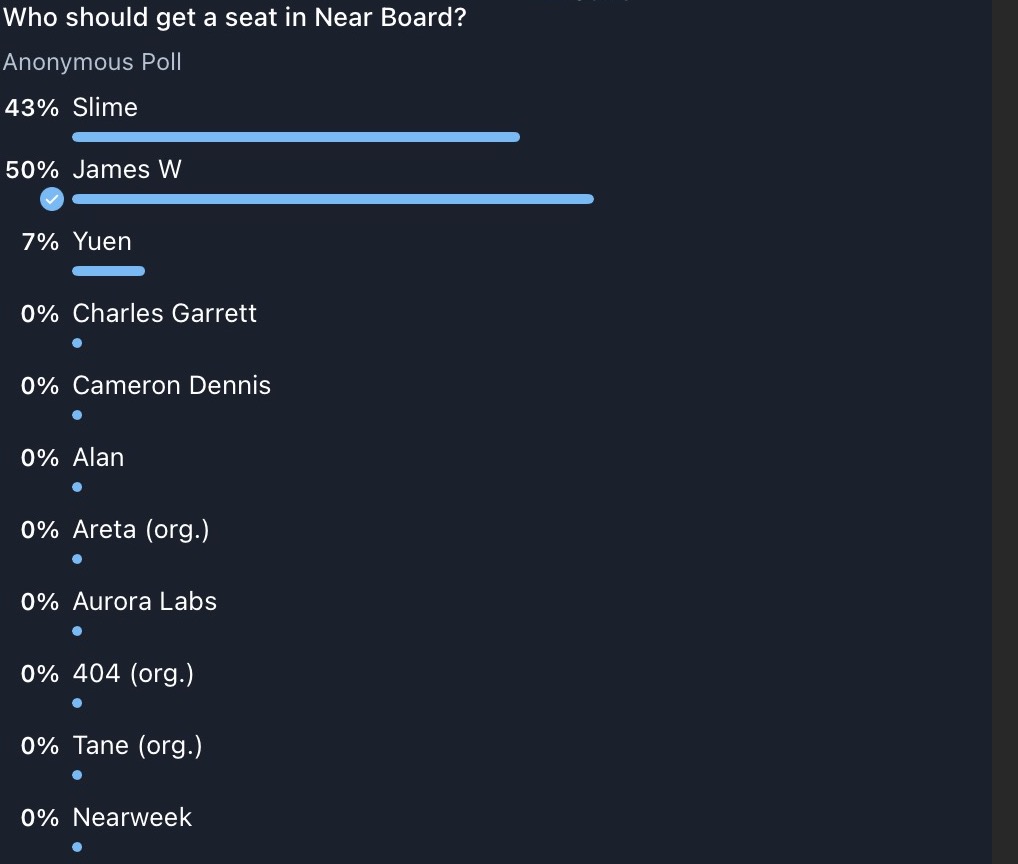
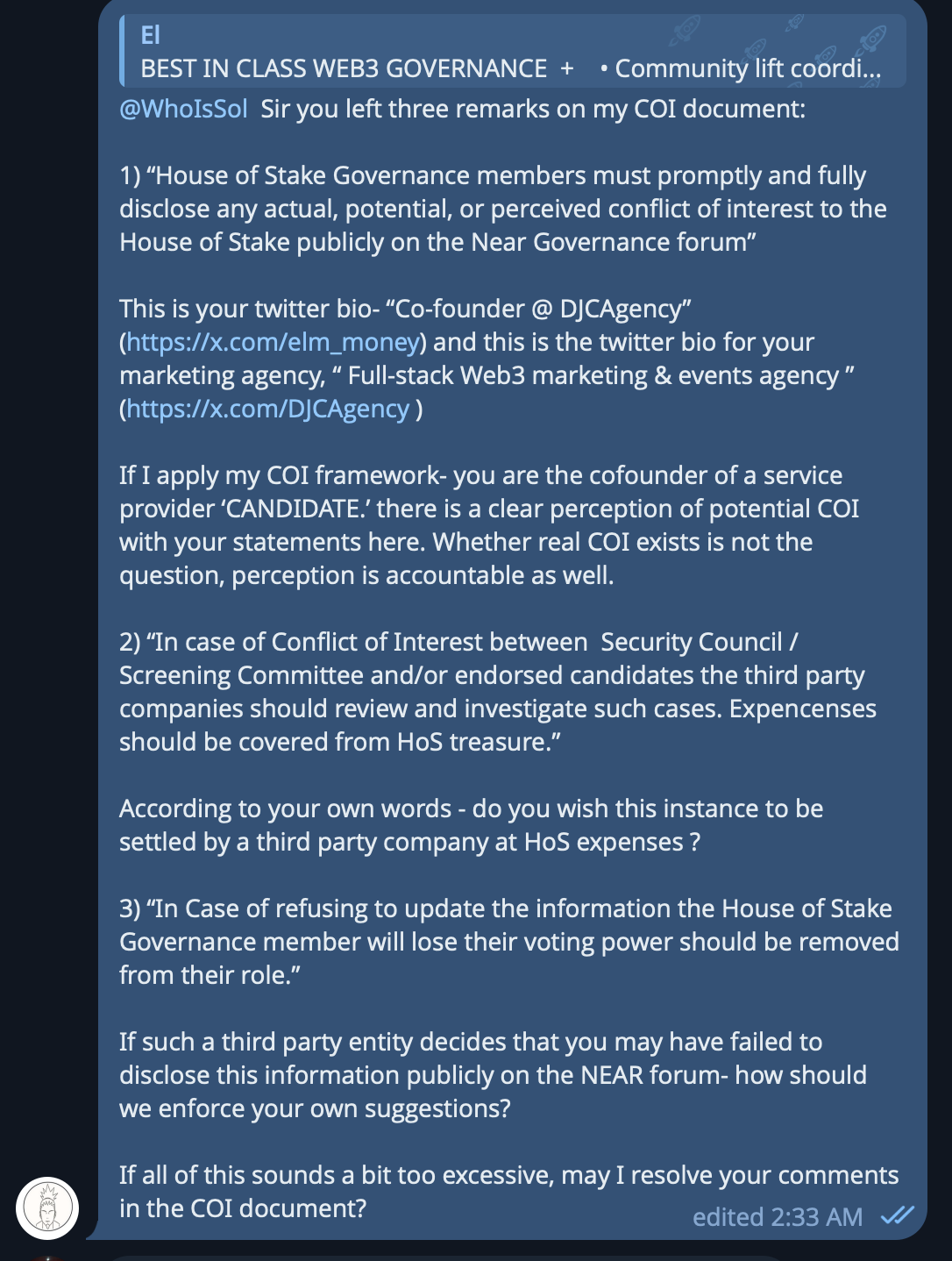
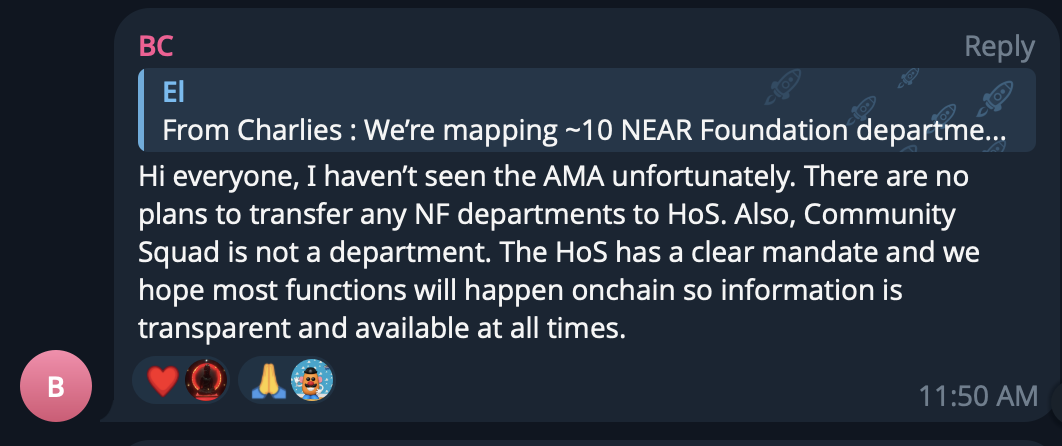
Endorsed Delegates (11 seats) – These are the community delegates who vote on proposals, initially chosen by the Screening Committee. Six out of the 11 inaugural delegates have direct connections to NF. For example, Cameron Dennis works on NEAR’s AI initiative (funded by NF), Yuen works in the Near Community Squad team (moderating NF chats and governance forum), NEARWEEK is essentially an NF-funded media outlet, Slime is a developer who received NF grants (creator of Intear wallet), Aurora Labs is a major NF contractor, and Charles (Garrett) has been a recipient of NF grants last month. This NF-heavy lineup has raised concerns of conflicts of interest, given that NF’s own team selected the delegates.
-
Security Council (5 seats) – A special council with veto power over proposals (meant to act in emergencies or protect the network) is being formed. All five known members are prominent NEAR insiders often described as part of co-founder Illia Polosukhin’s close circle. They include Bowen Wang(NEAR core contributor and NF board member), Alex Shevchenko (CEO of Aurora Labs, longtime NF partner), Evgeny Kuzyakov (early NEAR core developer, a.k.a. “Maestro” from FastNEAR), Kendall Cole(lead at Proximity Labs, an NF-funded DeFi arm), and Lane Rettig (NF’s HoS lead). In other words, the exact same figures already deeply involved in NEAR’s ecosystem governance are now also in HoS’s top oversight body.
Together, these appointments mean 15 of the 20 total governance seats in HoS (75%) are effectively controlled or strongly influenced by the Foundation and its affiliates, giving NF a supermajority voice. On the NEAR governance forum, some community members have openly criticized this outcome, calling it “just an example of nepotism” and claiming that NF’s leadership “appears to fear independent candidates” The original intent of HoS was to “eliminate favoritism” and dilute the Foundation’s influence, but in practice “the complete opposite has happened”, one long-time NEAR contributor lamented.
Additionally, Lane, the NF lead for House of Stake, holds seats in both the Screening Committee and the Security Council. Likewise, Aurora Labs is represented in two areas as well—among the endorsed delegates and within the Security Council.
Calls for Decentralization and Screening Committee Elections
To its credit, the Near Foundation has acknowledged that the current setup is interim. HoS was always meant to transition to more community control after launch. NF has stated that the interim Screening Committee will be replaced via on-chain elections in the near future. According to HoS lead Lane Rettig, a Screening Committee Charter proposal was expected by mid-August (probably by September) to define how elections work, committee size, member terms, etc., enabling the community to elect a new committee. Once that charter is passed, the interim NF-appointed committee would step aside for an elected team of screeners. In anticipation, Lane opened a nomination thread for community members interested in serving on the Screening Committee.
The community’s hope is that this election will bring genuinely independent voices into the governance process, reducing NF’s outsized influence. However, skepticism remains high. Given the track record so far, many in the community worry that the “new” committee might end up populated by the same insiders under a different name. The **“no surprises”**outcome that cynics predict is that NF’s close associates will continue to dominate.
Stalled Proposals and transparency concerns
Another early concern is the lack of transparency and speed in the HoS process so far. With HoS’s alpha platform online, community members and delegates have indeed begun drafting and posting proposals. At least five major proposals were published on the NEAR governance forum in August – covering topics from creating a social media team, to temporarily suspending delegate compensation, to forming a due-diligence audit team, to transparency reforms, and a call for further decentralization of delegate selection. These garnered discussion and represent exactly the sort of community input HoS was meant to empower.
Yet as of mid-August, none of these proposals has been acted on by the Screening Committee. More than 12 days have passed with no official review decisions or votes initiated. By design, proposals cannot advance to a token-holder vote until the Screening Committee labels them “Pre-Approved” or not – a step that has been a bottleneck. According to a community-run HoS watch blog, “all review is still by the private screening committee, and no outcomes or schedule have been announced” . In other words, the initial proposals appear stuck in limbo.
This delay has drawn frustration because HoS was supposed to be an improvement in efficiency over the previous governance system (the NEAR Digital Collective, or NDC). Under NDC, funding decisions often lagged for weeks; HoS was intended to streamline that. Now community members are openly questioning how HoS will be better if it takes over two weeks just for a committee to even acknowledge proposals. There are also practical worries: HoS is supposed to manage ecosystem funding on a rolling basis, yet if the process drags on, it’s unclear how budget timelines (e.g. monthly funding cycles) will be met.
Part of the problem is opaque decision-making. The interim Screening Committee has operated entirely behind closed doors so far. It has not published any criteria for how it selects delegates or evaluates proposals, nor does it provide meeting minutes or rationales for its pending decisions. This contrasts with the transparency many hoped for.
How the HoS Governance Process Works (Draft)
To better understand what to expect, the House of Stake Proposal Process Charter (v1 draft) lays out a structured lifecycle for governance decisions. Although still being finalized, the draft process is as follows:
-
Stage 1: Forum Discussion – Any NEAR token holder (with veNEAR) can submit a rough proposal idea on the NEAR Governance forum. This is a preliminary discussion phase, usually lasting about 7 days, where the community can provide feedback and gauge sentiment. The goal is to refine ideas publicly before they become formal proposals.
-
Stage 2: Formal Proposal (NIP) – After sufficient discussion, the proposer writes up a formal proposal (a NEAR Improvement Proposal or similar) following a required template. This proposal is then submitted to the official HoS platform (Agora) for an official decision process.
-
Stage 3: Screening Committee Review – Once a formal proposal is submitted on-chain, the Screening Committee reviews it during a limited window (by draft rules, 3 days, extendable up to 10 days maximum). The committee evaluates the proposal on criteria such as technical feasibility, NEAR ecosystem alignment, legal compliance, risk, and financials. It then labels the proposal either “Pre-Approved” or “Not Pre-Approved.” This label does not stop the proposal from proceeding, but it influences the next stage: if Pre-Approved by the committee, the proposal will face a lower threshold to pass in the token-holder vote (simple majority). If not approved by the committee, the proposal can still go to vote but requires a higher supermajority to pass. The Screening Committee is supposed to publish its decision and rationale on the forum for transparency (though as noted, this hasn’t been happening yet).
-
Stage 4: Proposal Activation – Following committee review, the Screening Committee (typically the chair) formally opens the proposal for voting on the on-chain governance platform (e.g. activating it in the Agora voting interface). A snapshot of veNEAR holdings is taken at this point to determine voting power for the upcoming vote.
-
Stage 5: Token Holder Voting – The proposal is then subject to a 7-day on-chain vote where all veNEAR holders can participate (either directly or via their chosen delegates). Voting is stake-weighted: each user’s influence is proportional to their veNEAR (i.e. how much NEAR they locked and for how long). Quorum: at least 30% of all delegated veNEAR must vote (yes/no/abstain) for the vote to be valid. Passing threshold: If the proposal was Pre-Approved by the Screening Committee, it needs a simple majority >50% “Yes” to pass. If the Screening Committee did not approve it, then it requires a supermajority >75% “Yes” to pass. This two-tier system is meant to give extra weight to the committee’s expertise without giving it an absolute veto over ideas. It also incentivizes proposers to incorporate feedback to earn committee endorsement.
-
Stage 6: Security Council Review – After a successful vote (i.e. the community approves a proposal), there is a short safety window (e.g. 48 hours) during which the HoS Security Council can intervene onlyif the proposal poses a critical security threat or could fundamentally harm the network. The Security Council’s mandate is to veto malicious or dangerously flawed decisions (for example, a proposal that has a bug or would violate the protocol’s integrity). In normal circumstances, the council would not override the token-holders’ will, and this veto power is expected to be used rarely, only as an emergency brake.
-
Stage 7: Execution of Decisions – Finally, once a proposal is approved by voters (and not vetoed), it moves to implementation. In HoS 1.0, the Near Foundation directors still handle execution of on-chain decisions. In other words, the Foundation will carry out the approved changes – whether that’s disbursing a grant, enacting a protocol upgrade, or implementing a policy – as long as it doesn’t conflict with any legal or fiduciary obligations. (The Foundation has reserved a right to reject proposals that are illegal or could incur liability, though this is expected to be extremely rare.) Over time, future phases of HoS intend to automate more of the execution and transfer those powers directly on-chain or to the community. For now, as an interim “safety net,” NF serves as the executor to ensure compliance and continuity. Notably, the draft charter calls for the NF team to publish an Implementation Plan within 3 days of a proposal passing – outlining steps, timeline, and roles – to keep the community informed.
Roles & responsibilities in this system are also clearly defined. Endorsed Delegates are expected to vote on every proposal (with >80% participation) and act in the best interest of the ecosystem. They can be removed by token-holder vote if they fail to perform or violate the code of conduct. Token holders themselves can always choose to vote directly or delegate their vote to any endorsed delegate. The Screening Committeeplays a crucial quality-control role but is not meant to be a final decision-maker. And the Security Council and Foundation act as guardians to ensure nothing catastrophically bad or illegal slips through. All of these structures are new to NEAR, and the exact parameters (quorums, thresholds, terms) may be adjusted as the community learns what works. The Proposal Process Charter is still in draft (as of mid-August 2025), and will likely be one of the first documents the community ratifies via HoS.
AI in Governance: The Roadmap to “Self-Driving” DAOs
One of the most novel aspects of NEAR’s House of Stake is its plan to integrate artificial intelligence into on-chain governance. This is not just about simple automation or sentiment analysis – HoS envisions AI eventually taking on active roles in decision-making, under human oversight. Jack Laing, HoS’s AI Product Lead, recently published a roadmap outlining a three-phase progression for AI’s role in governance (a concept sometimes dubbed the move toward a “self-driving DAO”):
-
Phase 1: The AI Assistant (Support) – In the initial phase, AI acts as a copilot for human participants. The goal is to reduce the cognitive burden of governance and increase participation. For example, an AI assistant can provide a conversational interface where community members ask questions about proposals and get summaries or clarifications. Other planned tools include a Proposal Quality Agent that automatically reviews draft proposals for completeness or flags potential issues, a Sentiment Agent that gauges community feedback from forums/social media, a Feasibility Agent that checks the technical viability of proposals, and a Simulation Agent that models scenarios (e.g. what happens if a certain protocol parameter is changed) before a vote. By Q3 2025 (the next few months), NEAR aims to roll out the first governance copilots and quality-checking bots in this category.
-
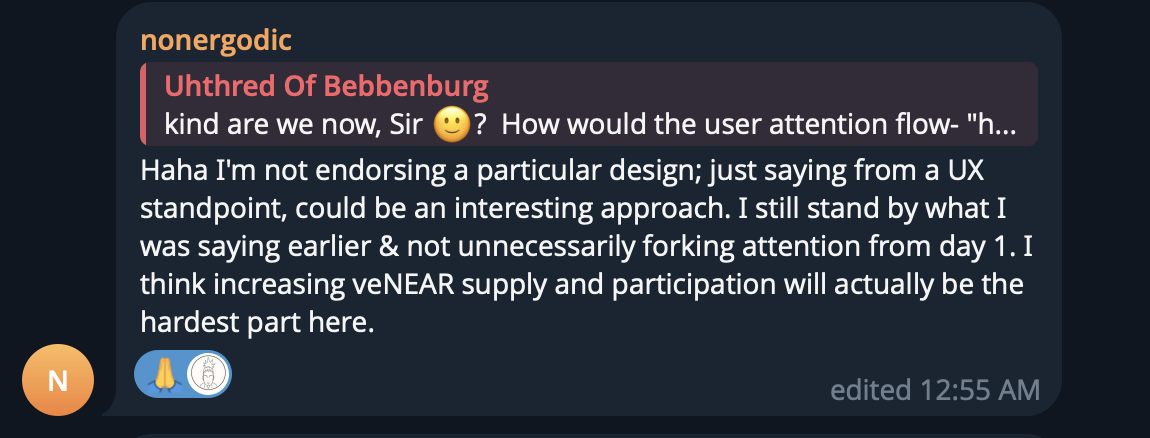
Phase 2: The AI Delegate (Represent) – In this more advanced phase, AI could take on a representative role, effectively becoming delegates in governance. The idea is to ensure decisions reflect broad stakeholder preferences, without each individual having to vote on every issue. Planned initiatives include “Broad Listening” algorithms that analyze and cluster the diverse viewpoints of token holders, identifying major sentiment groups or policy preferences. Based on these, the HoS team envisions creating AI Delegates – autonomous agents aligned with those specific clusters of opinion. For instance, one AI delegate might consistently vote in line with the preferences of risk-averse stakers, while another might represent developers’ viewpoints. A Delegate Selection Agent could even help match human token holders to the AI delegate best reflecting their values. The roadmap also mentions Digital Twins – personal AI agents for users that learn an individual’s preferences (potentially via private data stores) and could vote on their behalf within a limited scope. There’s a concept of Modular Delegation, where a token holder could delegate their vote on technical upgrades to one AI (or human) expert, but maybe delegate their vote on financial budgets to a different expert, dividing representation by topic. Another concept is Memory Governance, essentially an evolving, stake-weighted knowledge base that these AI agents draw from to inform decisions. Phase 2 is expected to roll out through late 2025 into early 2026, with early versions of AI delegates and preference-matching tools targeted by Q4 2025.
-
Phase 3: The AI CEO (Manage) – The final and most experimental phase pushes the envelope by granting discretionary decision authority to AI agents in order to scale governance beyond human limits. This might involve forming hybrid councils of humans and AIs (where AI agents sit alongside elected humans to make decisions collectively), and eventually even full AI councils for certain domains of decisions. To keep such power in check, a suite of oversight tools is envisioned: an Accountability Agentto audit decisions, a Conflict of Interest Agent to ensure agents aren’t biased or colluding, and a Transparency Agent to track all governance actions. Humans would retain oversight and ultimate control– for example, through the ability to audit AI decision logs, or veto rights if an agent goes rogue. Another innovation is role-gated memory, allowing an AI agent to be “trained” with confidential information relevant to its role (via private vector databases) which can be securely transferred or wiped when the agent is replaced, ensuring continuity without exposing sensitive data. This phase essentially asks: can we trust AI to manage parts of a blockchain ecosystem under our rules? Milestones for Phase 3 are farther out, toward 2026; by mid-to-late 2026 the roadmap hints at trials of “agentic consensus” (AIs reaching rough consensus on proposals among themselves, only escalating to humans if they hit an impasse) and by Q4 2026 possibly the first AI-only governance councils operating with defined scopes.
It’s important to note that these AI initiatives are exploratory – they will be developed gradually and with community input. The HoS team has stressed that AI is meant to augment and scale human governance, not replace it. In practice, that means starting with supportive tools that make it easier for people to engage (Phase 1), then automating routine decision-making in a way that still reflects human-defined preferences (Phase 2), and only then cautiously trialing more autonomous agents (Phase 3). NEAR’s approach is being watched in the wider crypto industry, as few other projects have outlined such an “AI-governance” vision. If successful, it could address long-standing issues like voter apathy and the bandwidth problem (few people can follow all governance discussions) by letting trustworthy agents shoulder some of the load. Still, many challenges remain – from technical feasibility to ethical considerations – before an “AI CEO” can be at the helm. For now, NEAR stakeholders seem cautiously intrigued by the possibilities, even as they debate the immediate governance issues at hand.
Missed launch deadline and outlook
Originally, the House of Stake mainnet launch was slated for August 14, 2025 (following an alpha release on Aug 7). That date has come and gone, and HoS is still in a “beta” state, with official launch slightly delayed. The HoS core team indicated that a checklist of final tasks (like completing certain charters, documentation, and security audits) must be finished before giving the green light. As of August 18, those tasks were reportedly close to done but not fully completed, hence the brief holdup. This minor delay in launch, while not catastrophic, has added to community impatience – especially given the broader context of NEAR’s ecosystem eagerly awaiting a functional governance system after the winding down of the NDC experiment.
The critical question going forward is whether House of Stake will live up to its promise of a more open and effective governance model. In these early weeks, perceptions are mixed. On one hand, the mere fact that NEAR is attempting this innovative structure – with on-chain votes, elected delegates, and an evolving constitution – is a positive sign of commitment to decentralization. The inclusion of the community in discussions, the forthcoming committee elections, and the transparency of posting drafts (like the governance charter) for feedback all demonstrate some willingness to share power. Additionally, the NF → HoS transition plan (a roadmap for gradually shifting funding control from the Foundation to the community-elected bodies over 1–3 years) is in development, which shows that even the Foundation expects to step back as HoS matures.
On the other hand, old habits die hard. The dominance of NF-affiliated personnel in HoS’s initial phase has raised eyebrows and drawn criticism that “decentralization” so far is largely on paper. If the upcoming Screening Committee election simply reinforces the status quo (i.e. seats go to people from Illia’s inner circle or NF-funded entities), then HoS could lose credibility with the very community it needs to engage. Furthermore, if processes like proposal reviews and budget approvals don’t speed up, NEAR risks recreating the bureaucratic inertia that plagued prior efforts.
Some community members have suggested that Lane Rettig, despite being the face of HoS, may not be empowered to enact the deep changes needed to truly decentralize governance. As the NF’s Head of Research, Lane has championed community involvement and even frequently acknowledged past mistakes in NEAR’s governance approach. But skeptics feel that ultimate decisions – like who gets on crucial committees or which proposals move forward – are still being orchestrated “above” Lane, by NEAR Foundation leadership. In essence, they argue that Lane’s calls for openness are colliding with an entrenched top-down culture. “It’s clear Lane doesn’t really decide anything,” say detractors in community chats, pointing out that structural power (control of funds, veto ability, appointments) remains with NF for now. The Foundation’s true test will be whether it actually lets HoS committees and token holders start making big decisions in the coming months, even if those decisions sometimes go against NF’s preferences.
In the coming weeks, all eyes will be on a few key developments: the outcome of the Screening Committee Charter and election, the first set of on-chain votes (once proposals finally clear the screening stage), and how the Security Council wields its veto authority (if at all). The success of HoS will be measured in transparency and inclusivity: Will we see regular public reports and open criteria from the committees? Will independent, community-chosen delegates have a say equal to NF’s sponsored delegates? Will funding and protocol changes start reflecting the community’s voice? These are open questions that only real operation of HoS can answer.
For now, NEAR’s House of Stake remains an experiment in progress – one that is undoubtedly pushing the envelope with concepts like AI integration and stake-based democracy, but also facing skepticism about whether it can escape the gravitational pull of centralized influence. As a flagship governance project in the crypto space, HoS’s journey will be instructive. If it succeeds, it could set a new standard for decentralized decision-making at scale. If it falters due to internal politics or apathy, it will join the list of Web3 governance ideas that sounded better in theory than in practice. The coming months, as HoS 1.0 formally launches and enters its first active cycle, will be crucial in determining which way it goes. The NEAR community is watching – and, hopefully, voting – to ensure that this House of Stake truly becomes a house owned by the stakeholders.
–
If you wish to share concerns anonymously, feel free to use this inbox:
 hostip@proton.me
Disclaimer:
Some or all of the content in this document/message/publication was generated using AI language models, including Near AI assistant and ChatGPT. While we aim for accuracy and objectivity, the information may contain errors and should not be considered expert or professional advice. The author assumes no responsibility for any outcomes resulting from the use of this information.

 Play the mini game and check how much time & money have vanished — and governance still isn’t live
  hostip@proton.me

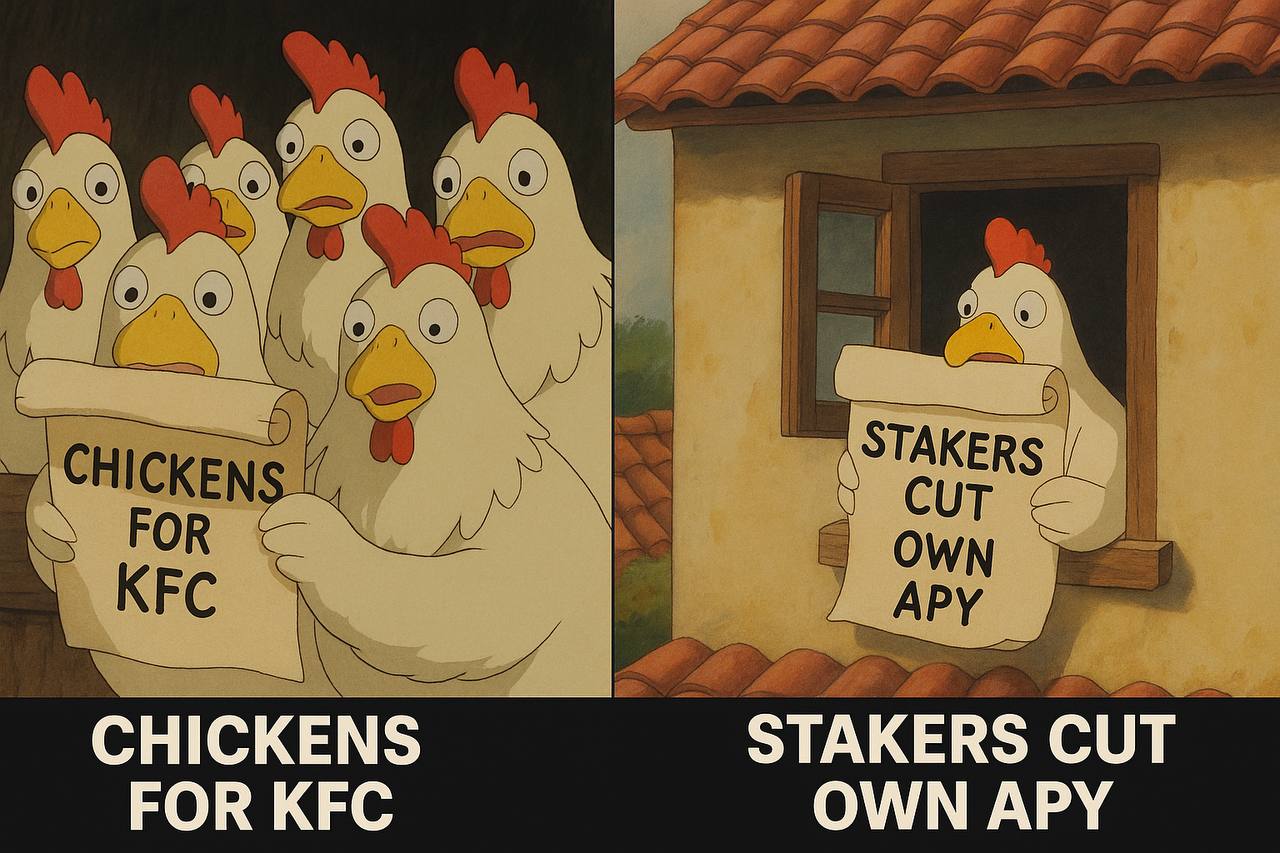

 Play the mini game and check how much time & money have vanished — and governance still isn’t live
  House of Stake — Weekly Recap (week 27)





 Time Passed Since the NEAR Foundation announced New Governance but not yet launched: 477 days, 17 hours, 43 minutes, 29 seconds, 121 ms