Hey there!
I applied for the Head of Governance role at House of Stake last August and you can see my public application here with details on my background and motivation for this role.
Since I was invited to answer these challenge questions, I took the opportunity to drill down deeper into the history and context of House of Stake up to the present day and by answering these questions I believe I crafted a vision for what I think should be prioritized going forward.
I hope it is an interesting read.
These are my answers below.
Essay Answers
Please allow me to start answering in a different order than the one proposed, since my answer to the third essay question about the current governance design and mandate influences every other answer of mine.
Third essay question
Short answer is no.
I don’t believe this design is the best to accomplish the stated goals in the recently shared mandate. But that’s mostly an issue with the recent mandate than with the governance design proposed by @Gauntlet some 15 months ago.
1. My critiques of the proposed governance design
Vote escrow governance models were originated and conceptualized to be applied in DeFi protocols like Curve Finance, Balancer, and more recently in Velodrome, where long-term stakeholder alignment is essential to foster long-term liquidity pools. Vote Escrow is not a governance model that has ever been applied successfully to a L1 blockchain like NEAR (maybe it can be argued that Polkadot’s conviction voting is a kind of vote escrow, but that’s the only example I can think of), and more importantly, I don’t think it incentivizes a power distribution that is healthy for a multipurpose ecosystem like NEAR.
In vote escrow governance systems, the largest stakeholders that can afford to lock their tokens for longer timeframes become way larger over time, that’s the design goal of vote escrow, and in the specific case of the proposed design for NEAR, they would become 3 times larger after 4 years of locking. This means that with vote escrow, the most powerful stakeholders today, will probably be the most powerful stakeholders in 4 years as well by capturing most of the yearly inflation rate allocated to these rewards, and for an ecosystem like NEAR, that has so many different moving parts, and products, and verticals (Intents, Chain Signatures, NEAR AI), it is not really smart to enshrine the same handful of stakeholders as the ones with the most power that would be able to almost unilaterally decide on all of these very different things in the future. We need a governance design that would allow for the most powerful decision makers to change over time, in tandem with the future priorities of NEAR. We need to have that flexibility to avoid complete capture from a few powerful entities.
The other issue with vote escrow is that it needs a source of revenue to fund its rewards, and as it is pointed out in the proposed governance design by Gauntlet, those rewards will inevitably divert $NEAR rewards from other currently existing token sinks, like the validator staking mechanism, which this proposal ominously refers to as “legacy staking”.
As it says in the original Gaultlet proposal:
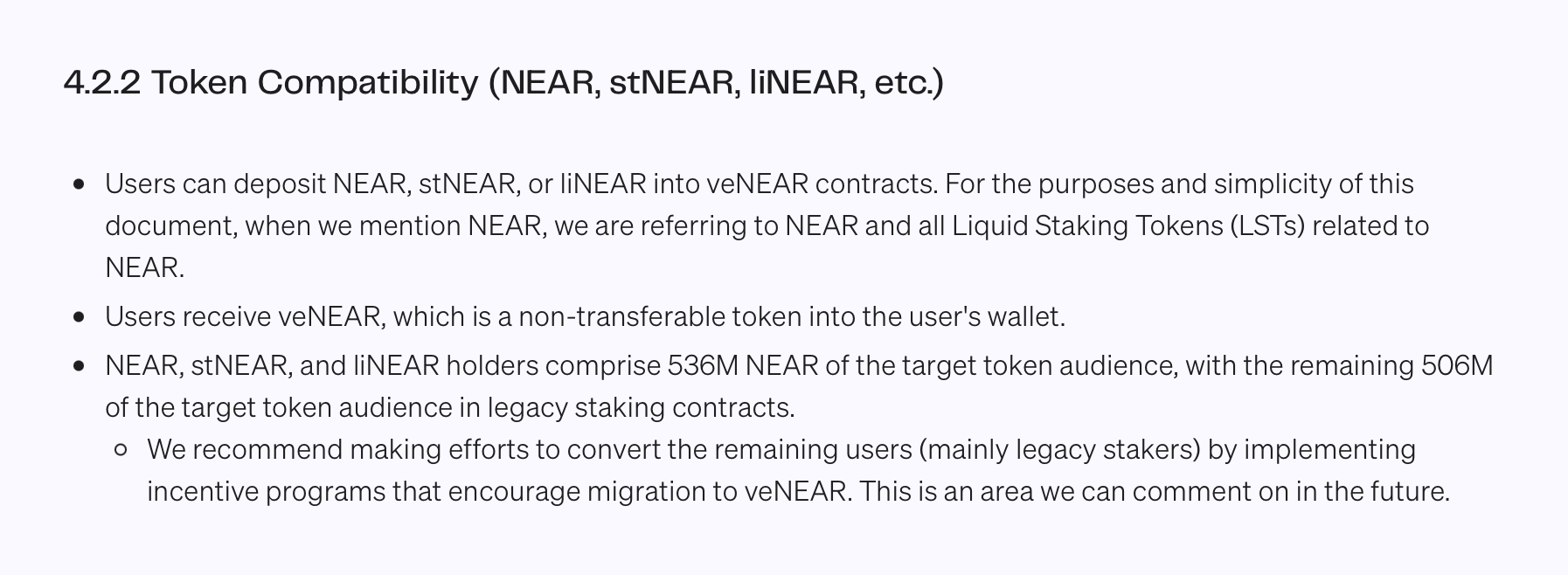
“We recommend making efforts to convert the remaining users (mainly legacy stakers) by implementing incentive programs that encourage migration to veNEAR. This is an area we can comment on in the future.”
And as the main solution to this challenge, Gauntlet proposes:

I think this is the biggest flaw of this governance design when applied to a proof of stake sharded blockchain like NEAR. If we run this system for long enough, we might get into a situation where we will be running 2 major competing staking mechanisms, one for veNEAR governance, and another one to secure the proof of stake network with its validators. Between allocating rewards into one or the other, I think it is preferable to prioritize the one that keeps the NEAR blockchain running fast, and in an ever more decentralized way.
Despite the fact that there are additional plans to include the ability for $NEAR stakers to also lock their tokens and then choose a validator, like Illia mentioned publicly here, this is not included in the original Gauntlet proposal. To my knowledge this is the last public update from Gauntlet regarding this crucial issue.
I believe the legitimacy of House of Stake hinges on the amount of NEAR that is used for governance. With this proposed veNEAR design, it is going to be really hard to engage token holders to participate in governance and achieve sufficient legitimacy in this governance architecture, or even worse, we might be able to bribe them into getting veNEAR at a huge financial cost to cover the rewards, and huge network security cost by decreasing incentives to validators.
Also, such a high amount of native, almost risk-free yield from these proposed veNEAR rewards, makes it really hard for a competitive DeFi ecosystem to flourish in NEAR, and that might actually be the biggest risk of this proposal design.
Another critique I have on the proposed design is that it is very heavy-handed in enshrining a set of Endorsed Delegates, that were initially unilaterally chosen by the Screening Committee, which in itself was unilaterally chosen by the NEAR Foundation. This design nukes very needed legitimacy at the start of our governance journey. In my view, there should be no distinction between delegates, and every single one of them should be able to compete on a level playing field to attract more $NEAR to be delegated to them, which doesn’t look like it’s going to be the case in the current implementation of the proposed design.
I think the Endorsed Delegates body is an example of a “check” in this governance design that is not proportional to what I think is needed in the context of NEAR right now. It feels like an overreaction to the challenges that plagued the open nature of the NDC and I understand why it was proposed, but it’s a very heavy “check” with no recourse for “balance”.
Also, the Screening Committee should also not be able to veto proposals for going up for a vote, that’s an emergency power that should belong to the Security Council, and only be enacted after and if a vote passes. This is actually what is specified in the proposed governance design by Gauntlet, but I’m not sure if that’s what’s going to be actually implemented in practice. All proposals should be able to proceed for a vote requiring a 75% super majority support, and the ones that would be favorably screened by the Screening Committee would proceed for a vote requiring only a 50% majority support. Also, I think the screening committee members should be paid for this work, and if so, a commitment of the Screening Committee being able to screen, favorably or not, a proposal under 24 hours, should be explicit and a contingency on their payment.
Also, I think that the Screening Committee members should be elected by the community, and they should have a term limit and be replaced every 6 months or 1 year.
This way, we wouldn’t need a screening committee to be appointed by the NEAR Foundation at the start of the House of Stake DAO or an unfair distinction between Endorsed Delegates and Non-endorsed delegates. We could start with a minimum support threshold of 75% for all proposals in the first 6 months/1 year, ensuring that only proposals that have large support and alignment would pass, and then once the community is already participating in governance and has passed proposals successfully for 6 months to 1 year, we would do elections for the Screening Committee members to be able to lower the support threshold for the proposals that are favorably screened by the elected Screening Committee.
Something like this:

Then in the future, once the legitimacy of this process is undisputed, the delegates could also elect the Security Council members, with a term limit of 1 year or more.
Another critique I have about the proposed governance design is that point 5.1.4 Evaluation and Removal of Bad Actors is completely impossible to enforce without onchain mechanics that are anti-ethical to the spirit of decentralization and censorship resistance.

I agree we should have a process to exclude elected members from governing bodies (like the Screening Committee and the Security Council) via a community wide onchain vote of no confidence, but never allow blacklisting of delegates and force token holders to re-delegate. This is unheard of in any serious DAO governance setup.
Additionally, I think there is another body that should be part of this process in the future and have specific checks and balances on its powers, and that is the Head of Governance, but only when it becomes accountable to the community by being directly employed by the DAO, aka, as an employee or director of the House of Stake Foundation. Specifically if its mandate is to be a more presidential one, like it’s framed here. Of course, that the legitimacy for this person to have special powers can only exist if there is a fair election for this role, and if it is truly accountable and has to answer to the community, like I meme’d about here when I initially applied for this role. I’m not sure if this is still an option for this hiring process right now, but I would be comfortable with either approach. Both by being hired directly by the House of Stake Foundation after a successful DAO election, or by the NEAR Foundation, in the interim, until the governance process of the DAO gets up to speed and legitimate enough to elect a “president”.
Despite all of these concerns with the proposed governance design by Gauntlet, I think we can still make the necessary changes, for it to be a suitable design for NEAR if:
- there’s a very simple way to use $NEAR already staked to the proof of stake validators, in House of Stake governance. maybe something like what was attempted last June for this reduced inflation vote. $NEAR staked in validators is the most legitimate decision-making body in the whole NEAR ecosystem right now, by far, and the clunky participation (validators had to vote from the CLI with a specific command) in the vote above kind of proves it.
- we reduce significantly the rewards for veNEAR locking, or start with zero rewards and reassess if they are even needed at all to incentivize governance participation.
- eliminate any distinction and preferential treatment between delegates, aka, no more endorsed delegates appointed by the Screening Committee. That undermines legitimacy.
- dissolve the current NEAR Foundation nominated Screening Committee and organize elections for a new one, that can only fast-track proposals into a 50% majority support vote (instead of the initial 75% majority support vote), some 6 months / 1 year down the line or once we have sufficient legitimacy and governance activity in the DAO.
- do not engage in any attempt to blacklist delegates from onchain voting, and definitely do not encode this functionality in the governance smart contracts.
- clarify the responsibilities, duties, liability, approach, and transition of authority/powers (if any), to the individual in the Head of Governance position.
2. My concerns regarding the recently shared mandate
Despite all my critiques above, regarding the proposed governance design, my main overall concern is about the recently shared mandate.
Specifically, this anti-mandate:
Gauntlet’s proposal enshrines point 6.3 Grant Proposal Requests as the only mechanism for spending funds in the treasury.near wallet, in addition to the spending for 6.1 Incentives to veNEAR holders and for 6.2 Incentives to Delegates.
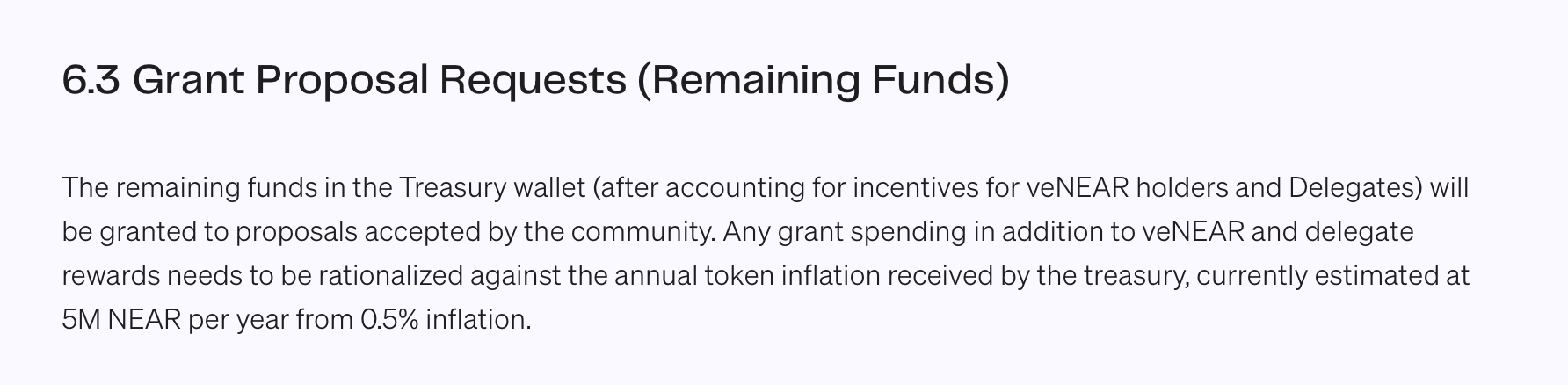
So, to start, this anti-mandate is already contradictory to the goals and governance design specified in the initial Gauntlet proposal.
But I think the main issue here is one mostly about legitimacy and growth, which are the third and fourth stated goals in the mandate, making this anti-mandate contradictory to the mandates themselves:
For starters, the idea of a top-down mandate/anti-mandate from the Foundation to the DAO feels… unusual, to say the least.
In a DAO, the only legitimate constituency that should be able to define a top-down mandate (or if there should be a mandate/anti-mandate to begin with) is the body of token holders, or a representative elected by them.
I understand the need for focused seasons and increasing levels of authority and control and resources being gradually released from the NEAR Foundation to the DAO, but potentially enshrining in the constitution (even if it’s an interim one) an anti-mandate regarding grants in the first season of the DAO, is a sure fire way to guarantee that the community engagement with the DAO, and the ecosystem health, gets nerfed from the get-go. We can accomplish the same goals of gradual control transition via other means.
This is especially critical right now, because when we eventually launch House of Stake, hopefully soon, we need all the hype and incentives we can get to convince NEAR holders to participate in governance. To put it simply, veNEAR rewards alone will not attract the right crowd, one that is able to decide on future protocol issues related to economic and technical governance. A grant program, however, if structured correctly, will attract builders and founders that will create the next drivers of growth for NEAR, and if they are committed to build in the NEAR ecosystem for the future, they will be the most aligned cohort of stakeholders possible, so they will obviously participate in the governance of the blockchain they are personally invested in.
This is specially concerning since, as stated in the recently shared transition plan:
If there isn’t even the potential for grants in House of Stake, from its inception, our ability to attract the best builders and founders to the NEAR ecosystem, gets severely diminished, and the success of the House of Stake launch and its legitimacy goals would be definitely compromised.
Regarding the 2 main goals in this mandate, the ones for economic and technical governance, I also think they are the right ones to focus on at the moment since they are the kind of decisions that really need to be made in a decentralized way, both from a legitimacy point of view, but also from a regulatory and security risk point of view.
I agree that economic governance should be the priority in the beginning of the DAO given that there are already several attempts of specific proposals for protocol inflation reduction for example, but I also think we should be wary of reducing protocol emissions before having reliable revenue streams or reliable demand for NEARs block space. $NEAR token price is obviously an important thing to be worried about, but simple tactics to artificially increase it might backfire as well.
Also, reducing protocol emissions would also reduce the available budget for House of Stake’s treasury, which following the Gauntlet proposal should be allocated to veNEAR incentives, Delegate incentives and grants.
Regarding technical governance, I think there are some decisions that also need to be made in a decentralized and legitimate way, and those should be prioritized as well. Specifically because, with the current regulatory environment where potentially the CLARITY Act in the US might get approved, NEAR should work towards achieving a mature status of technical decentralization, which necessarily will require complying with all 7 criteria specified in the Clarity Act, where the System Governance criteria and the Impartial System criteria are the ones where a healthy DAO with a truly decentralized decision-making ability is definitely needed.
To summarize, my main concerns with the current mandate and the governance design proposed by Gauntlet are:
- the proposed governance design and mandate contradict each other, especially in regard to funding grants
- the anti-mandate against grants should be removed from the current mandate
- the veNEAR mechanics proposed might be detrimental to a fair distribution of power in future NEAR governance
- the veNEAR incentives proposed will be a huge strain on the House of Stake treasury and will negatively impact validators and therefore network security
- the governance architecture in the proposed design is too centralized to start, which undermines legitimacy in the system
Second essay question
I believe that a sound economic policy should be a main priority for any healthy DAO, and, in short, I believe that we should focus more on increasing DAO revenue than in cutting DAO expenses. Ideally, for every approved proposal that spends DAO funds, we should pass 2 proposals that aim at increasing revenue for the DAO. This is obvious easier said than done, and in a decentralized DAO we can’t really control the outcome of proposals that spend funds, but we can do our best effort possible to highlight and show current spending, with transparent and live treasury dashboards. This was indeed one of the priorities I highlighted in my application post 6 weeks ago:
I believe we should enforce proposers to meticulously detail and breakdown the costs for every proposal that requests funding, and to also specify financial KPIs and targets for the initiative being proposed, specifically in terms of potential additional revenue it could bring to the DAO. This could be socially enforced with a proposal template that requires proposers to include this kind of financial analysis in each proposed initiative.
Also, I think one of the first initiatives we should invest and facilitate, is a collaborative effort to define a holistic budget for the DAO, where we would have socially agreed spending caps per theme, per quarter, and in building a treasury dashboard where the community could see in real time the socially agreed available budget available for each main theme. This exercise would also have the additional benefit of bringing more transparency into the financials of the DAO for everybody to see, bringing economic sustainability to the forefront of the community concerns as well. For example, even for Arbitrum DAO (where I’m currently a delegate in) which has a diversified treasury of $1.5 Billion USD, we can see that in the worst case scenario, the DAO runway is only 7 years. These type of dashboards are exactly what we should invest in, so that financial transparency and awareness is top of mind in every delegate when they are voting for spending precious DAO resources.
Another priority should be to diversify the treasury into different assets, not just $NEAR, which could also become a good example of showcasing the NEAR Intents technology. Traditionally, DAO treasury management companies require assets to go offchain to be able to manage them faster and with more autonomy, which compromises security, transparency and complicates subsequent reporting of treasury management operations. I believe we have the opportunity to harness the power of NEAR Intents for on-demand cross-chain swapping so that we can have an actively managed and diversified treasury that edges against the potential volatility of the $NEAR price, and generates yield for the DAO. Ideally, all DAO expenses would be covered from the yield of putting treasury assets to work without the need to ever spend the principal, kind of like traditional university endowments work. Also, we should have a dedicated stablecoin balance for quarterly budgeted DAO expenses, whose conversion from $NEAR into stablecoins is done carefully and in a way that minimizes $NEAR price impact.
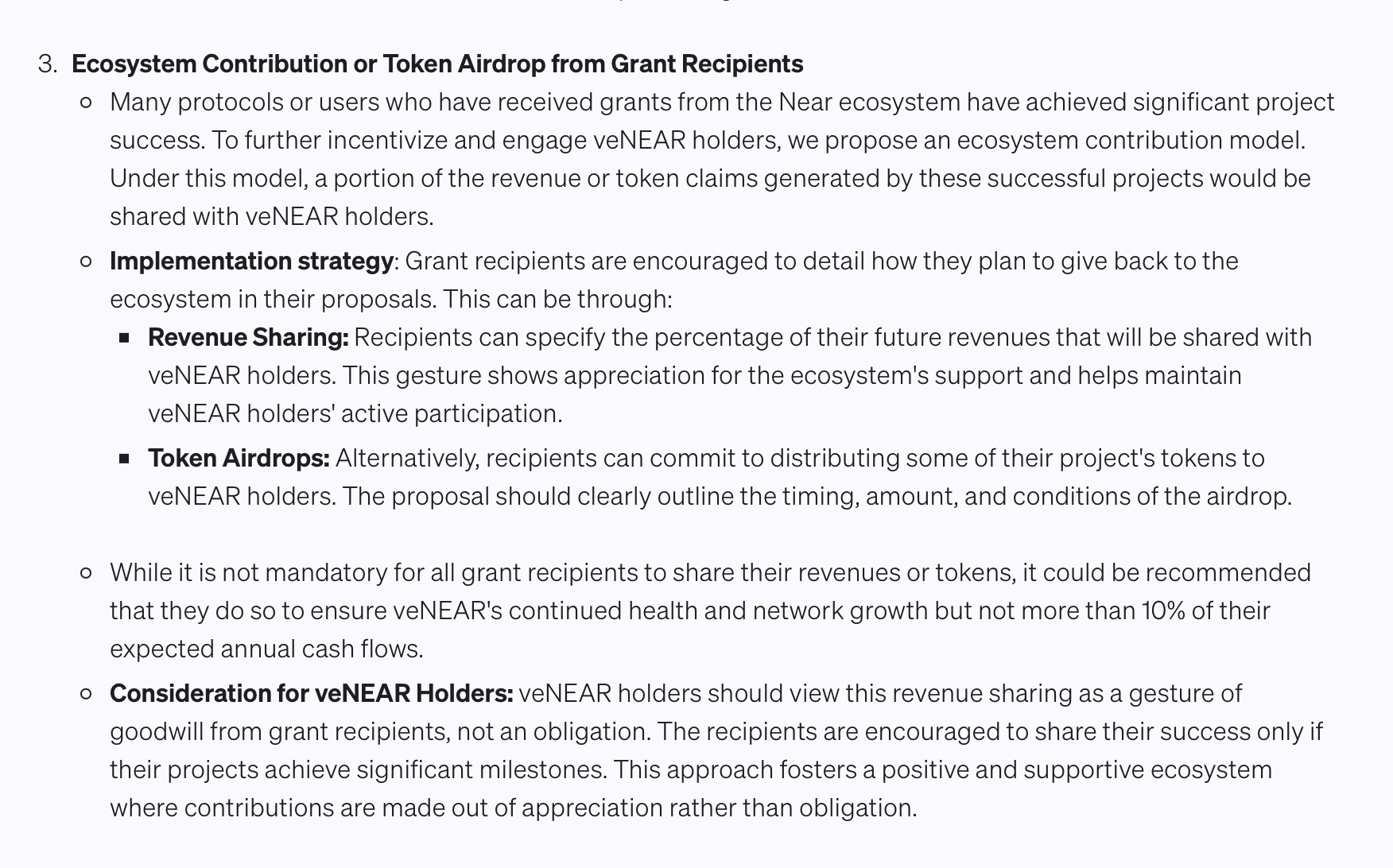
On the revenue side, we should increase and also diversify the sources of revenue and direct them to the DAO treasury. For example, switching-on a fee for NEAR Intents sounds like a tempting possibility, since it is one of NEAR’s offerings that has clearly achieved product-market fit, but maybe it is still too early to do that, in my opinion. Other sources of revenue for the DAO might include requiring NEAR nodes to participate in a revenue-sharing program, similar to what is suggested in the original Gauntlet proposal:
Currently, the only sources of funding for House of Stake DAO are the old NDC Community Treasury that holds roughly 3.5M NEAR (and whose legitimacy and legal grounds to be used for House of Stake is apparently still being debated), and most importantly, the treasury.near wallet that gets 10% of the protocol’s 5% yearly inflation, and currently holds roughly 28M NEAR, as is specified in the Gauntlet proposal. At today’s prices, that’s a little bit shy of $100M USD in total.
As a comparison, Arbitrum DAO’s Treasury Management Program, started almost 1 year ago to this day, has $89M USD currently under management and has accumulated $1.5M USD mostly from RWAs and ETH and ETH correlated yield, as it can be seen in this dashboard.
In summary, I believe we should follow a conservative economic policy, where:
- we don’t spend more than what we earn and try to keep the principal of the initial endowment intact
- we engage the community in collaborative budget setting processes
- we invest in active treasury management that brings data to the forefront of delegates minds to inform their every vote
- and we sensibly invest the assets in our treasury in reliable strategies so we can fund our DAO operations mostly from that yield
First Essay Question
I think that the challenge of the “need to increase our operational capacity without compromising the principles of decentralized governance” is a false dichotomy. In my opinion, increasing operational capacity is not in tension with decentralized governance, in fact, a properly decentralized organization can have way bigger operational capacity than a centralized organization of the same size that is designed so that the leader has to participate in every decision. This is an organizational design issue, that should be solved with organizational design solutions, and it’s actually the main reason why I got into DAOs in the first place, back in 2016. Then, when I was in RnDAO, we deeply researched these issues and had sessions with the world’s most influential minds in organizational design, that can be seen in RnDAO’s youtube channel. The first session was with Doug Kirkpatrick, an expert in self-management methodologies, about scaling a self-management organization, and whose founding work in Morning Star, is one of the examples of how an organization can scale to achieve huge operational capability (Morning Star is the world’s largest tomato processing company that operates without managers, bosses, or titles) by relying on thoughtful organization design and self-management methodologies.
In the DAO world, I think the most effective model we’ve seen is the subDAOs/working groups one, where membership is voluntary and composed of multidisciplinary talent, where the group gets formed with an explicit and well-defined and concrete mission, and is by its very nature, a temporary arrangement. SubDAOs should have to compete with other SubDAOs for funding and the individuals that compose them should be accountable to the whole DAO. Individuals in those SubDAOs should be autonomous and in equal standing to each other, and should never be forced to make commitments they don’t want to make. But when an individual commits themselves with doing something, they do so in a public and accountable way. If they fail a public commitment they’ve made, that information should be tracked and recorded to inform future funding decisions. This is why financial transparency is essential in a DAO, and why I’m a very loud advocate for it. That’s why I publicly disclose all the earnings I receive that have originated from the Arbitrum DAO treasury, here. I believe that individuals that work for DAOs and occupy positions of power should comply with the same level of disclosure as real world politicians.
Where I think most DAOs fail while trying to scale their operations is regarding transparency and concentration of power. It’s very common for DAO service providers to become more and more sticky and monopolize their position and authority in the DAO, after an initial minimally successful engagement. In my experience, this is mostly a failure of lack of competition and behind closed doors’ procurement practices. As a DAO, we need to be able to attract and nurture the best talent possible and the best way to do that is to offer them an environment to work that is fair, transparent, and publicly accountable.
Service providers are also an integral part of scaling operations, and one practice that is not as wide spread as I think it should be in DAOs is the practice of launching public Request for Proposals (RFPs) where service providers can apply in the open and compete to be selected for the job. ZK Sync is a good example on this front nowadays.
(to be continued…)