(Deprecated) NEAR House of Stake — Code of Conduct (CoC) draft for community review

Dispute & Appeal Process Overview

The NEAR community will establish a peer-based Ombuds-style system to handle conflicts and complaints informally. Inspired by DAO best practices, this process is neutral, confidential, and open to all HoS participants (token holders, contributors, delegates, working-group members, etc.). Any member can file a concern, and a trained Ombuds team helps the parties communicate and resolve issues without resorting to public accusations or litigation. This aligns with HoS’s permissionless, community-driven ethos, empowering holders to have a say in the ecosystem. By providing a trusted, informal channel, we reinforce HoS’s values of respect, fairness, and accountability.

Key Principles: The process is confidential and non‑binding. Ombuds practitioners listen impartially, coach parties to communicate, and suggest options for resolution (reframing issues, mediation, coaching toward direct dialogue). They do not participate in formal investigations or impose binding judgments; rather, they aim to restore trust and address underlying concerns. All activities follow Ombuds best practices — independence from other governance bodies, neutrality regarding outcomes, and strict confidentiality.

Process Details

Reporting & Intake

  • Who can report: Any HoS community member who experiences or witnesses a potential conflict or conduct violation. Working group leads and delegates are encouraged to guide members to this process.

  • How to report: A central, confidential intake portal (online form or email) is provided, with an option to submit anonymously. Alternatively, members can reach out directly to the Ombuds in HoS community channels. This lowers barriers and protects reporters’ privacy.

  • Acknowledgement: On receiving a report, the Ombuds team sends an acknowledgement within 48 hours, explaining next steps. They then triage the case, assessing urgency (especially if safety or protocol integrity is at risk) and noting any potential conflicts of interest among the Ombuds. Reporter identities are kept confidential wherever possible. Repeated or malicious reporting is flagged as abuse.

Informal Mediation & Resolution

Once a complaint is logged, the Ombuds team (typically 3–5 trained members from diverse backgrounds) steps in to mediate. Typical steps include:

  • Listening Sessions: Each party meets one-on-one with a neutral Ombuds member who listens without judgment, clarifies facts, and identifies underlying concerns.

  • Issue Framing: The Ombuds helps reframe contentious statements into concrete interests or misunderstandings (for example, distinguishing between poor communication vs. intentional slight). This promotes empathy and solution-finding.

  • Guidance & Options: The Ombuds suggests ways for the parties to communicate directly — one-on-one call, facilitated chat — and may coach them on constructive dialogue. They may also point members to relevant HoS resources (Code of Conduct, working-group leads, or formal governance procedures) if escalation is needed.

  • Negotiated Solutions: Through discussion, the parties may agree on actions which could be clarifying miscommunications, giving credit for past work, or adjusting process. The Ombuds does not enforce outcomes, but can recommend balanced remedies or mutual agreements.

At all stages, the Ombuds team remains impartial. They do not take sides or make binding rulings. They report systemic issues, which could be recurring communication breakdowns in a working group, to HoS governance leadership so improvements can be made. Importantly, parties are encouraged to use this channel before airing grievances publicly. As HoS’s draft Code of Conduct advises, one should first seek clarification in private or via official channels rather than accusing on social media. This process thus acts as a safety valve, helping resolve disputes early and informally.

Enforcement & Consequences

If a mediation uncovers a clear violation of HoS’s expected norms (e.g., harassment, overtly bad-faith conduct), the Ombuds can recommend corrective actions on a graduated scale. These might include:

  • Private Feedback: A reminder or coaching conversation to address minor or first-time issues.

  • Written Warning: For serious or repeated misconduct, a written notice requesting change, possibly mediated by an Ombuds member.

  • Temporary Restriction: Short-term suspension from certain channels or decision-making roles (e.g., revoking moderator privileges, pausing voting delegation) while the issue is addressed.

  • Permanent Restriction/Ban: In the rare case of egregious or irreparable harm, removal from HoS governance bodies or channels. On-chain penalties are out of scope for the Ombuds, but they can refer cases to core HoS governance if needed.

These actions follow the principle of proportionality and restoration. Harsher penalties are only applied after efforts at reconciliation, and always allow the affected member a chance to improve. Moderators (Ombuds members) are explicitly chosen to avoid conflicts. Those with a personal stake in a case recuse themselves, so the process is fair. The team keeps secure, privacy-respecting records of all steps, which can later inform transparency reports.

Appeals Process

A formal Appeals Panel provides a secondary review for cases involving temporary or permanent sanctions. This ensures checks and balances, as recommended by governance best practices. The appeals process works as follows:

  • Who can appeal: Any party sanctioned with a significant action (e.g. suspension or ban) may appeal, as long as they do so within 14 days of the decision. Appeals are also allowed if new evidence emerges or if there was a procedural error (e.g. a conflict of interest or lack of documentation).

  • Appeals Panel Composition: The panel consists of at least three impartial community members. These panelists must have no prior involvement in the case and disclose any conflicts. Membership rotates to keep perspectives fresh.

  • Review Criteria: The panel reviews the case file, evidence, and appeal arguments. They focus only on whether the original decision was justified in light of all evidence and HoS’s norms. For instance, if logs or additional testimony were not considered originally, the panel may incorporate them.

  • Timeline: The appellant submits a brief statement (via a secure form or direct email) within 14 days. The Appeals Panel aims to render a decision within 30 days of appeal filing. Delays should be documented.

  • Decision: The panel’s ruling is final and binding on the parties. In exceptional cases (e.g. if the panel itself is conflicted or if the issue affects core protocol rules), the community may subsequently ratify or override the decision via a vote. All decisions and their justifications (minus sensitive personal details) are logged in an audit trail for accountability.

If an appeal is successful (e.g. new evidence exonerates the sanctioned member), the panel can reduce or rescind the penalty. In a “good practice” scenario, new logs might significantly alter the understanding of an incident. Frivolous or serial appeals intended to delay enforcement are discouraged, and the panel may deny such appeals as abuse.

Governance & Compensation

Team Composition: The Ombuds Office will start with a small cohort (for example, 3–5 people) elected by HoS or appointed to one-year terms. Members should be geographically and demographically diverse, representing different HoS working groups, to ensure 24/7 coverage and broad perspectives. Candidates must agree to neutrality. They cannot adjudicate cases involving themselves or their own teams. The team should include a dedicated coordinator to manage scheduling, records, and feedback surveys.

Team members must not have any connection to the NEAR Foundation (NF), be affiliated with the NF or any of its contractors, be affiliated with the HoS Core Team or its contractors, or be part of that team. They must also have no affiliation with the HoS Foundation Team, including its board, representatives, or related entities.

Training and Conduct: Ombuds team members will receive basic training in conflict resolution and must commit to HoS NEAR’s emerging HoS Code of Conduct. They will operate under published guidelines and maintain transparency by releasing an annual report summarizing case volumes and general outcomes, with privacy protections. All Ombuds and panelists will disclose any financial or personal interests that could bias their judgment, and they must not accept any outside payments for their role.

Compensation: To support their time, Ombuds team members receive a fixed monthly stipend as compensation for their time, capped at $500 in months when they have active duties or cases, and no payment ($0) in months without any work. This ensures they remain impartial and do not profit from conflict outcomes. Because this proposal is a high-level outline, compensation figures can be refined later; the key point is to fund the team modestly while avoiding any pay-per-dispute incentives.

Alignment with NEAR Governance

This informal dispute system complements HoS’s formal governance (House of Stake). It does not replace on-chain decision-making or legal processes, but provides an internal grievance channel consistent with HoS NEAR’s values. It covers issues arising both on-chain (e.g. disagreements over proposal procedures or funding decisions) and off-chain (forum behavior, collaboration conflicts, etc.). By addressing grievances early, we reduce toxic public conflicts and uphold the collective mission.

Importantly, while the Ombuds suggests resolutions, any sanction beyond the Ombuds’ scope (such as slashing tokens or on-chain bans) would still go through HoS’s constitutional processes. However, the Ombuds findings can inform such decisions by providing context and evidence.

The appointment will be dissolved immediately after the HoS launch.

Team members must not have any connection to the NEAR Foundation (NF), be affiliated with the NF or any of its contractors, be affiliated with the HoS Core Team or its contractors, or be part of that team. They must also have no affiliation with the HoS Foundation Team, including its board, representatives, or related entities.

hey gm @Dacha

Please, is there a reason you posted this here?

This is not your proposal, so curious why you posted without acknowledging/consulting the author. Plus, it’s still a rough draft so non-binding atm.

Thanks for pointing that out. Not sure why copy-pasting the link directly into Discourse didn’t work, but I’ve updated it with explicit HTML and now it works!

Calendar Event (updated)

And in case you need it, the details for joining the Zoom meeting are:

1 Like

I would suggest posting Dispute & Appeal Process Overview as a separate Forum post so feedback from community members specifically on that can all be gathered in one place, and we can iterate together on that proposed policy as well.

2 Likes

Yes, I have shared the link on GitHub above on original version.

And No, It’s my proposal to implement the process with some amends , greatly written by some one [NEAR] Dispute and Appeals Process - Google Docs . I don’t need any permissions to propose it.

If you’re willing to get a rewards for the work, please send a message to James.

Thank you so much, @dancunningham , appreciate your help! :blush:

5.1.7 is this defined clearly anywhere?

How will spam complaints be averted?

How will this be enforced?

Code of Conduct Co-Creation Status Update

We have taken note of all contributions of feedback made thus far (on this Forum and via Telegram). Detailed notes on how each piece of feedback is used will be included in the cycle end feedback report.

How To Get Involved

After discussing with multiple stakeholders, the following dates have been set to participate in the development of the next version (v0.2.0) of the NEAR House of Stake Code of Conduct:

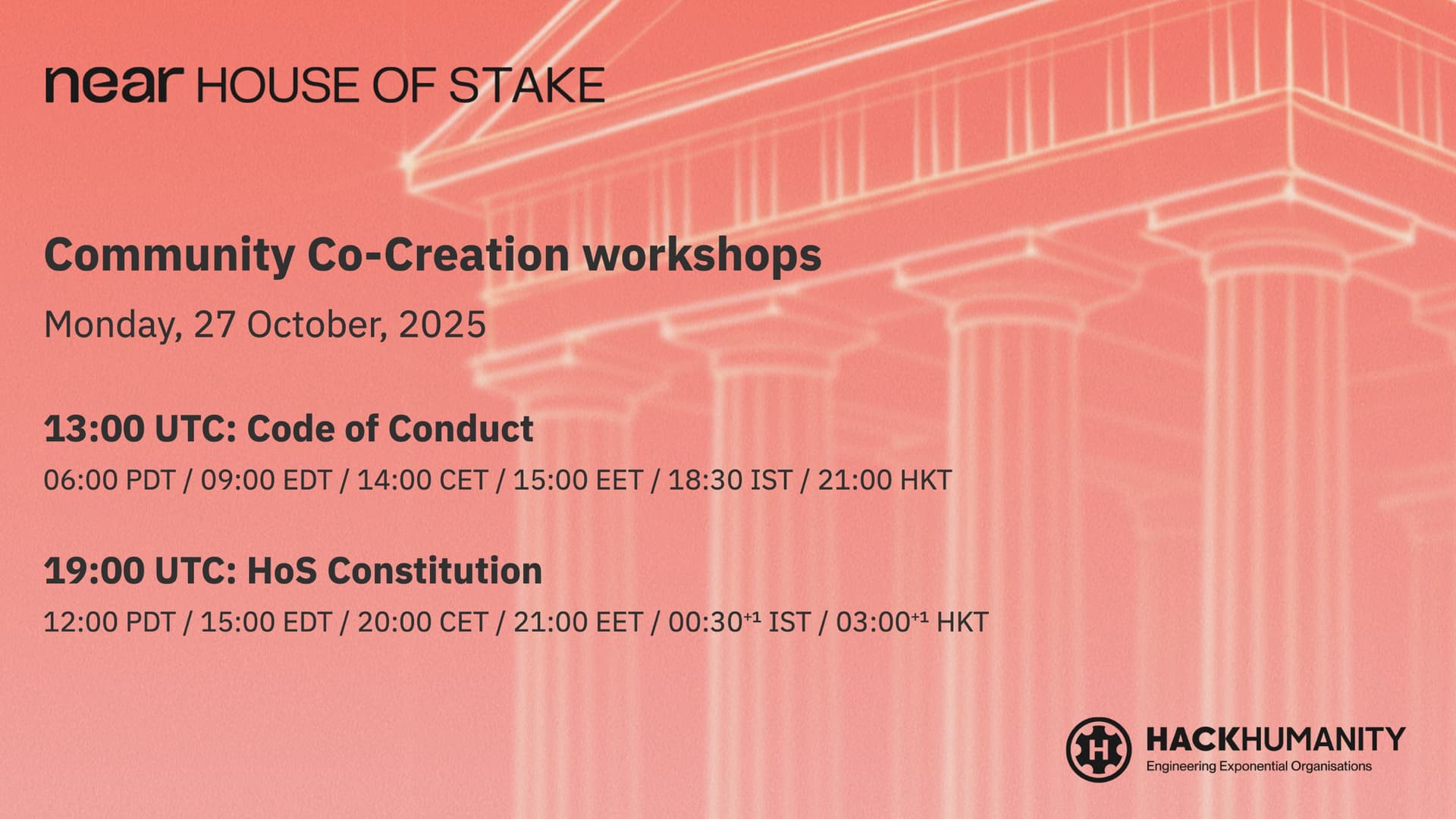
  • Community Workshop: Monday 27th October 13:00–14:30 UTC [Register here]
  • Focus Groups with Senior Moderators from other communities: Between 22nd and 27th October.
  • Posting Code of Conduct v0.2.0: 4th November (end of iteration 8).
  • Co-Creation Cycle Feedback Report: 4th November (end of iteration 8).

Why the Cycle Has Been Extended

The decision to extend the first co-creation cycle is based on the following:

  • A desire to include the new Head of Governance.
  • To host focus group feedback sessions with experienced community moderators.
  • Aligning the co-creation cycles to the 2-week iteration (sprint) cadence.
  • Learning the difficulty in getting stakeholder feedback from all key stakeholder groups and iteratively improving the co-creation cycle process.
  • A priority focus during iterations 6 & 7 on the interim Constitution and its supporting charters along with the Mission Vision Values.
8 Likes

Are there guidelines for moderators on how to go about a step by step evaluation of the complaint?

Thank you to the @HackHumanity for this COC draft, it’s a very strong and inclusive proposal. I particularly like the inclusion of this expanded scope of on-chain, off-chain (forums, social media), and real-world events/partnerships, which is unique in most DAO COC’s.

Here are a couple of other things that I really like in this proposal:

  • prohibition of doxxing and disclosing personal/financial information in 4.2.1
  • the bad and good examples for each section provide a good guideline for the community and provides clarity
  • and the mandate of public reporting of all decisions made by moderators and/or the Appeals Panel. Transparency is important in this process to provide an even playing field for all delegates and community members.

I do also have some questions about some of the sections in the CoC:

  1. Section 9: Appeal Process - The Appeals Panel is mentioned in this section but the CoC does not define who these 3 independent members are (delegates, HoS Foundation, etc.) and how they are chosen (appointed, on-chain vote).
  2. Section 2.3 Definitions - since Section 9 includes the term, “members” for the Appeals Panel, can you include the definition of a “member”, or define/change the wording for member to a listed role in Section 2.3 for Section 9.

Finally, I do have some suggestions for additions to the CoC to help strengthen it:

  • 2.4 Appointment of Stewards: The COC states that “Stewards are currently appointed by NEAR Foundation, until which time that authority can be granted to House of Stake”. However, while I understand it’s inclusion as a current necessity with our Phase 1 Governance approach, the CoC should include a Transition Date or Trigger in the CoC to include a specific month timeline, for example, 6 months after the HoS is operational to decentralize the enforcement arm.
  • 8.5.2 Permanent Ban: The inclusion of this language, “Removal from all governance spaces (on-chain and off-chain) to the greatest extent possible” is very ambiguous. Instead, the ideal way to do this (with real consequences is auto-delegate - such as OBOL’s staking contract), which removes all delegated VP, but that would require an upgrade to the staking and governance contracts, which may be something to consider for a future revision. However, since the Permanent Ban is basically a social punishment, I would also include removal of the offending individual/delegate group/service provider from participation in any delegate incentive programs, multi-sigs, Screening committee, Security Council, Moderator or any other committee or council role in the DAO.
  • 10.2 On-chain Actions & Remedies: There is an immutability problem with this section, if on-chain actions may be irreversible. Instead, I would adjust this that the CoC must mention that in cases of clear on-chain violation (e.g., 3.2.3 Vote-buying), the DAO is mandated to vote on an immediate counter-proposal to reverse or mitigate the financial damage, even if the original transaction is irreversible. The CoC itself is the social layer for defining what warrants that financial response.
3 Likes

House of Stake — Code of Conduct (CoC) Co-Creation Workshop Summary

Session: Community Co-Creation Workshop on the Code of Conduct (v0.1 → v0.2)
Facilitators: HumbertoBesso, Juan, DanCunningham (Hack Humanity)
Participants: Near Community members and House of Stake contributors; including Community Squad moderators and Aurora moderators who were consulted in a prior focus group
Artifacts:


Purpose & Context

  • Part of the governance transition plan (Stage: Assembly) and the wider co-creation cycle: collect community input, test proposals, and iterate.
  • Aim: make the CoC operational (not symbolic) — clear intake, objective severity, proportionate remedies, workable appeals — and align it with the Constitution (esp. Screening Committee / Art. 11), with NEAR moderation practices.

What the group chose to work on

Initial vote on “hot topics” (pulled from Forum / Telegram / GitHub feedback):

Priority Topic Rationale from participants
1 Enforcement & Remedies Current Section 8 is too high-level; need clarity on severity tiers and matching sanctions.
2 (tie) Appeals Panel Independence, selection, training, and funding pathway should be done via a complementary proposal.
2 (tie) Dispute Resolution Process A concrete, step-by-step meta-intake flow; multiple intake channels; public vs private data.

Direction from community

1) Enforcement & Remedies (Graduated + Proportionate)

  • Move to a three-tier severity model with examples and mapped remedies:
    • Small-scale: spam, minor off-tone, forgotten attribution, premature critique, mild gaslighting.
    • Mid-scale: targeted disruptive comments, exclusion from opportunities, system-gaming (e.g., repeated proposals w/o cooldown), reputational harms.
    • Big-scale: impersonation, sabotage, coordinated manipulation, treasury-attack proposals, doxxing/defamation, evidence forgery.
  • Sanctions should escalate: warnings → temporary restrictions → permanent bans; with proportionality factors and documented rationale.
  • Keep a case registry for auditability; publish what (status, sanction type, case ID) while keeping sensitive why/evidence private.

2) Dispute Resolution: Meta-Intake Flow

A practical pipeline everyone can follow:

  1. Report intake via multiple channels (email, moderators, Screening Committee, leadership), to lower barriers.
  2. Map & classify against clear rules/boundaries and severity matrix.
  3. Mediation-first (when not clear-cut): seek win-win outcomes; if parties refuse or fail to resolve → escalate.
  4. Tie-break / Arbitration: escalate to Screening Committee (per current Constitution).
  5. Decision & publication: record outcome; publish appropriate summary;
  6. Follow-up: responsibilities, deadlines, and check-ins; reopen if needed.

Note: Negotiation/mediation handled by moderators / an eventual appeals function; tie-breaks by the Screening Committee (per Constitution) — until further policies refine this.

3) Appeals Panel: How to Create It (and keep it legitimate)

  • CoC references an appeals panel (“≥3 independent members, annual rotation, no CoI”) but does not instantiate it.
  • Creation path = separate governance proposal defining:
    • Mandate & scope, selection (community election / requirements), rotation, CoI rules, budget/rewards;
    • Training: mandatory conflict-management training (@juankbell outlined a curriculum as baseline).
  • Independence concerns raised: options discussed include mutual monitoring within the community with strict eligibility + CoI and exploring double-blind evidence review.
  • Long-term: consider recognition of jurisdiction & external arbitration pathways where appropriate; encode in policy which venue applies, and when.

Objectivity, Legitimacy & Transparency (recurring theme)

  • Community flagged perceived legitimacy as critical: who decides, based on what, and how outcomes get communicated.
  • Responses:
    • Objective rubrics + severity matrix to constrain discretion.
    • Standardized decision templates + public case ledger (status/sanction IDs), with privacy for sensitive details.
    • Role requirements + training for moderators/appeals members; clear CoI handling (separate, referenced policy).
    • Explore double-blind evidence options for appeals and randomized panel selection to reduce bias.

Alignment with the Constitution & Other Bodies

  • CoC must sync with the Constitution (e.g., Screening Committee as tiebreak), and coordinate with NEAR moderation.
  • CoC + Constitution are living documents; additional charters/policies to draft next:
    • Conflict of Interest Policy (standalone; referenced by CoC)
    • Appeals/Dispute Process Charter (details of selection, rules, training)
    • Severity Matrix + Rubrics (codified examples and mappings)

AI Assistance (later, not first)

  • Once rules are concrete, explore AI-assisted moderation to flag language/use-cases against the matrix and support (not replace) human decisions.

Open Questions to Resolve

  • Appeals structure: one body vs two (moderation/appeals) and which criteria they should have to be selected.
  • Transparency balance: what’s public vs private at each stage?
  • Jurisdiction recognition: which courts/venues are taken when DAO processes fail?
  • Thresholds: when to move from mediation → arbitration → permanent sanctions.
  • Scalability: randomized panels, double-blind evidence, workload for moderators.

Interim Reality & Priorities

  • Today’s moderation sits in a gray area; moderators hesitate without community-ratified rules.
  • Priority: ship a narrow, usable CoC v0.2 (intake → severity → remedies → follow-up) aligned with Constitution; then add a deeper policy stack (Appeals Charter, CoI Policy, full matrix/rubrics).

Next Steps

  • Run focus groups with moderators (NEAR/Aurora) to stress-test the severity matrix and templates.
  • Prepare a governance proposal to instantiate the Appeals Panel (mandate, selection, training, rewards).
  • Publish a public case-log format + internal evidence protocol (privacy by default, audit on request).
  • Invite the community to comment on forum.

Call to Action

  • Comment on the Forum with your top 1–2 priorities for v0.2 and your view on the Appeals design.

– Author of the Summary: @haenko - HackHumanity

3 Likes

Thank you for the detailed summary and for facilitating this important co-creation process.
I fully support the direction on moderation and the Appeals structure — especially the focus on proportionality, transparency, and community legitimacy.

However, one essential aspect seems to have been missed:
Team members involved in moderation, enforcement, or appeals must not have any connection to the NEAR Foundation (NF), its contractors, the HoS Core Team (or its contractors), or the HoS Foundation Team (including board members or related entities).
This independence clause is crucial to ensure impartiality and to avoid potential conflicts of interest, as outlined in the principles behind HSP-006: Establishment of the HoS Ombuds Office.

Also, I’d like to support the idea of scheduling future workshops in time slots that are more accessible for participants based in the U.S. time zones — this would help include a broader segment of the community in the co-creation process.

Thanks again for keeping this process open and community-driven.

1 Like

Thank you, Dacha, for sharing your thoughts! :folded_hands:
Do you think House of Stake should have its own moderation team? If so, it would be great if you could share a bit more detail about your idea:
— Should moderators be elected to this position?
— If yes, who do you think should organize and oversee the elections?
— And finally, how should their compensation be handled — should it come from the community treasury, or another source?

It would be wonderful to hear more from you so we can explore this idea together. Thanks again for your valuable input and engagement!

I also fully agree that scheduling a future workshop in U.S. time zones shouldn’t be a problem.

2 Likes

Absolutely. Community squad team is biased and has a questioned experience. So, the hos mods team proposal outlined here -

1 Like
1 Like

House of Stake Code of Conduct v0.2.0

Version: v0.2.0
Audience: NEAR Community
Purpose: Community draft looking for rough consensus.
Archive: Version.0.1.0

Introduction

Proposal for Interim Code of Conduct

The purpose of this Code of Conduct version is to propose an interim version that serves two key purposes:

1) Enables specific rule testing: Establish a temporary and legitimate rules of engagement. The House of Stake Community and its Moderators don’t have the tools to actually take care of the health of our social layer. This version brings up an initial set of guidelines and approaches to facilitate that.

2) Foundation for Co-Creation: Using an interim version will facilitate co-producing a richer policy asset from integrating continuous community feedback. The goal is to replace the interim Code of Conduct before May 31st 2026.

This document serves as a basis and can be further developed by House of Stake documentation, as well as future charters to be proposed.

1. Our Pledge

1.1 We, as members, contributors, delegates, moderators, stewards, and other participants of the House of Stake (HoS), pledge to create a governance environment where participation is safe, inclusive, and transparent.

1.2 Commitments:

1.2.1 Act with professionalism, integrity, and respect in all spaces.
1.2.2 Align behavior with NEAR’s long-term interests and ecosystem health.
1.2.3 Protect privacy, safety, and data integrity.
1.2.4 Use technology, including AI, in an ethical, transparent, and accountable way.

1.3 Applicability:

1.3.1 This pledge applies to on-chain decisions, off-chain forums, events, and public representation of HoS.

2. Purpose & Scope

2.1 Purpose:

2.1.1 Ensure a healthy culture of productive participation in achieving House of Stake’s Mission.

2.2 Scope of Application:

2.2.1 On-chain: including but not limited to submission, delegate voting, treasury allocation, multisig participation.
2.2.2 Off-chain: including but not limited to governance forums, Discord, Telegram, GitHub, social media, community calls.
2.2.3 Community & Events: including but not limited to workshops, hackathons, AMAs, partnerships, and DAO-to-DAO representation.
(new) 2.2.4 House of Stake participants are by definition all veNEAR token holders and the scope of this Code of Conduct applies to all members and partners, without exception.
(new) 2.2.5 House of Stake decisions don’t have competence to rule outside of House of Stake.

2.3 Definitions:

2.3.1 Token-holders: participants with stake or voting rights.
2.3.2 Delegates: participants acting with proxied voting authority.
2.3.3 Moderators: individuals tasked with managing discussion, intake, assessment and enforcement.
2.3.4 Stewards: elected or appointed roles in HoS committees, councils or working groups (including the CoC Appeals Panel).
2.3.5 Contributors: developers, writers, organizers, and others engaged in HoS activities.
(new) 2.3.6 Working group members: Appointed or selected individuals tasked with providing various professional services to the community.
(new) 2.3.7 Appeals: Mechanism to report and address a violation of this code of conduct.

2.4 Appointment of Stewards

2.4.1 Stewards are currently appointed by NEAR Foundation, until that authority is granted to the House of Stake, which will then appoint them.

3. Values & Standards

3.1 Agreed Behaviors

3.1.1 Act in good faith and perform due diligence before voting or advising.
3.1.2 Make your best effort to resolve disputes or issues privately or with a moderator instead of escalating to public channels.
3.1.3 Disclose conflicts of interest, according to the Conflict of Interest Policy.
3.1.4 Provide clear rationales for governance actions.
3.1.5 Communicate with respect, inclusivity, and professionalism.
3.1.6 Protect the privacy, dignity, and safety of community members.
3.1.7 Collaborate transparently; document decisions; support iterative improvement.

3.2 Prohibited Behaviors

3.2.1 Harassment, bullying, stalking, or identity-based abuse (amend) targeting protected characteristics like gender, race, nationality or religion, including synthetic media harassment, impersonation or AI-generated identity manipulation.
3.2.2 Plagiarism, falsification, or misrepresentation of work.
3.2.3 Vote-buying, bribery, or covert influence.
3.2.4 Failure to disclose conflicts of interest.
3.2.5 Doxxing, privacy violations, or unauthorized data exposure.
3.2.6 Spamming, shilling, brigading, disinformation, or sabotage. (amend) Including knowingly false or misleading information intended to influence governance outcomes or produce harm to the House of Stake and its members.

3.3 Good Practice Example:

3.3.1 A contributor critiques a proposal respectfully and offers alternatives with evidence.
(new) 3.3.2 A contributor is associated by an organization and properly discloses affiliation to understand its influence.
(new) 3.3.3 A contributor raises consideration and signals a behavior that can be contrary to the Code of Conduct, following the reporting mechanisms and providing substantial evidence for analysis.

3.4 Bad Practice Example:

3.4.1 A contributor spreads unfounded or unsubstantiated rumors without evidence about an author to discredit their work.
(new) 3.4.2 A contributor buys votes or hides affiliation and influence in relation to submitted proposals.
(new) 3.4.3 A contributor creates noise in public platforms about behavior subjectively evaluated, not facilitating proof or evidence, nor reporting it to proper instances.

4. Confidentiality & Financial Independence

4.1 Agreed Behaviors

4.1.1 Respect confidentiality and uphold privacy in all processes.
4.1.2 Maintain independence in decision-making; proactively disclose financial or personal interests when relevant.

4.2 Prohibited Behaviors

4.2.1 Disclosing personal information without explicit consent. This includes contact details, physical location, financial data, wallet addresses, or any information that could enable identification, coercion, or reputational harm.
4.2.2 Accepting undisclosed compensation or benefits in relation to governance actions.

4.3 Good Practice Example:

4.3.1 Challenging the value for money of a particular piece of work, based on substantiated evidence.

4.4 Bad Practice Example:

4.4.1 A member speculates publicly about another’s earnings to undermine their credibility.

5. Work Quality, Pace, and Feedback

5.1 Agreed Behaviors

5.1.1 Encourage timely contributions while respecting diverse work rhythms (amend) to foster global collaboration through asynchronous coordination.
5.1.2 Provide feedback that is constructive, specific, balanced, and respectful. (amend) Constructive feedback is defined as “well communicated, action-oriented, and evidence-based.”
5.1.3 Recognize and credit the efforts of others.
5.1.4 Foster a safe, professional, and supportive environment.
5.1.5 Assess ideas, work and deliverables based on the arguments and evidence that support them, not personal attacks targeting the character, identity, or unrelated attributes of a member.
5.1.6 Provide appropriate feedback based on the stage a piece of work is at.
5.1.7 Give people a fair chance, space and time to do the work and do it well.
(new) 5.1.8 Encourage open participation in feedback, creation and execution processes.

5.2 Prohibited Behaviors

5.2.1 Dismissing contributions with superficial or derogatory remarks.
5.2.2 Making baseless criticism without representative evidence.
5.2.3 Undue or hostile pressure to conform to arbitrary work rhythms. Constructive encouragement is acceptable. (amend) Accountability and transparency are mandatory, and should be practiced without personal attacks.
5.2.4 Comparisons designed to discredit colleagues based on pace.
5.2.5 Generalized criticism without constructive intent.
5.2.6 Any pressure, speculation, or unconstructive criticism that harms collaboration.
5.2.7 Avoid toxic or hostile criticism disguised as urgency.
(new) 5.2.8 intentionally excluding others from participating, obliterating, not attributing or taking over others work.

5.3 Good Practice Example:

5.3.1 A reviewer highlights strengths and specific improvements with constructive feedback and actionable suggestions.

5.4 Bad Practice Example:

5.4.1 A member mocks another as “lazy” or “too slow” without understanding size, complexity, dependencies, review processes, etc. that a piece of work may need to go through.

6. Reporting & Intake

6.1.1 Anyone who experiences or witnesses a potential violation is encouraged to report it as described below.
6.1.2 Moderators will also pro-actively monitor for violations and process those on behalf of the community.
(new) 6.1.3 AI moderation tools are considered key in achieving a neutral, objective, and human-enhanced environment.
(new) 6.1.4 Member’s feedback is objectively processed without ad hominem criteria, meaning feedback is taken by what is being communicated, and not by who is communicating it, to protect minority voices from being labeled.

6.2 Reporting Channels (to be set up)

6.2.1 Confidential Code of Conduct complaint form with option to submit anonymously (official HoS portal).
6.2.2 Email: info@houseofstake.org (alternative submission if needed).
6.2.3 Direct contact with the current Community & Moderation team at events or in community channels or calls. (amend) Including Head of Governance (HoG), Councils, Committees, and Panels.

6.3 Intake & Triage

6.3.1 Acknowledgement of received complaint by the Community and Moderation team, this includes explaining what action they will take.
6.3.2 Urgency assessment within 48 (amend) Business hours to address immediate risks to safety or governance integrity.
6.3.3 Confidential handling; reporter identities protected where possible.
6.3.4 Detect abuse of process (e.g., repeated malicious or false reports) is a violation.

6.4 Good Practice Example:

6.4.1 A member reports a prohibited behavior with timestamps and supporting evidence.
(new) 6.4.2 A minority flags a violation to the Code of Conduct from a high reputation member, with substantial evidence.

6.5 Bad Practice Example:

6.5.1 A member files repeated false reports to harass another participant.
(new) 6.5.2 A member complains that they are being signaled or excluded, but do not provide solid evidence.

7. Moderation Standards

7.1 Impartiality: moderators must have no conflicts of interest.
7.2 Cultural and linguistic competence: include moderators who understand the parties’ context.
7.3 Documentation: maintain secure records, a clear evidence trail, and access controls.
7.4 Timeliness: target resolution within 14 calendar days; document and communicate extensions.
7.5 AI oversight: AI-powered tools may assist with triage or pattern detection; humans make final decisions.
7.6 Evidence standards: use verifiable records (e.g., logs, messages, transactions) and note limitations.
(new) 7.7 Objectivity and Fairness: Once documents are ratified, they become legitimate and auditable standards.
(new) 7.8 Hermeneutics: written content could be understood or interpreted differently, and clarification or appeals are a possibility for checks and balances.

7.7 Good Practice Example:

Assign moderators from outside the immediate dispute to ensure impartiality.

7.8 Bad Practice Example:

Allowing a conflicted delegate to oversee a case involving their own committee.

8. Enforcement & Remedies

8.1 Principles: proportionality, predictability, and restoration where feasible.
(new) 8.1.2 Restorative approaches and capacity building after violations of the Code of Conduct can be implementes by Negotiation, Mediation, and arbitration, as enforcement mechanisms.
(new) 8.1.3 Education about Appeals process and criteria for severity and escalation of sanctions are to be developed to improve predictability, by future proposals on this matter.

8.2 Feedback

8.2.1 Observation: first, minor or potential violation.
8.2.2 Consequence: private or public feedback, at Moderator’s discretion.
8.2.3 Repair: acknowledgement, clarification, improvement in behaviour.

8.3 Warning

8.3.1 Observation: feedback ignored or serious violation
8.3.2 Consequence: private or public written notice with requested changes.
8.3.3 Repair: apology, acknowledgement, or clarification. (amend) Including amendments, removal of content or restorative practices.

8.4 Temporary Restriction

8.4.1 Observation: repeated or significant violation
8.4.2 Consequence: time-bound restriction or suspension from channels or roles. (amend) Which can apply even while cases are being analyzed.
8.4.3 Repair: reflection, mediation and a plan for corrective steps with conditions for return defined.

8.5 Permanent Ban

8.5.1 Observation: severe violation undermining safety, governance integrity or legitimacy
8.5.2 Consequence: removal from all governance spaces (on-chain and off-chain) to the greatest extent possible. (amend) Including mitigating, reducing, or reversing financial damage when possible.
8.5.3 Repair: not applicable; reserved for irreparable breaches of trust.

8.6 Proportionality Factors

Moderators will exercise judgement on the level of remedies based on intent, impact, prior history, cooperation, and community safety.

9. Appeals Process

9.1 Appeals Panel: at least 3 independent members, rotating annually; no conflicts of interest.
9.2 Criteria: temporary restrictions and permanent bans can be appealed based upon new evidence (amend) (logs, screenshots, transaction records), a claim of misinterpreted evidence, procedural error or disproportionate sanctions.

9.3 Timeframe: submit within 14 days; decision within 30 days.
9.4 Submission: encrypted form or direct email to the Panel’s published contact.
9.5 Finality: Panel decisions are binding, subject to community ratification in exceptional cases. (amend) Escalation to Screening Committee could be requested.

9.6 Good Practice Example:

  • A sanctioned member submits new logs that change the assessment; sanction reduced.
  • Evidence shared is objective and within scope. (logs, screenshots, transaction records)

9.7 Bad Practice Example:

  • Multiple frivolous appeals filed to delay enforcement.
  • Evidence shared is out of scope or subjective. (Behavior signaled is outside of HoS, biased claims, faulty evidence)

10. Risk Disclosures & Limitations

10.1 Enforcement capacity depends on moderator resources and jurisdictional constraints.
10.2 On-chain actions may be irreversible; remedies cannot fully counteract immutability.
10.3 This CoC complements applicable law; it does not replace legal rights or obligations.
10.4 Jurisdictional differences may require tailored measures while upholding core principles.
(new) 10.5 Applicable jurisdiction for legal purposes is Cayman Islands.

11. Transparency & Governance Oversight

11.1 All reports, evidence, decisions, feedback and enforcement actions are logged in an auditable but privacy-preserving way.
11.2 Annual reports summarize cases, categories, timelines, outcomes, and reforms (respecting privacy where required).
11.3 Committees overseeing this CoC maintain a public change log and explain major policy updates.
11.4 Moderation team discloses their affiliations, incentives and responsibilities to reduce conflicts of interest.
(new) 11.5 Oversight to all governance actors should be done by responsible bodies ensuring accountability and checks and balances. This is done working in sync with all HoS institutions and ruling documents.
(new) 11.6 NEAR Foundation is accountable for moderation of its ecosystem’s platforms, including the House of Stake’s.

12. Contact & Amendments

12.1 Contact: info@houseofstake.org.
12.2 Amendments: updates follow a public notice and versioning process with a “Last Updated” date.
12.3 Effective Date: this CoC takes effect upon community ratification and remains in force until amended.
(new) 12.4 A minimum public comment period of 7 days is required prior to version adoption of this document, based on Art. 6.1.1 of the interim constitution.

END OF CODE OF CONDUCT POLICY V0.2.0

:memo: Authorship & Acknowledgements

Authored by: @juankbell & @humbertobesso from @HackHumanity
Review and feedback from: @klausbrave, @disruptionjoe, @haenko

3 Likes

Code of Conduct v0.2.0: Analysis of Community-Driven Changes

Author: @HumbertoBesso and @Juankbell
Reviewers: @klausbrave @dancunningham @disruptionjoe @haenko
Date: November 04, 2025

1. Executive Summary

The evolution from the House of Stake (HoS) Code of Conduct v0.1.0 to v0.2.0 is a significant step forward in our commitment to participatory governance. This updated version is the direct result of co-creation cycle 1. Where stakeholder feedback was actively solicited, analyzed, and integrated.

This report provides a strategic overview of changes, demonstrating how community voices are shaping our governing principles. Through five distinct channels: Workshops, Focus Groups, GitHub, the Governance Forum, and Telegram. We processed 96 unique pieces of feedback. Approximately 75% of this feedback was incorporated, leading to 33 distinct modifications, which included 16 new clauses, 11 amendments, and 6 new examples to the document.

For transparency and to allow for auditing, every piece of feedback is logged and cross-referenced in a public spreadsheet, available at the HoS Public Feedback Log [1].

LEGEND

F = Forum, TG = Telegram, Wo = Workshop, GH = GitHub, FG = Focus group
CoC = Code of Conduct
After the acronyms a number comes for consecutivity within the channel it was reported.

2. Strategic Impact of Key Changes

The modifications in v0.2.0 can be grouped into three primary themes.

A. Strengthening Governance and Objectivity

A primary concern among participating stakeholders was ensuring fairness and preventing arbitrary decision-making. The new version addresses this by:

  • Clarifying Jurisdictional Boundaries: New clauses explicitly define House of Stake participants and limit the CoC’s competence to HoS matters (FG-CoC-16), preventing overreach.
  • Institutionalizing AI-Assisted Moderation: The CoC now formally recognizes AI-powered tools as key to achieving a neutral and objective moderation environment (FG-CoC-14, 18), with the critical safeguard that final decisions remain in human hands.
  • Establishing Auditable Standards: A new principle of “Objectivity and Fairness” (Wo-CoC-42, 43) signlas that once a document is ratified by the community, it becomes a legitimate and auditable standard, thus grounding enforcement in co-created rules rather than individual interpretation.

B. Improved Protections and Enforcement

Stakeholders emphasized the need for the CoC to favor restorative outcomes. The document now includes:

  • Advanced Harassment Rules: Prohibited behaviors were amended to include new forms of abuse, such as AI-generated identity manipulation and synthetic media harassment (Wo-CoC-17).
  • A Clear Definition of Disinformation: The CoC now defines disinformation as knowingly false or misleading information intended to influence governance outcomes, a direct response to feedback on manipulation and sabotage (Wo-CoC-14, 20, 22).
  • Restorative Justice Mechanisms: The enforcement section was significantly enhanced to include negotiation, mediation, and arbitration as potential remedies (Wo-CoC-23, 36, 39), reflecting a community preference for repairing harm over purely punitive actions.

C. Enhancing Transparency and the Democratic Process

The community requested more transparency and direct participation in the governance process itself. In response, v0.2.0 introduces:

  • A Mandated Public Comment Period: A new clause requires a minimum 7-day public comment period before any future version of the CoC can be adopted (GH-CoC-14), hard-coding a vital step of the democratic process.
  • Clear Accountability Structures: The document now explicitly states that the NEAR Foundation is accountable for moderation on its platforms, including House of Stake’s (FG-CoC-5), providing a clear line of responsibility.

3. What Was Not Included and Why

Approximately 25% of feedback was not incorporated into this version. This was not a dismissal of its value but due to:

  • Out of Scope: The feedback pertained to other governance bodies or processes outside the CoC’s mandate.
  • Already Addressed: The suggestion was already covered by existing clauses in v0.1.0.
  • Requires Deeper Discussion: The topic was too complex to be resolved in this cycle and warrants its own dedicated proposal. A prime example is the detailed composition and selection process for the Appeals Panel (F-CoC-11, GH-CoC-5), which is now a priority for the next steps.

This approach ensures that all feedback is acknowledged and that complex issues are given the attention they deserve.

4. Next Steps: A Roadmap for Continued Co-Creation

The v0.2.0 document concludes with a new “Next Steps” section, which serves as a roadmap for future work that directly emerged from the feedback cycle. This ensures that the momentum of co-creation continues. Key proposals to be developed include:

  1. An Appeals Panel Charter: A dedicated proposal to define the composition, selection process, and compensation for the Appeals Panel, addressing significant community interest (F-CoC-11, GH-CoC-5, 17).
  2. A Progressive Decentralization Plan: A formal plan with a timeline and triggers for transitioning authority from the NEAR Foundation to the House of Stake, a key demand for long-term autonomy (F-CoC-12, GH-CoC-9).
  3. Onboarding and Education Toolkits: The creation of accessible materials, including visuals and guides, to improve community-wide understanding and adoption of the CoC (Wo-CoC-44).

5. Conclusion

The Code of Conduct v0.2.0 is a tangible outcome of our commitment to listening and adapting. It was shaped by 96 unique contributions from our stakeholders. The process includes improvements to the document itself and a clear path forward for maturing our governance structures.

We thank every participant who contributed their time and expertise to this co-creation cycle. We invite all stakeholders to review the changes, participate in the upcoming sensing or ratification votes, and join us in developing the subsequent charters that will continue to build a truly community-led NEAR House of Stake.

6. References

[1] House of Stake. (2025). CoC v0.2.0 Public Feedback Log. Available: Feedback Log - CoC - Google Sheets

4 Likes