NEAR House of Stake - Interim Constitution
Version: v0.1.0 (Draft for Community Review)
Status: Interim Constitution
Expiration: May 31, 2026
Introduction
 WHAT - The Purpose of the Constitution
NEAR House of Stake Constitution represents an agreement for how decisions are made as a single collective entity.
Once ratified, it defines how we transform many inputs such as proposals, votes, and stake, into legitimate actions.
By reducing ambiguity in collective intent, the Constitution enables structured, transparent decision-making to begin.
House of Stake is designed to give NEAR holders meaningful voice through stake-weighted governance, where locking tokens as veNEAR increases influence in proportion to commitment.
For onchain governance systems, 1-token-1-vote remains the only enforceable and sybil-resistant model for legitimacy, because onchain systems cannot yet guarantee one-person-one-vote without sacrificing privacy.
The Constitution provides the structure that translates voting outcomes into clear directions to the NEAR House of Stake Foundation and community, building accountability and shared intent across all participants.
WHY Now
Ratification of this Interim Constitution will be the first formal act of governance by NEAR House of Stake participants.
WHY Interim
The interim version serves two key purposes:
-
Enables Immediate Governance: It will be formally proposed for ratification when the House of Stake smart contracts launch. Once ratified, it establishes temporary, legitimate rules of engagement, empowering collective decision-making to begin.
-
Foundation for Co-Creation: It acts as the starting point for the co-creation process that will produce a long-term, collaboratively drafted version to replace the interim Constitution before its expiration on May 31st, 2026.
Legitimacy
This interim version ensures that early governance actions are legitimate, structured, and aligned with NEAR’s broader Governance Transition Program, which moves through the phases of:
Assembly → Alignment → Activation → Autonomy
Note: Many in the community may find issues they would like to change in this interim constitution. At the end of this document Hack Humanity has included a list of items to consider updating as the community co-creation process unfolds.
This phased approach balances the need for immediate functionality with the long-term goal of fully decentralized, community-first governance.
Process
The process for creating the Interim Constitution is based on:
- The goal to bootstrap House of Stake with a minimum viable constitution
- Adherence to the NEAR Foundation provided starting mandate (view here)
- Alignment to the original Gauntlet proposal - NEAR House of Stake Governance Proposal (August 7, 2024)
- Referential integrity with the Bylaws of the NEAR House of Stake Foundation and Memorandum & Articles of Association
Additional Resource: Q&A: Understanding the Legal Structure of the House of Stake (HoS) may prove useful in understanding the legal documents and their relationship to the House of Stake DAO.
This phased approach is necessary to match the timeline for House of Stake V1 Mainnet launch.
First; the Interim Constitution is ratified to bootstrap the House of Stake DAO.
In parallel the Community-created Constitution will be developed during it’s Co-Creation Cycle - once this process completes, it will be ratified and replace this Interim version.
NEAR House of Stake - Interim Constitution (v0.1.0)
Article 1 — Foundational Provisions
1.1. Purpose
The NEAR House of Stake (“HoS”) is the stake-weighted governance system of NEAR that exists to preserve neutrality, legitimacy, and resilience by enabling meaningful, stake-aligned participation.
1.2. Binding Effect
Rules may be enforced onchain or off-chain; all rules adopted under this Constitution are binding.
1.3. Supremacy
This Constitution is the supreme governance document for NEAR House of Stake - the decentralized network of veNEAR tokenholders. In the event of conflict with any policy, charter, or guideline, this Constitution supersedes their controls unless amended under Article 9. (Referring to DAO ratified policy & charters, excludes NEAR House of Stake Foundation bylaws.)
Article 2 — Mandate
2.1 Economic Governance
2.1.1. Treasury management
2.1.2. Programs to support economic sustainability
2.1.3. Economic parameters:
- 2.1.3.1. Inflation
- 2.1.3.2. Fee switch for AI products, intents, etc.
2.2 Technical Governance
2.2.1. Incremental, narrow scope to begin
2.2.2. e.g., MPC signers for chain signatures
2.2.3. Determine which NEAR Enhancement Proposals (NEPs) should be escalated to HoS
2.2.4. Anything that can’t be governed on GitHub
2.3 Build Legitimacy
2.3.1. Maximize the amount of NEAR/veNEAR in the system
2.3.2. Participation by broad subset of the community
2.3.3. Decentralise Screening Committee
2.3.4. Put in place policy: mission, vision, values, constitution, charters, policy, co-creation cycles
2.4 Grow Engagement and Ecosystem Health
2.4.1. In the DAO, in governance, in the protocol, in NEAR ecosystem more broadly
2.4.2. Decentralized stakeholders participate in governance
2.5 Anti-Mandates
The following are explicit anti-mandates, i.e., things to avoid:
2.5.1. Grants for the sake of grants. House of Stake won’t have an official “grants program” for now, and there won’t be a free-for-all for funding requests. Proposals that target the above mandate items may, of course, include requests for funding for specific uses.
2.5.2. Full technical governance of the NEAR protocol, or of other products including Chain Signatures, NEAR Intents, and NEAR AI. These products are all extraordinarily complex and House of Stake doesn’t have the necessary technical expertise, and isn’t well positioned, to own this anytime soon. We’ll start with less complex technical governance tasks, such as the one outlined above: governing the Chain Signatures MPC signer set, and build capacity to take on more technical governance in the future.
Article 3 — Membership & Rights
3.1. Citizens
All NEAR holders are Citizens by default; they must lock their NEAR or eligible liquid staking token to become a veNEAR holder (registered voter) with rights to delegate or participate where allowed.
Official NEAR House of Stake Contracts:
venear-contract (venear.dao)
voting-contract (vote.dao)
3.2. Registered Voters
veNEAR holders may submit and vote on proposals, and delegate/self-delegate.
3.2.1. Voter Rights
Registered Voters have the following rights:
- 3.2.1.1. The right to transparent access to governance records
- 3.2.1.2. They may submit and vote on proposals in accordance with the Proposal Process Policy
- 3.2.1.3. They may vote to approve or amend Constitutional Policy & Charters, Bylaws, and governance procedures
- 3.2.1.4. They may vote to appoint or remove Directors and veto Security Council actions
- 3.2.1.5. They may raise concerns about delegates or governance matters
- 3.2.1.6. They may expect votes to be binding unless a Near House of Stake Foundation Director justifiably rejects a proposal due to:
- 3.2.1.6.1. Violations of law or fiduciary duties
- 3.2.1.6.2. Conflict with NEAR House of Stake Foundation Articles or Bylaws
- 3.2.1.6.3. Risk of legal or reputational harm
3.2.2. Terminology Alignment
For the avoidance of doubt, all references to “veNEAR holder,” “Registered Voter,” or “Citizen (veNEAR participant)” are equivalent during the interim period.
Article 4 — Institutions
4.1. Endorsed Delegates
Endorsed delegates are a subset of overall delegates which are selected by the Screening Committee based on the endorsed delegate application process. All delegates represent veNEAR holders; Endorsed Delegates meet heightened transparency and activity standards.
4.1.1. Endorsed Delegates Mandate
- 4.1.1.1. Vote on proposals and justify their votes
- 4.1.1.2. Must participate in 80%+ of votes monthly
- 4.1.1.3. Help bridge community input and execution of governance
- 4.1.1.4. Adhere to the Endorsed Delegate Charter
4.2. Screening Committee
Selected by NEAR Foundation in the interim; transitions via a community elected process by ratification of a co-created charter.
4.2.1. Screening Committee Mandate
- 4.2.1.1. Elect Endorsed Delegates
- 4.2.1.2. Vet and pre-screen community proposals
- 4.2.1.3. Remove Delegates who fail to meet responsibilities or act against NEAR values
- 4.2.1.4. Adhere to the Screening Committee Charter
4.3. Security Council
4.3.1. Mandate
- 4.3.1.1. Handle on-chain security and integrity operations
- 4.3.1.2. Execute Emergency Actions (e.g. patching critical vulnerabilities)
- 4.3.1.3. Approve Non-Emergency Actions like protocol upgrades (which must also be approved by Delegates)
- 4.3.1.4. Veto proposals that do not align with HoS mandate
- 4.3.1.5. Call Emergency Meetings if needed
4.3.2. Safeguards
- 4.3.2.1. Emergency Actions require a 75% supermajority vote of security council members
- 4.3.2.2. All actions must be followed by transparency reports to the community
4.3.3. Appointment/Removal
Appointment/Removal by NEAR Foundation.
4.3.4. Escalation
Refer to NEAR House of Stake Foundation bylaws for handling of unaddressed issues.
4.4. NEAR House of Stake Foundation
4.4.1. Legal Documentation
4.4.2. Purpose
The NEAR House of Stake Foundation exists to:
- 4.4.2.1. Empower the NEAR community to lead
- 4.4.2.2. Translate community intent into legal and operational action
- 4.4.2.3. Ensure decisions are carried out safely, fairly, and transparently
- 4.4.2.4. Provide checks and balances between community, directors, and oversight bodies
4.4.3. Director Mandate
The HoS Foundation currently has one Director.
- 4.4.3.1. Manage the day-to-day business of the Foundation
- 4.4.3.2. Implement Tokenholder-approved proposals unless legally required to veto them
- 4.4.3.3. All execution authority for approved proposals rests solely with the NEAR House of Stake Foundation; Committees may only recommend
- 4.4.3.4. Authorize expenses and execute contracts
- 4.4.3.5. Ensure the Foundation complies with all applicable laws
4.4.4. Director Appointment/Removal
Appointed and removed by successful passing of a constitutional decision proposal.
4.4.5. Supervisors Mandate
- 4.4.5.1. Provide oversight of Foundation Directors
- 4.4.5.2. Review records, attend general meetings, and request reports
- 4.4.5.3. Ensure Directors are acting in the interest of the Foundation and the community
4.4.6. Supervisor Appointment/Removal
- 4.4.6.1. Appointed by Directors; required if the Foundation has no members
- 4.4.6.2. Removed by resignation, conflict of interest, or as outlined in their terms
- 4.4.6.3. Can be overridden or removed by successful passing of a standard decision proposal
4.5. NEAR Foundation
- 4.5.1. Screening committee & security council appointment during interim
- 4.5.2. Funding & operational support through launch & stabilization at their discretion
- 4.5.3. Transitions responsibilities to the NEAR HoS Foundation upon ratification of new policy & charters which reassign current roles
- 4.5.4. Is not managed or directed by NEAR House of Stake voting
Article 5 — Integrity, Conflicts of Interest, and Accountability
5.1. Disclosure
All governance actors (Delegates, Committee/Council members, Foundation directors) must disclose material conflicts prior to decision-making; failure to disclose may be grounds for sanction or removal.
5.2. Removal for Cause
Delegates, Committee members, or Council members may be removed for misconduct, undisclosed conflicts, or failure of duty by Decision Proposal, with notice and opportunity to respond and appeal the issue to the screening committee.
5.3. Transparency Duties
Institutions publish meeting notes, rationales, and decisions; community reporting is mandatory.
Article 6 — Legislative Procedure (Proposals & Voting)
6.1. Proposal Process
The detailed proposal creation, deliberation, and voting lifecycle is governed by the Proposal Process Policy.
6.1.1. Implementation Sequence
Proposals shall follow the sequence:
7 Day Deliberation Period → Screening filter → On-chain Vote → Security Council 72-hour Review → Foundation Execution
6.2. Eligibility to Propose
Any Registered Voter (veNEAR holder) or Endorsed Delegate may submit proposals. All proposals must undergo a minimum deliberation period, not less than 7 days, before a binding vote.
6.3. Screening
The Screening Committee must approve proposals to be eligible for an onchain vote.
6.4. Voting, Thresholds & Quorum
| Proposal Type | Voting Requirement | Additional Requirements |
|---|---|---|
| 6.4.1 Sensing Proposal | May utilize any methodology for assessment that serves the purpose of the inquiry | N/A |
| 6.4.2 Standard Decision Proposal | Simple majority of votes cast | AND passing by screening committee |
| 6.4.3 Constitutional Decision Proposal | Two-thirds (67%) supermajority | AND a majority vote from the screening committee publicly posted on the governance forum PRIOR to screening committee onchain approval |
6.4.4. Quorum: Will align to the technical quorum settings put in place by the onchain system.
6.5. Challenge & Implementation
Results are recorded publicly; implementation follows a public timeline; deviations or Security Council interventions are explained on-record.
6.6. Conflicting Measures
If approved measures conflict (as decided in retrospect by the screening committee), the measure with higher veNEAR support prevails.
6.7. Legal/Technical Feasibility
If execution is impossible or unlawful, the HoS Foundation must publish justification within 14 days and propose a path forward.
Article 7 — Treasury & Financial Stewardship
7.1. Treasuries
The Interim DAO Treasury is controlled by the NEAR House of Stake Foundation and is located at __________, an onchain DAO Controlled Treasury will be created with a future software version update.
7.2. Custody & Control
The NEAR House of Stake Foundation executes funding decisions validly approved under Article 6, subject to Cayman legal and compliance obligations and technical feasibility. (Including but not limited to KYC/AML & OFAC screening)
7.3. Interim Adjustments
NEAR House of Stake Foundation may adjust fund release schedules for passed proposals to minimize risk of fraud, waste, or abuse.
Article 8 — Emergency Powers
8.1. Trigger & Scope
The Security Council may act to respond to urgent threats or vulnerabilities and coordinate emergency measures.
8.2. Notice & Review
The Council must inform the community after intervention.
8.3. Veto Period
The Security Council shall have a 72-hour review window following any successful vote to veto or suspend implementation where security or legal risk is identified.
Article 9 — Transition & Interim Arrangements
9.1. Interim Policies
Interim policy set (including this Constitution in interim form) expires May 31, 2026 unless ratified. If a successor constitution is not ratified, all NEAR House of Stake funding stops because the Foundation cannot receive legal direction to take action.
9.2. Screening Committee
The screening committee will be replaced using a community-involved selection process.
Article 10 — Dissolution
10.1. Authority
Dissolution requires a constitutional amendment and would require a succession plan to allocate any remaining and/or future treasury. The supremacy for dissolution is the NEAR House of Stake Foundation Bylaws.
Article 11 — Interpretation & Dispute Resolution
11.1. Interpretation
Where text is ambiguous, interpret to maximize neutrality, participation, transparency, and feasibility.
11.2. Review Mechanism
The community may establish an independent review/arbitration panel by Decision Proposal to resolve constitutional disputes.
11.3. Dispute Resolution
Where disagreement arises regarding the meaning or intent of any constitutional policy or charter clause, particularly in novel or gray-area situations, the Screening Committee shall deliberate and decide by vote and the result must be confirmed by the Foundation Directors & Head of Governance. The resulting interpretation must be recorded in the Transparency Thread and serves as binding precedent until formally amended or superseded. In the event of continued dispute requiring binding arbitration, refer to the NEAR House of Stake Foundation Bylaws.
Constitutional Policy and Charters
The Constitution includes, and is not limited to the following supporting policy and charters:
- Screening Committee Charter
- Endorsed Delegate Charter
- Proposal Process Policy
The above Policy and Charter documents will be posted each with separate Forum posts shortly & cross-referenced here.
 Call to Action
Community participation is essential to establishing the legitimacy and effectiveness of this governance framework.
Feedback
Feedback below this post is welcome now.
Note - Feedback provided before the Mainnet V1 launch may be considered but is not guaranteed to be included in the Interim Constitution, however your feedback will be considered in the Community co-created version of the Constitution.
Timeline
| Date | Milestone |
|---|---|
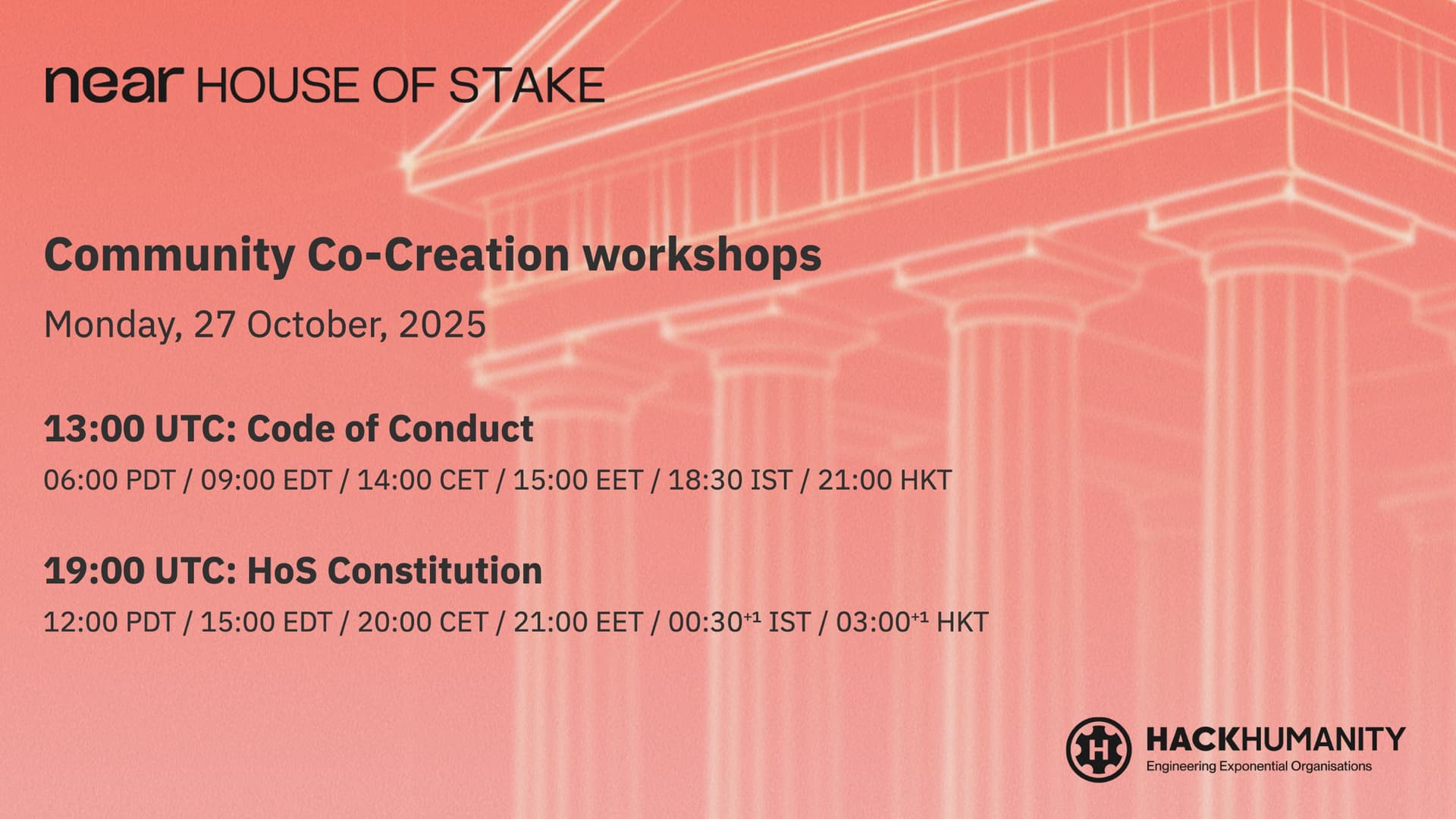
| October 10 | Constitution Co-creation Cycle 1 Begins |
| October 20 | Target Constition Co-creation Workshop Date |
| October 28 | Open Feedback Period Ends |
| November 4 | Constitution Co-creation Cycle 1 Ends |
Conclusion
The Interim Constitution is required for the House of Stake DAO to begin collective decision making.
It will be replaced by a Community Co-created version.
Your participation now shapes the foundation for NEAR’s next era of decentralized governance.
Below is a nonexhaustive list of Key Focus Areas to consider for Expanded Legitimacy in the replacement Community Co-created Constitution version:
Addendum: Key Focus Areas to consider for Expanded Legitimacy
1. Define Clear Evolution Pathways
Specify how and when interim governance bodies transition to elected, decentralized, or algorithmically managed forms. Ensures institutional adaptability and long-term legitimacy.
2. Structure Low Stakes Experimentation Environments
Consider the unique requirements and needs of humans and AI working together to co-govern and co-operate House of Stake. Design subordinate governance structures where experimentation in low stakes “test governance” environments can be adopted if successful and remove risk from critical paths.
3. Establish Feedback Circles and Audit Loops
Embed regular system audits, cultural reviews, and community surveys to detect misalignment between formal rules and lived behavior. Design roles representative of specific stakeholder groups to increase access to different perspectives.
4. Track and Publish Legitimacy & Mission Metrics
Use transparent metrics — participation rates, delegate diversity, proposal throughput - as continuous indicators of community legitimacy and trust. DAO Self-Awareness checks that House of Stake is not doing governance for governance sake, but decisions and actions further the House of Stake Mission, Vision, Values.
5. Strengthen Conflict Resolution and Fair Process
Define clear escalation triggers, roles, and enforcement mechanisms for disputes, including transparent removal and appeal procedures.
6. Incentivize Alignment and Participation
Implement reputation- or token-based rewards for meaningful contributions, focusing on quality engagement and collaborative policy design.
7. Balance Efficiency with Inclusion
Model human coordination costs — limit bureaucracy, simplify onboarding, and provide meaningful opportunities for tokenholders of all sizes to participate and contribute.
8. Guard Against Elite Capture
Introduce rotation, term limits, and public accountability reports to prevent concentration of influence and ensure equitable representation.
9. Preserve Institutional and Cultural Memory
Create a shared archive of decisions, rationales, and outcomes to strengthen continuity and reduce repetitive re-litigation.
10. Foster Cultural and Psychological Resilience
Reinforce shared values - trust, respect, curiosity - and promote psychological safety so dissent and diversity of thought strengthen rather than divide the community.
11. Model Power and Decision Flows
Map influence across all stages (proposal → screening → ratification → implementation) to prevent centralization, bottlenecks, or opaque control.
 Authorship & Acknowledgements
Authored by: @KlausBrave & @disruptionjoe - @HackHumanity
Review and feedback from: House of Stake Core team, NEAR Foundation, Gauntlet, Agora