Frontmatter
HSP: TBD
Title: Establish a 24-Month Issuance Ramp to a 1.6% Target Rate Of NEAR Token Emissions
Description: Reduces NEAR's maximum protocol issuance from 2.5% to a target 1.6% target rate on a smooth 24-month per-epoch ramp, retaining the measured 90/10 split.
Author: Sal Ternullo (SVRN), @salternullo
Discussions-to: https://houseofstake.org/proposals/cmuyez8j80000ru0sz6emyqpe
Status: Draft
Track: Decision
Type: Supermajority
Category: Economic Governance
Stakeholders: Validators, delegators, NEAR token holders, House of Stake
Created: 2026-10-07
Requires: HSP-001
Actionable Insights
This proposal reduces NEAR’s maximum annual issuance from 2.5% to 1.6% on a smooth 24-month per-epoch ramp of roughly 3.75 basis points per month (0.0375%), with the measured 90/10 staker-treasury split retained exactly.
Only one parameter changes. No new emissions mechanism, no redirected validator rewards, no new spending program, no oracle, no administrator. This is the simplest protocol change that delivers a material reduction.
Modeling indicates the ramp avoids 11.8M NEAR of issuance over two years and 66.1M over six years which is a supply 4.36% smaller than the status quo and worth roughly $153M at today’s price, while gross staking yield declines from 4.80% to 3.93% and 3.07% across the first two years.
The cost to a token holder that is staking their assets is small and measurable. A holder staking 1,000 NEAR ends year two with about 20 fewer NEAR than under the 2.5% inflation regime. In this context, NEAR needs to be worth 1.66% more, or 7.9 cents, for that holder to be exactly whole.
Every holder who does not stake, which is currently 57.3% of supply, is better off immediately and with no offset at all.
Impact on validator viability is real and disclosed: on measured ownership, 24 of 405 pools lose economic self-sufficiency at spot at the target rate, however the measured evidence in Section 4 shows issuance was never sustaining the long tail in the first place.
Solana ratified an equivalent change on 28 August 2026 (SGP-0002, 67.001% of stake). NEAR’s proposed path reaches a higher target yield (3.07% vs 2.25%) on a shallower yield cut (36% vs 62%) while delivering a deeper six-year supply reduction (4.36% vs 2.60%).
Every simulation below is measured against NEAR mainnet at block 216,701,043 on 22 September 2026, at a spot price of $4.30 cross-checked across Kraken, Coinbase, and CoinGecko, and reproduces from public endpoints using the method in the Reproducibility section.
Abstract
This proposal reduces NEAR’s maximum annual protocol emissions issuance from 2.5% to 1.6% over 24 months on a smooth per-epoch ramp, retains the measured 90/10 split exactly.
Why this, and why now. On August 20 Illia Polosukhin withdrew the Sovereign Fund proposal and, in doing so, named the problem more precisely than forum discussions previously had. A fund that generates yield needs discretionary management to determine where capital allocation and determination of who receives it; both are judgment calls; and replacing validator rewards that are algorithmic today with an allocation, however well governed, converts security from something the protocol guarantees into something a human process decides. In his words, these are “risks the protocol should not internalize.” He asked that the alternatives raised in that thread be proposed on their own terms. This is one of them.
SVRN engaged in that discussion on August 5 in support of the fund’s direction and proposed a controls framework for it. The feedback that followed from validators, token holders, and finally from Illia persuaded us that the problem was discretion itself, not the controls around it. This proposal is what follows from taking that conclusion seriously and iterating on the idea. In this proposal we suggest a change to one parameter on a published schedule, with no fund, no administrator, no allocation, and nothing left for anyone to decide.
What this proposal does not do. It creates no spending program, no eligibility test, no oracle, and no registry. Earlier drafts paired the ramp with a treasury-funded Node Floor guaranteeing machine-cost coverage for validators; every construction we tested required either a price oracle and an administrator, or a beneficial-ownership registry to resist Sybil farming, which is incompatible with the privacy architecture NEAR is building. The evidence that motivated the floor is retained in Section 4, because it is the reason the ramp is defensible. The mechanism is not.
It does not touch protocol revenue. Intents fee-switch buybacks, and any other revenue removed from circulation, stay removed. Nothing in this proposal creates a path for that NEAR to re-enter the market, and nothing here should be read as reopening that question.
Every simulation below is measured against NEAR mainnet at block 216,701,043 and reproduces from public endpoints using the method in the Reproducibility section.
Context
Three measurements taken directly from mainnet drive this proposal.
First, the issuance split is 90/10. Measured by observing total supply growth against treasury.near inflow over identical block windows of 7, 28, and 92 days: the treasury’s share is 10.13% in every window, and gross realized issuance is 2.45%, slightly below the 2.5% cap because transaction fees are burned. This supersedes the commonly cited 96/4 figure.
Note for implementers: the protocol_reward_rate config field returns 0/1 following the July 2026 network upgrade and must not be used to verify the split. Supply-drift measurement over an identical window is the reliable method.
Second, the long tail of the validator set holds almost no capital of its own. We labeled all 406 active pools by owner identity, delegator count, and owner staked balance. In the 163-pool entry cohort between 30k and 60k of stake, the median operator runs 40,130 NEAR of delegated stake against 19 NEAR of its own, which is 0.05% of the capital. The median owner’s liquid balance is 1.4 NEAR. Across the whole set the median owner self-stake is 128 NEAR.
Third, stake is leaving while the price rises, and that tells us something about what retains it. NEAR has appreciated 86% in the two weeks before this measurement, from $2.31 to $4.30. Over the same fortnight the staking ratio fell from 46.92% to 42.71% as roughly 54.5M NEAR was unstaked, and the active set contracted from 424 validators to 406. Gross staking yield did not fall during that period; it rose, from 4.796% to 5.268%, precisely because the denominator shrank.
This matters for the central question this proposal is asked to answer. If yield were what retains stake, a period of rising yield would retain it. Instead stake left into price strength, and the proposal queue grew from 416 candidates to 459 — more candidates now wait for a seat than hold one. Stake responds to price and to the opportunity cost of liquidity, not principally to the emission rate. The active set stands at 406 validators, 100 block producers and 306 chunk-only.
The network measured on September 22, 2026
| Metric | Value |
|---|---|
| Measurement block | 216,701,043 |
| Total supply | 1,306,946,399 NEAR |
| Total staked | 558,165,227 NEAR (42.71%) |
| Active validators | 406 (100 block producers, 306 chunk-only) |
| Proposal queue | 459 candidates |
| Minimum active stake | 9,428 NEAR |
| Issuance split | 90% to staking participants / 10% treasury (measured 10.13%) |
| Realized gross issuance | 2.45% (below the 2.5% cap; fees burned) |
| Distinct pool owners | 397; no owner controls more than 3 seats |
| Median owner self-stake | 128 NEAR (entry cohort: 19 NEAR) |
| Gross staking yield | 5.268% at 2.5%; 3.372% at 1.6% |
Problem
NEAR emitted roughly $51M more per year than validator economics require, and continues to do so. The bootstrapping job that high issuance performed is largely complete: the network is established, the validator set is oversubscribed, and continued elevated issuance now adds sell pressure without the offsetting distribution benefit it once purchased.
Dilution is a transfer with deadweight loss. Issuance beyond the security threshold transfers value from holders who do not stake to holders who do. Just over half of NEAR supply at 57.3% is not staked and receives nothing in return for that transfer.
Tax drag leaks value out of the network entirely. Staking rewards are ordinary income in many jurisdictions, so a portion is sold to cover tax. At the roughly 17% effective drag estimated in the Solana debate, NEAR leaks about 20M in emissions per year`. This proposal reduces that leak by $8M to $17M annually. That value does not move between NEAR holders, it just gets absorbed by tax authorities.
Persistent issuance distorts the price signal. At 2.5%, NEAR issues about 89,517 new tokens every day. In equity terms this resembles a company consistently selling shares in the open market indefinitely. Most charts and dashboards do not properly adjust for it. At the target rate, daily issuance falls to 57,291.
Approach
The ramp. Maximum annual issuance declines linearly from 2.5% to 1.6% over 24 months, applied per epoch at roughly 3.75 basis points per month, with no step dates to anticipate or defend. The measured 90/10 split is retained exactly. A grace period of 90 days follows before the first basis point comes off, allowing wallets, exchanges, custodians, and staking providers to update disclosures.
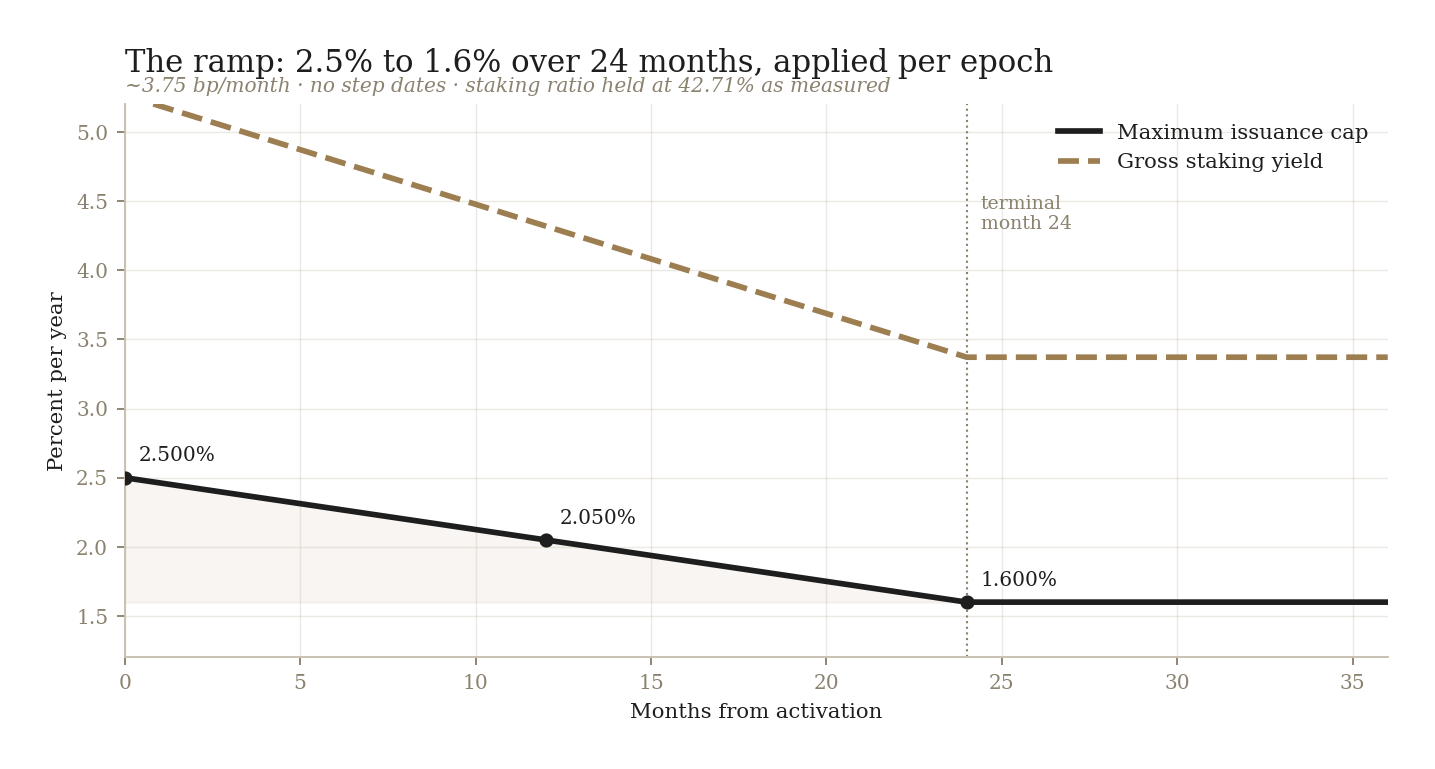
Figure 1. Maximum issuance and gross staking yield under the 24-month per-epoch ramp.
| Anchor | Issuance cap | Gross staking yield |
|---|---|---|
| Adoption (M0) | 2.500% | 5.268% |
| Month 6 | 2.275% | 4.622% |
| Month 12 | 2.050% | 4.320% |
| Month 18 | 1.825% | 3.847% |
| Month 24 (target) | 1.600% | 3.372% |
Notes: ~3.75 bp/month, no step dates, staking ratio held at 42.71% as measured
What This Means for NEAR Holders
Staking rewards are a transfer from holders who do not stake to holders who do. Cutting issuance shrinks that transfer: a token holder staking receives fewer new tokens, and every holder’s ownership share is diluted more slowly. Both sides are computable.
The breakeven for a token holder who is staking
A token holders count grows at 0.9 × π ÷ staking ratio. Compounding the ramp monthly against the current system in which issuance stays at 2.5% forever:
| Horizon | Cap | Gross yield | Shortfall | Breakeven price move | At $4.30 |
|---|---|---|---|---|---|
| Today (M0) | 2.500% | 5.268% | - | - | - |
| Year 1 | 2.050% | 4.320% | 0.434% | +0.434% | +3.9¢ |
| Year 2 (target) | 1.600% | 3.372% | 1.827% | +1.827% | +16.2¢ |
| Year 3 | 1.600% | 3.372% | 3.770% | +3.770% | +16.2¢ |
A token holder staking 1,000 NEAR ends year two with about 20 fewer NEAR than under 2.5% forever. NEAR needs to be worth 7.9 cents more for that holder to be exactly whole which is about 1.1% a year over three years.
The breakeven percentage does not depend on price. The cents figure does:
| Scenario | Price | Breakeven price | Cents needed | Shortfall per 1,000 NEAR staked |
|---|---|---|---|---|
| Bear (half of spot) | $2.15 | $2.186 | +3.9¢ | $42.85 |
| Spot | $4.30 | $4.379 | +16.2¢ | $85.71 |
| +25% | $5.38 | $5.473 | +9.8¢ | $107.13 |
| +50% | $6.45 | $6.568 | +11.8¢ | $128.56 |
| +100% | $8.60 | $8.757 | +15.7¢ | $171.42 |
Where the breakeven comes from
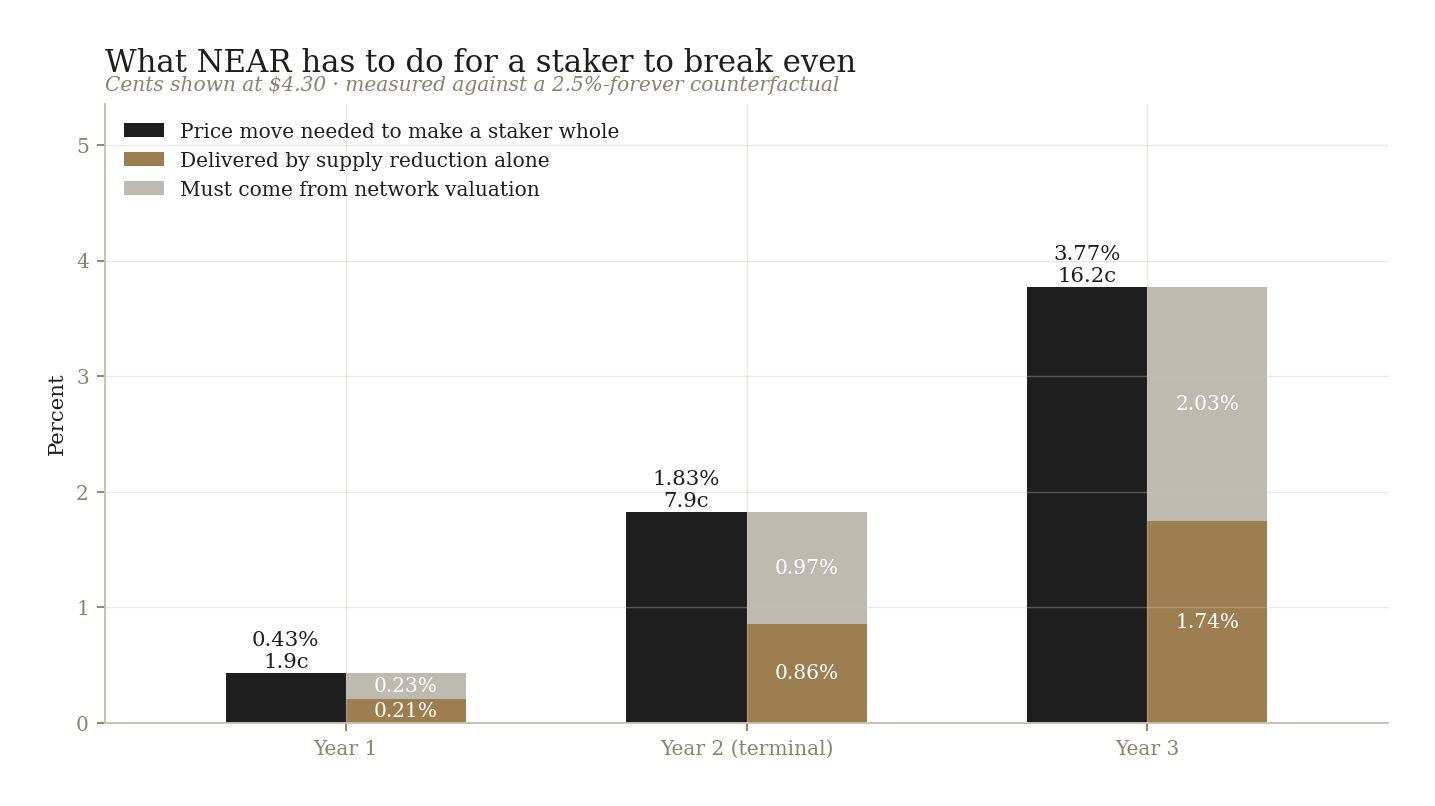
Figure 2. The price move required to make a token holder who is staking whole, and how much of it the supply reduction delivers on its own.\
By month 24 the ramp has issued 11.8M fewer NEAR, a supply 0.857% smaller than the current system. At an unchanged network valuation, a supply 0.857% smaller is a price 0.857% higher. So of the 1.827% a token holder who is staking needs, 0.857% arrives from the supply reduction itself, or a little over half, and the remaining 0.970% must come from the network being valued more highly.
We state that rather than assert that lower issuance pays for itself. Measured against the current state which holds 2.5% indefinitely, it does not quite do so for a token holder who is staking. Two things work in the holder’s favor beyond the table and neither is assumed in it: as yield compresses, some stake unbonds, and a lower staking ratio mechanically raises the yield for everyone who remains; and the current 2.5% rate is not a stable baseline, but a policy under active challenge.
The non-staking holder
For the 57.3% of supply that is not staked there is no offset at all. The full supply reduction accrues as avoided dilution of roughly $86 on a $10,000 position at the target rate with no price change whatsoever.
Cumulative effect
| Horizon | Issuance avoided | Supply reduction | Value at spot |
|---|---|---|---|
| 2 years | 11.8M NEAR | 0.86% | $51M |
| 3 years | 24.5M NEAR | 1.74% | $106M |
| 6 years | 66.1M NEAR | 4.36% | $284M |
None of this is spent. It is simply not emitted.
Time is of the essence
The saving is a function of when the ramp starts. Measured over a six-year window:
| Ratification delayed by | Issuance avoided | Forgone vs acting now |
|---|---|---|
| 0 months | 66.1M NEAR | - |
| 3 months | 62.8M NEAR | 3.3M NEAR ($14M) |
| 6 months | 59.6M NEAR | 6.5M NEAR ($28M) |
| 12 months | 53.0M NEAR | 13.1M NEAR ($56M) |
Every month of delay costs roughly $4.7M in emissions that could be saved.
Why the Rate Was Never What Protected the Validator Set
This section is the evidence base for the most common objection to any issuance cut: that it will break small validators.
The table below counts the number of validators whose measured revenue, which is commission on their actual stake plus yield on their actual owner balance, covers machine costs at published benchmarks of $500/month for block producers and $200/month for standard nodes which are deliberately conservative. The finding below holds at any cost assumption we tested, including halving both figures, under which the 300-node level remains unreachable at every rate and every price.
Validator viability against issuance.
The dotted line shows the hypothetical in which every operator self-stakes the stake it actually runs; the gap between it and the solid lines is capital the long tail does not have.
| Issuance rate | Bear (2.15) | Spot(4.30) | +50% (6.45) | +100%(8.60) |
|---|---|---|---|---|
| 2.5% (today) | 133 | 170 | 191 | 209 |
| 2.0% | 118 | 159 | 178 | 197 |
| ** | 1.6% (proposed target) | 105 | 146 | 169 |
| 1.0% | 77 | 118 | 143 | 159 |
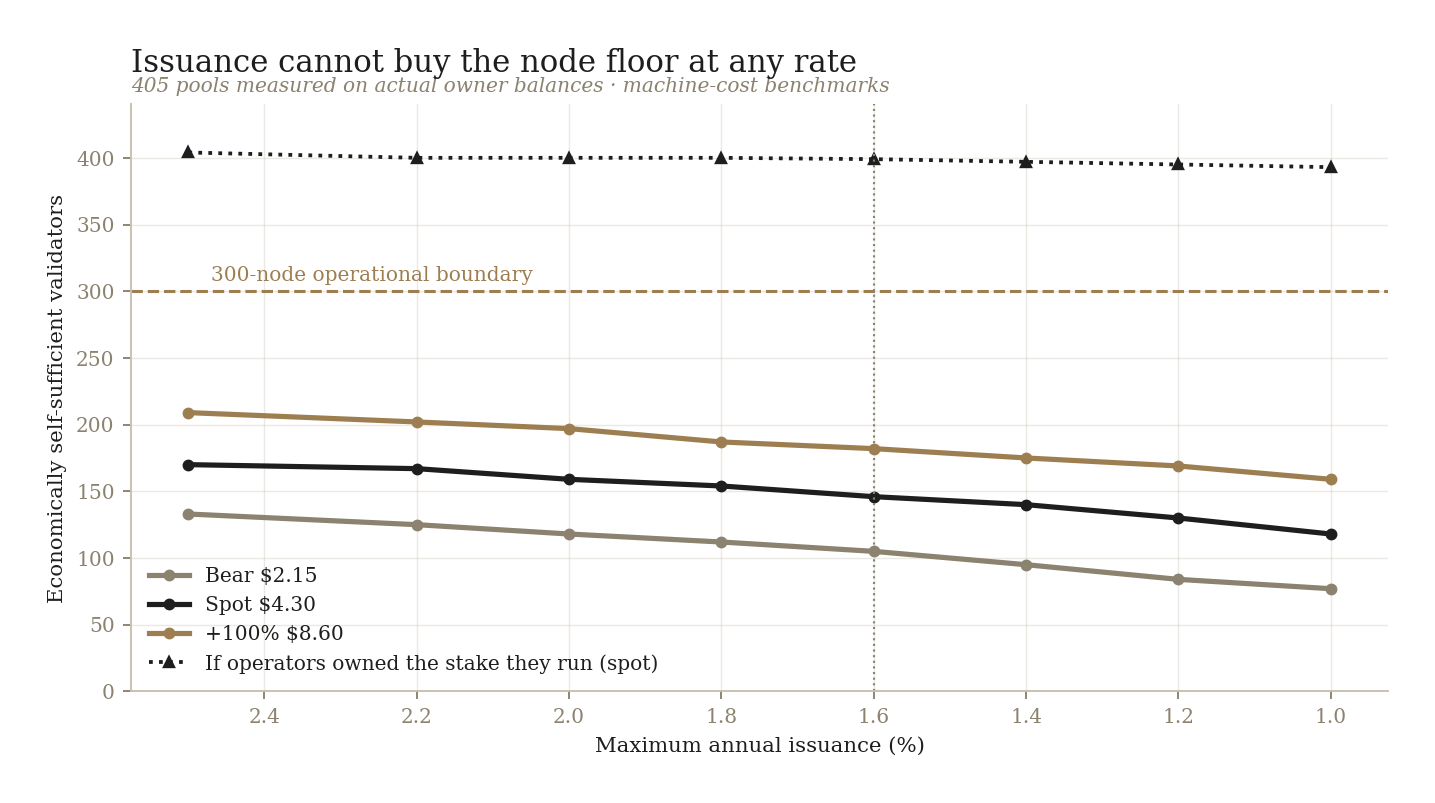
Figure 3. Validator viability against issuance. The dotted line shows the hypothetical in which every operator self-stakes the stake it actually runs; the gap between it and the solid lines is capital the long tail does not have.
Three findings follow, and they are the reason this proposal is a rate change rather than a support program.
No issuance rate at or below 2.5% sustains 300 self-sufficient validators at any price tested, including a doubling of the token. At today’s rate and a doubled price, only 209 of 405 cover their own costs. The 300-node level is not reachable by adjusting the rate in either direction.
The long tail runs on delegation, not issuance against their own stake. The dotted hypothetical reaches roughly 390 viable validators at spot, but only because it assumes operators own the stake they run. They do not, by a factor of about 700 so cutting issuance does not remove protection the tail was receiving, because the tail was not receiving it.
Therefore the inflation rate is the wrong instrument for validator support, in both directions. Raising it would not fix the tail and lowering it does not break the system.
Risks and Limitations
Operators who hold no NEAR have no offset. vadim_hom put this precisely in the Sovereign Fund discussion: a real share of the validator set holds no token at all, and for them an issuance reduction is pure downside; their revenue is being reduced, and they have no upside from price because they never held the asset, which our analysis confirmed. Median owner self-stake in the entry cohort is 19 NEAR. The breakeven analysis above does not apply to these operators; they lose roughly 36% of commission revenue. What we can say is this: their revenue is commission on delegated stake, and delegation follows service quality and fee competition rather than the protocol rate. Any discretionary alternative, i.e. a subsidy program, was rejected by this community and by the fund’s author in writing; Solana accepted equivalent attrition three weeks ago; and an algorithmic support mechanism proposed separately would have our support, if one can be designed without an oracle or a registry.
Validator attrition is real. On measured ownership, self-sufficient validators fall from 170 to 146 at spot and from 133 to 105 at the bear anchor, losses of 24 and 28 respectively. As a share of the set that is comparable to the 30-of-738 attrition Solana accepted in ratifying SGP-0002. The mitigating evidence is Section 4: these operators are largely sustained by delegation rather than by issuance. But this is a cost, and we do not present it as anything else.
Yield compression may reduce the staking ratio. Gross yield falls from 5.268% to 3.372% at today’s participation. The target figure sits above Solana’s ratified 2.25% and in the range of major proof-of-stake alternatives, but the equilibrium staking ratio at that yield is not known with confidence.
Note that the relationship runs the other way as well: a falling staking ratio raises yield, because the same staker share is divided among less stake. At a 30% participation rate the target yield would be 4.80%, above where NEAR sits today. Participation and yield are self-correcting within a wide band.
Constituency risk. The electorate for a stake-weighted vote is composed of the people this compresses. Our answer is the breakeven analysis above, disclosed rather than buried. Two features of the current market make the case easier than it was a fortnight ago: the target yield is now 3.372% rather than 3.069%, because the staking ratio fell, and the breakeven move of 1.827% sits against a token that has just appreciated 86%. The cost is 7.9 cents on a token that moved roughly two dollars in two weeks.
Measurement bounds. Owner balances are measured in the owner account, so operator capital held elsewhere is not counted; the effect is to understate operator capitalization, and the entry-cohort finding is large enough to survive a generous adjustment. Historical validator-set membership is not retrievable from public RPC because epoch information is garbage-collected.
Precedent
Every major proof-of-stake economy has attempted emissions reform. The record is consistent and this proposal is engineered against it.
| Network and measure | Design | Outcome | Lesson |
|---|---|---|---|
| Cosmos Hub, Prop 848 (Nov 2023) | Halve max inflation 20% → 10%, single step | Passed 41.1% to 31.9%, 72.7% turnout | Breakeven evidence shipped with the proposal |
| Cosmos Hub, Prop 868 (Jan 2024) | Push minimum inflation to zero | Rejected | Communities ratify cuts and refuse zero |
| Solana, SIMD-0228 (Mar 2025) | Dynamic market-based emissions targeting stake participation | Failed at 37.8% vs 66.67% needed | Novel mechanisms and no operator floor lose badly |
| Solana, SIMD-0553 (Aug 2026) | Resource-based fee burn | Failed to reach supermajority | Complexity loses even in a favourable window |
| Solana, SIMD-0550 / SGP-0002 (Aug 2026) | Double the disinflation rate; one parameter | Passed at 67.001% vs 66.67% needed | Simplicity wins |
The most instructive pair is the last two. SIMD-0550 and SIMD-0553 were proposed by the same team, in the same window, to the same electorate. The change to the single issuance parameter passed and the one that restructured a resource-based fee mechanism did not.
NEAR against the schedule Solana just ratified
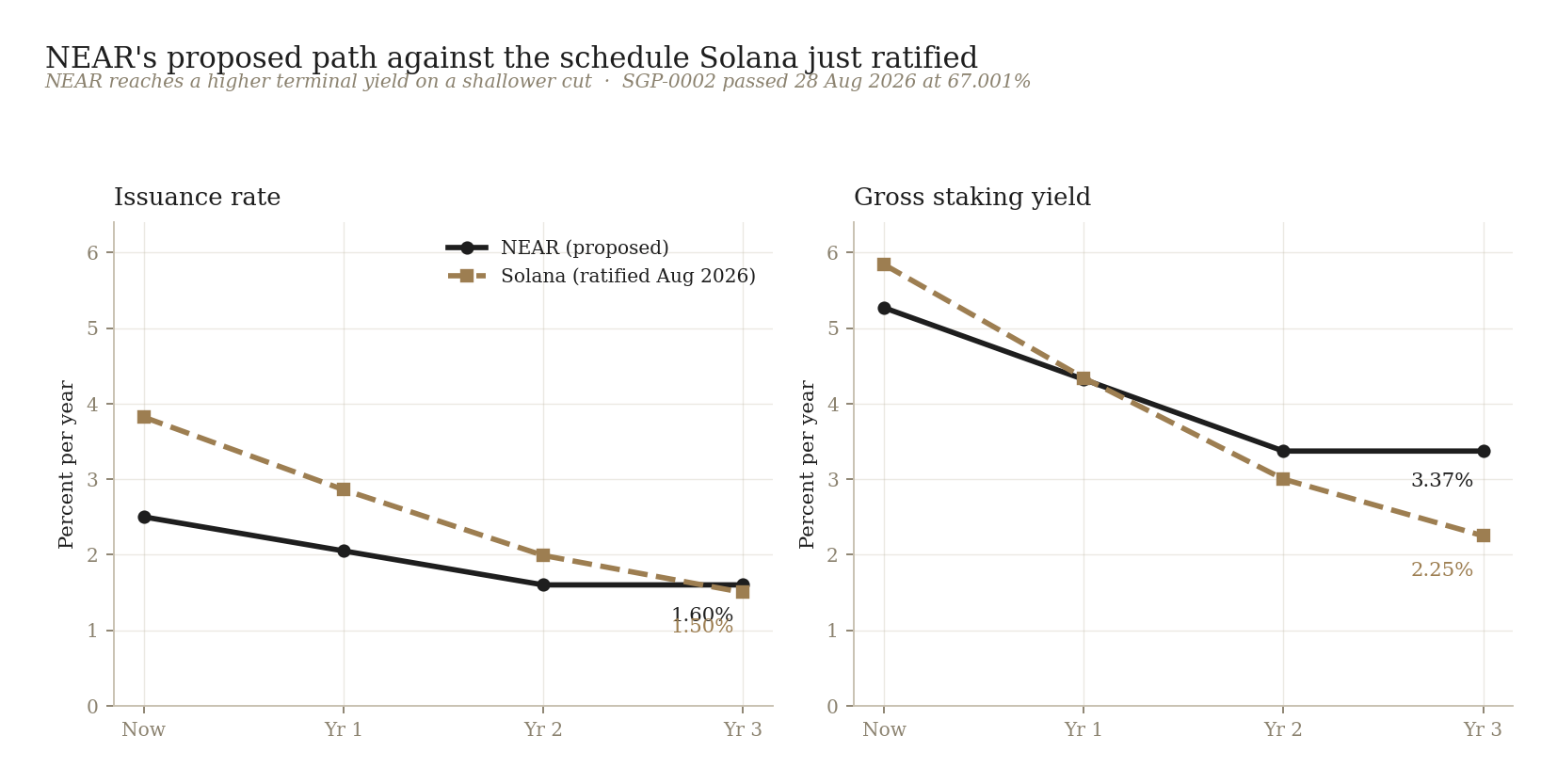
Figure 4. NEAR’s proposed path compared to SGP-0002, ratified 28 August 2026.
| Metric | NEAR (proposed) | Solana (ratified) |
|---|---|---|
| Start → target rate | 2.500% → 1.600% | 3.82% → 1.50% |
| Time to target | 24 months | 2.8 years |
| Parameters changed | 1 | 1 |
| Gross yield today → target | 4.80% → 3.07% | 5.84% → 2.25% |
| Yield compression | 36.0% | 61.5% |
| Supply reduction, 6 years | 4.36% | 2.60% |
| Validators losing viability | 24 of 405 (5.9%) | 30 of 738 (4.1%) |
NEAR arrives at a higher target yield on a shallower yield cut while delivering a deeper proportional supply reduction, because NEAR starts from a lower rate with a higher staking ratio. A delegator comparing the two networks after both schedules complete finds NEAR paying more.
End-to-End Value Hypothesis
Objective
Reduce maximum issuance to a 1.6% target on a schedule the market can verify epoch by epoch, and make it the final scheduled change.
Expected outcome
Holders retain 11.8M NEAR over two years and 66.1M over six that would otherwise be emitted; the schedule is predictable and bounded; monetary policy stops being relitigated.
Dependencies
This proposal cannot take effect on a House of Stake vote alone. The issuance cap is a protocol parameter, and changing it requires validator adoption through the standard upgrade process, which is the same path the 2025 halving took, at 68.41% approval. House of Stake ratification is necessary, however validator adoption is ultimately what makes it binding. That two-step structure is deliberate: it means the people who operate the network must independently consent to the change, and it answers directly the concern that House of Stake’s current participation level does not by itself constitute a mandate over protocol economics.
Key Performance Indicators
-
Ramp integrity: realized issuance versus schedule, per epoch.
-
Set health: raw and distress-filtered operator counts, queue depth, staking ratio.
-
Supply outcome: cumulative issuance avoided against the 2.5% current state.
Technical Specification
cap(t) = 2.5% − 0.9% × min(t, 24)/24
where t is months elapsed from activation, interpolated per epoch. Activation occurs one full quarter after ratification. The 90/10 split is unchanged.
Treasury
This proposal does not make a claim on the protocol treasury or establish a budget request.
Backwards Compatibility
The ramp is a protocol parameter change requiring validator adoption. No other consensus logic changes, the 90/10 split is unchanged, and no existing contract or staking mechanic is modified. HSP-007 continue under their own terms.
Security Considerations
Reducing issuance reduces the cost of acquiring stake-weighted influence at the margin. At the target rate NEAR’s yield remains above the level Solana has ratified, and the 24-month schedule provides time to respond to any observed decline.
There is no trigger under which emissions increase. The question was asked in the Sovereign Fund discussion whether there should be a security-budget floor at which emissions automatically resume. Our answer is no, and the reason is not indifference to the security budget. An issuance schedule that can rise is a schedule the market cannot underwrite: every institution pricing NEAR would have to price the probability of re-inflation, and every adversary would have an incentive to manufacture the conditions that trigger it. If the network ever concludes that the target rate is too low, the remedy is a proposal clearing the covenant’s thresholds, a deliberate, public decision, not an automatic one.
Implementation Plan and Milestones
-
Grace period of one full quarter after ratification.
-
Activate the ramp; cap moves per epoch thereafter.
-
Quarterly transparency reports: realized versus scheduled issuance, set health metrics.
-
target rate in force at month 24
Budget & Resources
None requested. This proposal changes a protocol parameter and creates no program, no disbursement, and no administrative function.
Stakeholders
-
Validators gross yield compresses from 5.268% to 3.372%.
-
Delegators roughly 5.00% to 3.20% at the median 5% commission fee, remaining above Solana’s ratified target.
-
Non-staking holders- dilution falls; the full supply reduction accrues with no offset.
-
House of Stake- ratifies, then governs the covenant thereafter; cannot bind validators, whose adoption is separately required.
RACI Chart
| Activity / Decision | Responsible | Accountable | Consulted | Informed |
|---|---|---|---|---|
| Prepare proposal, substantiate modelling, submit for voting | Sal Ternullo / SVRN | Sal Ternullo, HSP Author | Validators, delegators, protocol developers | HoS community |
| Finalize technical specification, including grace period and activation conditions | Sal Ternullo / SVRN | NEAR One | Protocol developers; validators | HoS community; NEAR ecosystem |
| Implement, test, and release the protocol upgrade | NEAR Protocol Working Group — | NEAR One — | Validators; House of Stake Security Council | HoS community; NEAR ecosystem |
| Independently adopt the upgrade through the standard protocol process | Validator operators | Each validator operator, for its own adoption decision | Protocol developers | HoS community; NEAR ecosystem |
| Coordinate activation readiness and publish the confirmed schedule | NEAR One — | NEAR One — | Protocol developers; validators | Wallets, exchanges, custodians, staking providers, tokenholders |
| Monitor issuance against schedule, validator-set health, and cumulative issuance avoided | Sal Ternullo / SVRN — | NEAR One — | Protocol developers; validators | HoS community; NEAR ecosystem |
| Publish quarterly transparency reports and verify completion at the target rate | House of Stake team — | Sal Ternullo / SVRN — | NEAR One, protocol developers, validators | HoS community; NEAR ecosystem |
Reproducibility
Split measurement. Read the chain head and an earlier block from the same node; take total_supply from each header and treasury.near account state at both heights. The treasury share is the ratio of treasury inflow to supply growth over the identical window. We measured over 7-day, 28-day, and 92-day windows and obtained 10.158%, 10.130%, and 10.129%. Do not use protocol_reward_rate.
Validator set and ownership. validators for the active set and proposal queue; per-pool view calls get_reward_fee_fraction, get_owner_id, get_number_of_accounts, and get_account_staked_balance for fees, ownership, delegator counts, and owner self-stake. All 406 active pools were labeled.
Historical staking participation. Epoch validator sets are not retrievable from public RPC, but pool state is: get_total_staked_balance resolves against archival RPC at any height. We summed that call across the 150 largest current pools — 96.5% of stake today — at monthly block heights over twelve months, divided by total_supply from the header at each height, and paired each point with the CoinGecko daily close. Because the sample is defined by today’s composition, it understates the level by roughly 2.2 points at the calibration point (40.55% sampled against 42.71% measured across all 406 pools); the band cited in Clause B is stated on the adjusted basis. The correlation and the direction of the relationship are unaffected by the offset, since it applies uniformly across the series.
Endpoints. rpc.mainnet.near.org and free.rpc.fastnear.com; archival via archival-rpc.mainnet.near.org and archival-rpc.mainnet.fastnear.com. Non-archival endpoints garbage-collect epoch validator information, so historical set membership is not retrievable from them.
Datasets. The full validator dataset and ownership map accompany this proposal.
Conflicts of Interest
Sal Ternullo is CEO of SVRN (OceanPal Inc., NASDAQ: SVRN). SVRN holds approximately 55M NEAR, 90+% of which is staked, composing 8+% of staked supply. SVRN operates NEAR validator infrastructure through third party infrastructure partners. SVRN authored HSP-007, the MPC Node Infrastructure Financing Program, and operates an MPC node that receives payments under that program. SVRN intends to vote in favor of this proposal with these disclosures standing.
What this proposal does and does not touch. It does not alter HSP-007, does not touch the treasury that funds it, and creates no program from which SVRN could receive an allocation. There is no spending, no eligibility, and no administrator anywhere in it. The only thing it changes is a protocol parameter that applies to every token holder who stakes identically.
On SVRN’s position. This proposal reduces the staking yield SVRN earns on its entire staked position from 5.268% to 3.372%, costing roughly 855,000 NEAR per year at the target rate. On the breakeven arithmetic above, SVRN’s position requires the same 1.827% price move as every other token holder who is staking to be made whole, and SVRN is on the losing side of that arithmetic in exact proportion to its size.
On SVRN’s accumulation. It was argued in the Sovereign Fund discussion that SVRN’s stated intent to accumulate a significant share of supply already absorbs several years of issuance at 2.5%, and that no reduction is therefore needed. We would put it the other way around. A public company’s treasury allocation is not monetary policy; it can change at any board meeting and a network should not rely on it as if it were. A network whose new supply is absorbed by a single buyer has concentration risk, not health. And a lower issuance rate means SVRN absorbs less of the float over any horizon, not more, which is the opposite of what a company seeking to maximize its share of the network would propose, and which should reassure precisely the people most concerned about SVRN’s footprint.
Copyright
Copyright and related rights waived via CC0 1.0.