I just fundamentally disagree with most of your premises here. I don’t feel like engaging with your questions is going to be productive. Happy to try again later some other way.
1 Like
Thanks for the feedback. Yes, as mentioned, we are working on onboarding someone into a full-time, focused “comms” role. Once this is done, you can expect more frequent updates, both from that person, as well as from other stakeholders and contributors, as facilitated by that person. Until then, you’ll have to bear with us, since we all have a lot on our plates and are doing the best we can.
If you have any specific questions, feel free to ask them here and I’ll do my best to find answers!
L
3 Likes
Valid point re: publicly posting job listings. The only reason this hasn’t happened yet is that I’ve been focused on other things, and don’t have final job descriptions that are ready to be posted. The Foundation has certain guidelines around the format for these, and I need to make sure they’re up to scratch before posting them. I’m also still figuring out in my own mind precisely what the right set of roles, division of labor, etc. should look like - the process so far has been driven more by serendipitously meeting folks that I thought might be a good fit, rather than leading with a formal job description. I’ll do my best to get these finished and posted.
Regarding hiring delegates to work for HoS, this feels like a conflict of interest to me. It’s important that NF remain as neutral as possible and have a very light touch on HoS governance. So far, IMHO we’ve done a good job here–none of the delegates have a direct NF affiliation (obviously, some are friends and folks the Foundation works with in various capacities, and I believe this has all been publicly stated in the applications). Having said that, of course I’d welcome support from the delegates, or anyone else really, with all of the things we need help with – but there is a fundamental difference between a full-time employee who reports to me, and an ecosystem volunteer. We need both.
Regarding funding, as I said here a moment ago, the HoS treasury isn’t being used yet. When that changes, we’ll establish new transparency guidelines around its spending. Right now, HoS is being funded by NF. I can’t speak directly to the transparency of NF spending as that’s not up to me.
Regarding the current composition of the delegates, I think we did a good job with the applications that we received through an open process. As I’ve said several times, we can expand the group in the future to include broader representation of other constituencies (AI comes to mind).
HTH.
L
4 Likes
We’ll take the time we need to get things right here. We’ll do it as fast as possible, but no faster - good things take time. The main blocker right now is the development of the Agora frontend, but rapid progress is being made here.
2 Likes
Hi folks,
Here’s another quick transparency update on what’s been happening over the past few days. I don’t have so much to report this week: I’ve been mostly focused on negotiating some research-related partnerships, which I alluded to in my last update, but I don’t want to say more here about them until they’re final.
Meanwhile, the delegate working groups have been quite active. We’re discussing the possibility of holding an in-person event soon, to get the delegates together face to face to build trust, review governance best practices, and draft the first few proposals together.
I’m happy to report that Agora is making rapid progress on the HoS frontend prototype. In fact, the first barebones prototype is already working. We’ll share it with the community as soon as Agora feels comfortable doing so.
The question arose on X about why the former NDC trustees are still being paid out of the HoS treasury. Here’s my response.
My top priorities at the moment are:
- finalize HoS job postings and post them publicly
- hire the roles mentioned above (esp. Head of Governance, and Comms). Thank you to everyone who reached out and expressed interest – your messages have been received and I’ll respond as soon as I can! Apologies for not being able to reply directly to all of them.
- finalize the set up of the new HoS legal entity, finish closing the NDC trust and transferring the treasury and assets
- finalize an initial proposed list of AI x governance research topics, and the plan for establishing a larger HoS research team, possibly including a third-party partnership
I’m attending a major conference this week. I’ll do my best on all of these tasks this week but progress on my end will be slow for a few more days. I appreciate your patience.
As always, feel free to post questions or ideas here.
Cheers,
Lane
4 Likes
Ultimately I’ve seen nothing to convince me that, “this time is different”.
We’ve seen vaguely community oriented approaches where users could vote themselves funds. We’ve also seen insider only approaches which delivered poor results.
The current approach appears to be a synthesis of both. I’m less interested in ideology and more concerned with seeing tangible results.
Empirically, both approaches have failed to deliver results. Reasoning from first principles, allowing the community to vote themselves funds has unresolvable malign incentives.
Typically firms with an economic interest in success would dish out consequences for insider graft or general poor performance. Here we see that some have been given another swing at the pinata, although we are assured that their intentions are not to once again eat the goodies. It is hard to believe this. Where are the observable changes?
Please excuse my ignorance of much of the insider lore and intrigue. I’m genuinely impressed by some of the comments here. They have been informative.
That said, I regard the question of NF as a firm with an economic interest in success as unresolvable under these premises. To understand it, I believe we would have to redefine success away from the stated terms.
Perhaps success in this context is better defined as the ability to raise VC funds, rather than deliver actionable changes which would result in robust, long-term ecosystem growth. From this perspective many of the decisions make sense.
Under these terms, modest ecosystem growth, apps with users and incremental wins are less valuable than selling the dream of hyper-growth. From this standpoint we can see how unimportant actual users are to the “success” metrics of NEARProtocol.
End users and messaging directed towards them becomes totally redundant. Similarly, completed apps become a liability. If it doesn’t fit the promised narrative of hypergrowth, then it is a distraction from the main product: raising money from VCs and institutions.
For me, this analysis fits much better. It offers a coherent explanation for the otherwise incoherent incompetence we’ve seen. Happy to be proven wrong.
4 Likes
Hi all
Excited to be here and to introduce myself. I am Maz, Head of Implementation at Agora, working with Lane, the NEAR Foundation team, endorsed delegates and other respective stakeholders on the development and implementation of the NEAR House of Stake Governance interface powered by Agora.
We are thrilled to be partnering with NEAR on this innovative approach to governance and see House of Stake as a evolutionary governance model that introduces two initiatives:
1/ Stake-weighted voting model
2/ Foundation for an AI-native agentic governance system
As you may know, Agora is the home for many DAOs in the ecosystem such as Optimism, Uniswap, ENS and more. We are true believers that good governance is a competitive advantage. Our team works closely with Foundations and Delegates to support the rollout of their governance strategy and community engagement.
Project goals
- Agora NEAR House of Stake governance front-end, UX and integration: we are working closely with fastNEAR engineers to integrate House of Stake contracts to a Agora governance frontend ensuring all functionality and UX meet the expectations as set out in the proposal by Gauntlet and the codebase to ensure NEAR token holders the ability to stake to vote. This includes:
- Token staking, delegation, voting, and governance participation
- Custom integration to the NEAR blockchain
- Support for the HoS gov contracts and voting systems, including integration of NEP-141 smart contracts
- Developing proposal drafts and rollout strategy: we are working closely with HoS endorsed delegates to provide support on proposal creation and strategy. This will be executed on an ongoing basis pre and post gov site launch to ensure clarity on proposal draft writing (proposal template), proposal themes and goals. Alongside engaging in necessary delegate working groups to ensure a successful rollout proposals for clarity and community engagement.
- User engagement goals: our aim is to ensure user engagement at a healthy level with the help of stakeholders to support the House of Stake governance rollout. This would include success metrics as such:
| Goals | KPIs |
|---|---|
| Help build an active and engaged delegate base | - Delegation participation rate - Voting participation rate |
| Provide technical support to Near delegates, foundation, and community. | - Delegate’s working group calls attendance - Technical governance support SLA |
| Ensure successful adoption of HoS governance | - veNEAR locked in the staking contract |
| Ensure proposals are completed and easily accessible | - Active voting power - Quorum is met for proposals |
Progress milestones and progress
Below is a high-level project overview of the key steps required for the Agora NEAR House of Stake governance implementation and engagement with HoS delegates. I will be updating this as the project develops.
| Phase | Description | Status |
|---|---|---|
| Initial R&D | Study House of Stake contracts codebase, logic, gov parameters and proposal parameters |  |
| Agora intro presentation to HoS delegates | Agora product demo and expressing areas of support | |
| MVP functionality | Develop a low design scrappy MVP to test staking, locking and proposal creation functionality | |
| MVP functionality and data indexing | Continue to refine functionality and data infrastructure for real-time governance data | |
| Agora product demo to HoS Delegates | First demo to delegates and to answer any technical Qs | |
| Delegates workshopping proposals | Write-up proposal strategy, themes and drafts with endorsed delegates |  |
| MVP functionality, data indexing and UI/UX | Continue to develop MVP to reflect UI/X and NEAR branding and theming | |
| NEAR Event @ ETHCC | Agora governance facilitation workshop | Incoming |
| MVP full integration with branded front-end | Full end to end interface and back-end integration for a working near complete app | Incoming |
| Internal testing | Internal testing for bug reporting and further iteration | Incoming |
| UAT | User Acceptance Testing for bug reporting and further iteration towards sign off | Incoming |
| Launch rollout | HoS governance interface rollout with first proposal deployed | Incoming |
Feel free to post comments and questions, I will be happy to answer as best as I can. We are aiming to showcase a prototype to the community in the coming weeks. I will provide further updates in this thread as the project develops.
10 Likes
Hi everyone,
Hope you had a nice weekend. Here’s a quick update from my end! As usual, lots of things are cooking but they’re not all immediately visible.
As before, I’m continuing to work on negotiating and hammering out the details of several partnerships. I apologize for not being able to provide a ton of detail on them, but I promise that we’re making good progress on all of them and that all of them are very promising. For the sake of transparency here’s some more info:
- Initiative 1 is a research partnership with an interdisciplinary lab at a major research university. The idea is that we’d hire one or more postdocs to be focused on the AI x governance research questions and topics that are the most interesting and relevant to HoS. They’d be partially or, potentially, fully dedicated to this work, and the outcome here would be both running code as well as real academic research (paper(s), talk(s), etc.). The benefit for us is that we could hire world class researchers much more cheaply than we could otherwise, we could outsource a lot of the “admin” work of the project to the university, and we could leverage the university’s brand. The first project we’re contemplating is a “call for data” to collect as much governance-related data as possible to fine tune a model specifically for governance use cases, and to build a governance “assistant” on top of it (i.e., stage one outlined here: Three Stages of AI Governance - by Lane Rettig). We’re quite far along in the discussions here and we have in-principal approval. We’re hammering out details around how to start and sequence the work, the financial arrangement, etc.
- Initiative 2 is a partnership with a consulting and events company that’s focused exclusively on governance, and that has run large, successful, well-organized and well-marketed events for other major ecosystems, both Web2 and Web3. It’s likely that they’ll also help us expedite basically all of the HoS initiatives and provide some extra hands on deck while we work on hiring and building the team. We’re reviewing legal paperwork and finalizing the details here.
- Initiative 3 is a partnership with a team that’s focused both on making access to DAOs and governance more accessible for more community members who aren’t whales, as well as on using AI to make governance more efficient. This latter goal is highly aligned with one of our main goals at HoS. We’re relatively early in figuring out this partnership but it’s highly values-aligned and I think very high potential.
- Initiative 4 is with an open source, community-driven project focused specifically on sovereign use cases of AI. They’re in meetings and conversations with a number of big governments around the world, and what they’re finding is that existing AI solutions offered by the incumbent, large, for-profit companies simply don’t suit the needs of sovereign actors. They need more control over how models are trained and tuned, over how and where inference runs, etc. - in other words, exactly the things that NEAR AI is developing. This potential partnership is a little bit less about immediate deliverables for HoS and more about long-term potential and public goods work, to which I believe HoS could contribute meaningfully. This conversation is also in the early stages but, again, is very high potential.
There are a few other things cooking but these are the big ones!
In other news, we’ve confirmed that we’re hosting our first in person event in Cannes on July 1 (alongside EthCC). We’re planning to do a closed-door session with the delegates and a few ecosystem partners, and then we’ll open the doors later in the afternoon to the community and host a “meet and greet” style happy hour event where we can share some of our findings and progress. The happy hour is free and open to the public. All are welcome to attend; I’ll share a sign up link shortly.
The delegates continue to be busy and to make good progress in the working groups. We’re still figuring out the best way for them to share that progress with the community for feedback. If you have ideas, feel free to share them here.
I’ve made some progress on the job descriptions for HoS. It’s my goal to finish and post these this week, and then formally kick off the hiring process.
On the transition from the NDC trust to the new HoS entity, we’ve made progress here as well. We’ve finalized the composition of the security council and the multisig that will govern the funds coming from the NDC trust. For security reasons I’m not 100% sure if we can share the members of these groups publicly, but if we can find a way to do so that doesn’t put anyone at risk, we will.
That’s about it from me for this week. I’ll do my best to keep these updates coming more often in the future. As always, feel free to post comments, questions, etc. here.
Cheers,
Lane
8 Likes
Thank you very much for the detailed update — it’s greatly appreciated. I have a few follow-up questions.
Firstly, could you kindly confirm whether the NEAR Foundation Board has formally approved the funding for these research initiatives? Additionally, it would be helpful to know the names of the partner institutions and companies involved, as well as the general scope of the budgets allocated to each.
With respect to the upcoming event in Cannes, I wanted to raise a concern: given the availability of free virtual meeting tools such as Google Meet, sponsoring in-person delegate travel and events of this scale might be perceived by the community as a potential conflict of interest.
Finally, many in the community are eager to learn more about the delegates’ progress. To date, there has been very limited visibility across social channels or public communications.
Regarding the Security Council composition — while the intention to protect members is understandable, their identities are likely to become known via wallet activity. With that in mind, a proactive and transparent approach might ultimately serve the community better.
3 Likes
Thanks for the feedback and questions.
I’ll share names once the deals are done. I don’t think it’s appropriate to do so while these are still in flight. I think we can share some info on the scope of budgets, though here I have to defer to NF and our legal team since NF budget transparency isn’t up to me. I’ll reiterate a point here that I made a few times before: when HoS is “up and running”, when it’s more mature and funds are flowing, NF can stop subsidizing these things, HoS can take them over, and the full HoS budget can and should be made public.
The delegates have done a bunch of virtual meetings already. It’s not the same thing. You need both. My personal opinion is that you also need face to face meetings from time to time to build trust and have higher bandwidth time to discuss important topics.
I don’t see a conflict of interest. As always, happy to hear other ideas and proposals to accomplish these goals.
Completely agree with this point. I know that some of the delegates are working on this. I’d personally love to see each working group begin to post public updates as well, but at the same time, the delegates are all volunteers and I’m hesitant to create more work for them. What do you propose?
I’ll give this some more thought. Open to ideas and proposals here, too.
L
4 Likes
I’ve yet to read a coherent argument for AI governance. If the humans framing the problem for the AI have been unable to identify suitable incentives to support ecosystem growth, why would we believe that they are capable of instructing an AI to do so?
In reference to “Project Cybersyn”, it was impossible from the beginning from the well known, “Economic Calculation Problem”. Without individual entrepreneurs acting towards their unique and subjective ends, price calculation becomes impossible or more accurately - the results of cybernetic price calculations were meaningless.
Similarly, the ecosystem will not be developed if insiders continue to pursue things which only resonate within their own echochamber. Incentives must relate to market forces and tangible performance, not toxic political connections and long debunked ideological baggage.
NEAR must pivot to developing a robust and active ecosystem. Projects which drive token consumption must be prioritized. If subsidies are to be deployed, active and released projects must be incentivized. If you’re not interested in driving NEAR token use and creating an active ecosystem, why are you here?
Proponents of AI governance should offer supporting arguments for their initiative. Afterwards, a vote should be held. Sidestepping this process from the beginning suggests that the the House of Stake will be yet another farce.
3 Likes
HI all,
Jumping in again with another update. Things seems to be developing well across the key work streams and I’ve personally been enjoying meeting with the delegates again to update them on the progress of product development and the overall project.
Before jumping into updates, wanted to share the demo snippet from our recent call with some of the delegates on May 9th where we covered:
- Basic user flow and functionality
- Key user behaviours like locking
- Product basic UI with data indexing resulting to a performing web app

(see full demo video [here]
Three core workstreams
1- Product, technical and design
- Locking down core user flows ensuring we have considered all critical user personas
- Design UI/UX sprint in progress for the locking and staking flows alongside overall in line with our existing Gov Site design
- Front-end improvements interacting with staking contracts to display staking balances
2- Delegate Engagement and governance support
- Latest demo and engagement with HoS Delegates answering technical Qs on product and flows
- Setting up every 2 weeks product demo and Q&A drop-in session to ensure development is visible
- Support working groups and individual delegates leading on proposal creation and process flow alongside technical docs creation for better onboarding
3- NEAR House of Stake @ EthCC 1st July
- Co-organizing the event’s program with NEAR Foundation and Gauntlet
- Looking to organize panels and breakout sessions to ensure we discuss House of Stake Governance
- Show a more fleshed out product to attendees, we are positive to have an even further developed product with polished UI/UX by the event
As always would love to get any feedback if you have any and will also hold myself to updating more frequently. This post is a general update across current priority workstreams and looking to go deeper in my upcoming updates as processes progress across these areas. Thank you.
8 Likes
It’s an interesting question, thanks for bringing this up. I have to say upfront that the entire HoS initiative is predicated upon the idea that AI will play a significant role in governance, so if you disagree with this statement, you probably won’t be a fan of HoS. Having said that, I feel strongly that we should approach this in a scientific fashion: i.e., we should come up with some specific, falsifiable hypotheses and systematically test them, without assuming that AI is a panacea and will just “fix governance.” (Hence the research initiatives I described above.)
My perspective is:
- humans are just bad at governance. There are lots of reasons for this. Governance isn’t fun, it’s contentious, we have lots of biases (including prejudices and biases that we aren’t even aware of), we’re corruptible, we’re lazy, etc.
- AI agents have the potential to be more neutral actors in governance than humans. (I say potential, I don’t think this is guaranteed, and also, they obviously won’t be perfectly neutral, but they can be more neutral than human actors.)
- governance is simply a lot of work, a lot of that work is drudgery that isn’t fun (ex: reviewing proposals, voting, committees, researching prior art, etc.), and AI can relieve a lot of this load from human actors.
- in governance it’s borderline impossible to aggregate preferences from all of the human participants, even in a democratic system. That’s because a lot of human actors are disenfranchised by the system, don’t have coins to vote, or are just apathetic/busy. It’s theoretically possible to have one agent act on behalf of every human actor, to make sure their interests are represented in governance. This could be a breakthrough in governance, and IMHO it’s exactly the sort of hypothesis that HoS should be testing.
- Sybil resistance is also a huge problem in governance, as we saw in NDC (and in many other places in crypto). AI has the potential to give us novel Sybil detection and collusion resistance systems. This is another area I think we could research, and could lead to a more democratic system.
I don’t think it’s so cut and dried, and these are not mutually exclusive. Including AI agents doesn’t mean we’re removing humans, human judgement, or human agency. See, for example, the DeepGov experiment run as part of the most recent Gitcoin Grants funding round. Projects can still submit suitable incentives with funding requests, and AI agents can play a role in distributing funding. There are still human experts in the loop. See also AI as the engine, humans as the steering wheel.
Project Cybersyn is fascinating, I’ve always been fascinated by it! I totally agree with this point. Nothing we’re planning here removes individual entrepreneurs acting towards their unique and subjective ends!
L
5 Likes
I’ve been around the NEAR ecosystem for 3+ years. I’ve watched millions of dollars in aggregate funding directed towards vaporware, meaningless initiatives and payments to clueless DAOcrats. Here your statement is nominally correct, because governance has never been centered around market performance. To remove something implies that it was present in the first place.
The entrepreneurial process requires that entrepreneurs put something at risk. It is a process of calculated risk. The previous initiatives failed because DAOcrats had nothing at stake. They had nothing to lose by granting funds to useless initiatives. Moreover, allowing individuals or factions to vote themselves funds or those aligned with them funds has obvious perverse incentives.
Using an AI model here doesn’t remove these conflicts of interest. Those training the AI will simply use it as a ventriloquist dummy to absolve themselves of responsibility. The AI has nothing at stake and no more to lose than the DAOcrats dictating the training data and interpreting the output.
It is cut and dried when we reason from first principles. Instead of pursuing more irrelevant projects from within the foundation’s echochamber, the DAO should respond to market signals. The market is and has always been the most effective, decentralized way to aggregate user preferences.
If we are not interested in market success, what is the goal? Why would we attempt to measure anything else?
Example: Funding unreleased vaporware has brought about even more unreleased vaporware. Unreleased vaporware has not benefited the ecosystem. Promotion and funding of vaporware has eroded trust among users and developers.
Solution: Fund active and released projects. Incentives should be directed towards the pointy end of the funnel. Incentivize builders to complete and launch their projects. Further incentivize projects with users.
This is so simple it that borders on tautology, yet it needs to be repeated again and again here. It doesn’t require research, AI, misdirection or further waste. This is immediately actionable.
The reference to the failed central planning project, “Cybersyn” is illustrative. There are direct parallels between the misallocation of resources in centrally planned economies and the previous failures of NEAR governance. In both cases, consumer and entrepreneurial preferences are overlooked in favor of political interests. After 3+ years of failure, the results speak for themselves.
Other chains have managed to cultivate vibrant and active ecosystems, while NEAR is appearing to retreat further into its self-congratulatory echochamber. If NF wants to look inward, look inward at the past failures. Show some accountability.
I would rephrase this: Nothing you’ve posted here demonstrates that (decentralized by definition) market signals will play a role. The problem isn’t in what you are removing, it is what hasn’t been added.
Nothing here convinces me that this iteration of governance will be any different from the previous failures.
4 Likes
I don’t doubt this. But, from my perspective, none of what you’re saying here has anything to do with HoS. HoS is a novel initiative, from scratch, with a new design, new people behind it, etc. What you’re describing here is a lot of NDC PTSD. I’m sorry that you, and the ecosystem, had to go through that, but again: HoS is a new initiative, and hopefully we’ve learned something from the mistakes of the past. In any case, it’s unfair and disingenuous to accuse HoS of something like “pursuing more irrelevant projects” when HoS hasn’t distributed a single dollar of funding yet.
I’ve said it before, I’m sure I’ll say it again many times: HoS is brand new. Give things a chance. You (plural, as in, the community) need to have faith, and a more positive attitude, to give this a fair chance of success.
Great idea. I shared some very concrete ideas in my previous post. Why don’t you be constructive and share some concrete ideas on how to better factor in market signals?
L
4 Likes
Thanks for your response here.
Firstly, hoping isn’t enough. We need results. What I’ve read so far doesn’t inspire confidence. To the contrary, it reads like more of the past, NDC or even before. It isn’t PTSD, but common sense observation. For the record, I spoke up and expressed similar concerns about the NDC before it launched. Don’t try to gaslight my criticisms or mischaracterize my intentions. Address the topic at hand, not the person.
Personally I’d be ecstatic if I believed, “this time is different” or the further leap, “this time is different, because AI”. We all hope for change, but hope alone isn’t enough. A coherent strategy is required. Action and a genuine desire to fulfill that strategy must follow from there. Simply going through the motions, playing to the echochamber (AI narrative) and collecting a check for showing up isn’t enough.
Even you concede here that the basic premises have unresolved issues. I believe at least some of the delegates are capable, if given a chance to start.
Your comments touch on the subjective nature of fallible man etc. The implication is that AI wouldn’t be? Again, this doesn’t inspire confidence.
Why are we going around to conferences to talk about governance and pontificating on what it might mean? Put the thoughts into action. Show us here in the NEAR ecosystem. Don’t go elsewhere to tell some other group about what AI might do. What end does this serve? How does it help develop the NEAR ecosystem?
The common theme here is AI gobbledygook. Meaningless hubris playing to the echochamber. Preemptive, coddling excuses for failure, speaking about the impossibility of the project. Framing the problem (poorly) in the theoretical instead of the practical. A lack of coherence and an inability to understand the basics. This isn’t about PTSD. This is like watching a school bus get stuck on a railroad crossing, again.
Let’s be honest here. AI is being shoehorned into an already poorly designed system, with faulty premises because it suits the current hype cycle. It suits what serial employees talk about in a collection of companies which have repeatedly failed to foster a vibrant ecosystem. Previous failures were also focused on the narrative du jour. If and when this initiative fails, employee-contractors will add it to their LinkedIn profile as a win.
Firstly, dump all of the voting where possible. Just forget about the DAO concept.
Secondly, end all of the existing subsidy programs, including the ones paying for github churn or other employee-contractor metrics. These ideas do not serve the market.
Hire a team of aggressive recruiters/developer advocates who work on commission. Pay their bonuses only when they on-board builders who can deliver results for the ecosystem.
Metrics shall include:
- Releasing the project on the mainnet
- Acquiring active users
- Acquiring paying users
- Multivariate testing and optimization of mature products
- ..And other tangibles.
Incentives will be weighted towards the pointy end of the funnel. Recruiter bonuses and developer incentives will be screened harshly. Failure to perform will result in termination. No more coddling. No more culture of failure. No more vapid narratives where performance is needed. Keep that nonsense directed towards outside marketing efforts. It should not govern internal decision making.
After this process is ironed out and effective - and only after, you may consider an AI integration for the least valuable rung of the funnel. Here the previously collected metrics can be used to automate the process. Think lead generation for new developers or unserious developers who talk endlessly.
6 Likes
Thanks for sharing your perspective. If this is your perspective, though, you’re not going to like House of Stake very much. It sounds like you don’t like decentralization very much.
To be totally honest - and I’ve said this before - I’m also deeply skeptical of DAOs, and of decentralized, community-led governance. I’ve been part of a number of DAOs that were epic failures. But I’ve also seen a few successes, most notably projects like Linux and Python. I decided to work on House of Stake in spite of this skepticism because I believe we can learn from the mistakes of the past (including NDC), and that we can do better and be better, and learn from more positive examples of open source governance and from ideas like rough consensus and commons-based peer production. Also, because - unlike you I suppose - I believe that AI will make a big difference here, and that we’re the right community to build that.
Thanks for sharing this as well. While I disagree with a lot of your points, this is constructive and worth discussing. I’m also skeptical of subsidy programs, and a lot of the ones that have been tried to date (in NEAR and elsewhere) have definitely been ineffective, you’re right about that.
This is precisely what House of Stake should be discussing, and now is a great time to do that, since the first ideas for proposals are just now being discussed. But I don’t think this forum thread is the right place to do that. I’d suggest starting a new forum thread on this topic, and/or sharing a draft proposal to this effect.
1 Like
Hi folks,
Time for another update. There’s a LOT going on in the HoS ecosystem, and things are definitely accelerating, so I’m not entirely sure where to start. I’ll break things down by workstream:
- Delegates: The four working groups are all making good progress in their respective areas and have begun to produce insights and actionable results. See the below slides for concrete examples of progress. I’ll encourage the working groups to also post updates, including some of these deliverables, here and/or in the public Telegram group. The delegates have begun to discuss topics including proposal process flow, constitution, and what the initial set of proposals should be.
- Hiring: I’ve onboarded two contractors to fill in the gaps while we continue to work on growing the team. @haenko has also generously offered to help out as a volunteer. All of these individuals are already adding value and helping me focus on the areas where I have the most to contribute; that said, they’re still onboarding and we haven’t fully decided what their respective areas of responsibility will be going forward. I’ll encourage them to also introduce themselves here. I apologize for the delay in getting those job postings up. It remains a top priority, but I’ve continually been pulled into more time-sensitive tasks over the past few days and haven’t had the chance to finish them yet. I intend to do so ASAP. In the interest of transparency, here is a draft of the Head of Governance job posting.
- AI work: I began personally reviewing the source code for the Cami assistant from NEAR AI, to assess whether we might be able to repurpose it for our HoS governance assistant. Unfortunately, this code isn’t open source yet so I cannot share it - that’s up to NEAR AI. @haenko also identified several other open source repositories that we may be able to rely on. We shared that we’re planning two initial, concrete initiatives here: a global call for data to create a governance-related data set (that we can use to build an assistant, an AI delegate, etc.), and one or more AI agents/delegates that can help with public goods funding. Progress here will continue to be slow until we have full-time technical staff working on this; reach out if you’re interested.
- Community: There were a couple of open AMAs on X spaces, including one with me that was recorded. Summary and takeaways here. There are more Spaces and AMAs planned by the community in the coming days. NF is working with an experienced social media consultant, whom I’ve personally really enjoyed working with and have learned a lot from. I asked him to run a workshop with the endorsed delegates on social media strategy, something that’s in the process of being organized. Delegates having a bigger social media profile will help raise the profile of House of Stake and of NEAR more generally; it will help the world understand what we’re doing and why, and why they should pay attention.
- Events: We have a final agenda, and some preliminary swag designs, for the in-person HoS activation that’s happening in Cannes on July 1. As a reminder, we’re going to have a one day workshop for the endorsed delegates and a few partners, followed by a happy hour (co-hosted with NF) that’s open to the public. I’ll also be giving a talk on HoS and AI at EthCC.
- Partners: Gauntlet continues to make great progress on the HoS 2.0 design: i.e., on the impact that HoS will have on overall protocol economics. Most recently, they delivered sensitivity analysis and scenario analysis on the impact on network security of things like changes in the NEAR price, changes in total validator rewards, changes in the amount of NEAR staked, etc. This work is ongoing.
- Agora continues to make great progress on the HoS frontend. @mmazco shared updates here previously, and I’ll let her do so again rather than speaking on Agora’s behalf.
- I’m very excited to announce that we’ve signed a contract with Hack Humanity, an experienced team of systems thinkers led by @KlausBrave that brings a wealth of expertise in governance and group dynamics from both Web2 and Web3. We expect that they’ll work with the delegates on things including building trust, ecosystem mapping, and proposal identification & acceleration. They’ll be participating in the Cannes event as well, and we plan to run an open GovHack event with them later in the year
- Research partnership work (mentioned previously here) is a bit stalled. We’re still working out what sort of partnership would make the most sense, and what the initial set of research tasks will be.
- Entity setup: Finalizing the setup of the new HoS legal entity is blocking on setting up a multisig to receive and custody the inbound NDC funds from the old NDC Trust. We finalized the composition of the multisig, and one of the signers asked that we use the Fireblocks MPC solution for signing. I have a call with Fireblocks tomorrow to better understand their product as a next step. In parallel, I also worked with the HoS delegates to come up with a list of questions for the NF legal team to better understand the entity setup, governance, and processes around executing proposals and disbursing funds. We’re still waiting for answers.
That’s all I can think of for now. As always, feel free to post questions or comments here!
Lane
–
Updated roadmap. This does NOT include all initiatives or everything that’s going on but it gives you a rough idea:

Working groups:
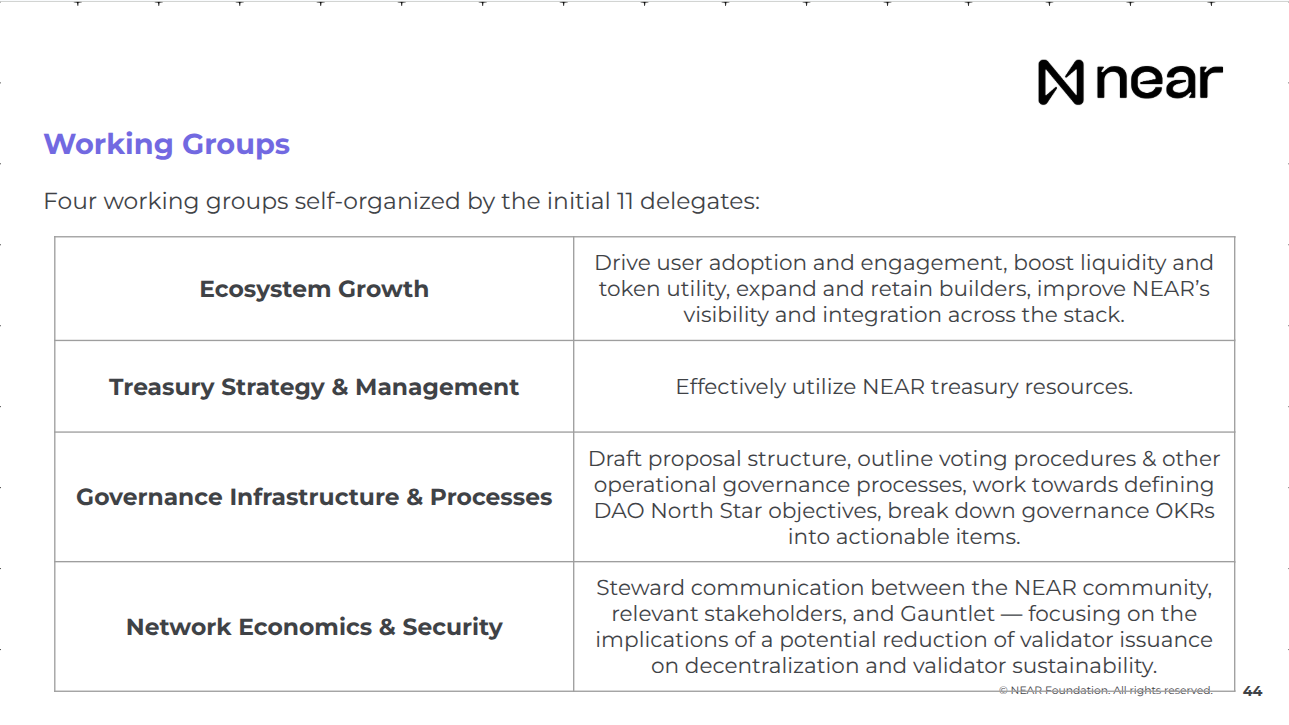
One concrete example of progress from each group. There’s a longer status report from @haenko coming soon.
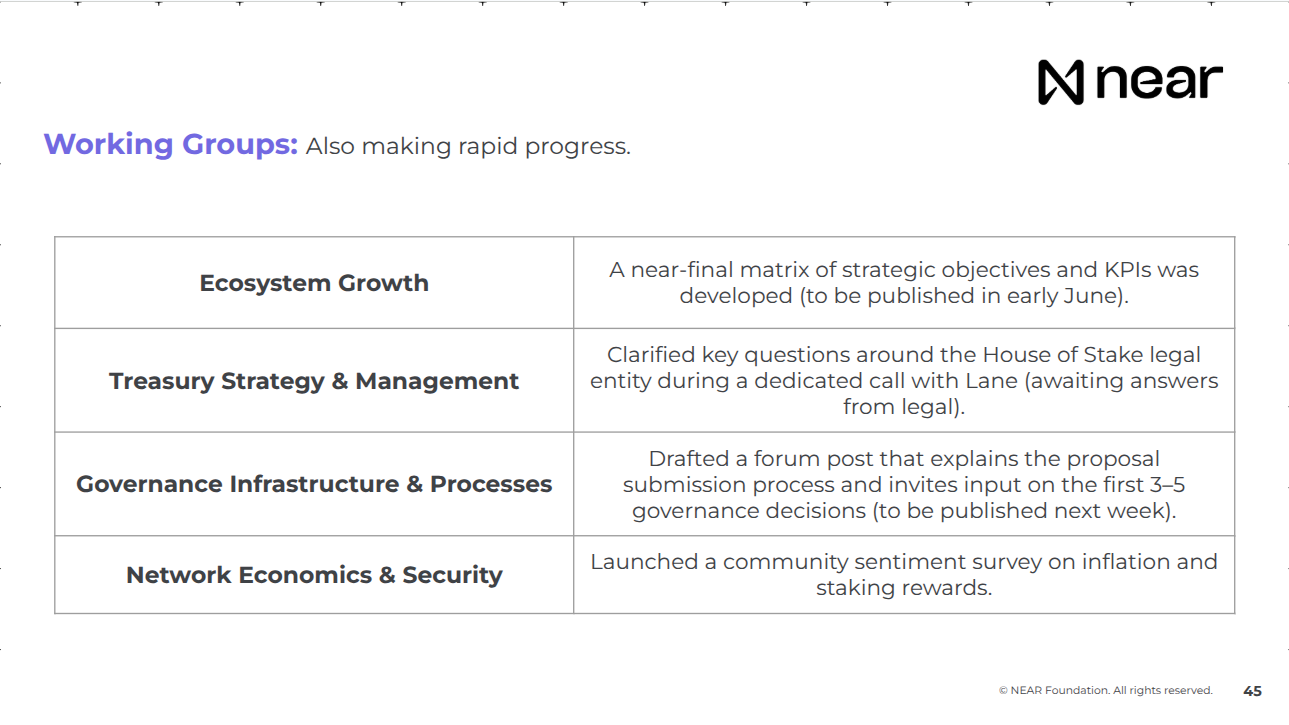
10 Likes
House of Stake Working Groups Update May 2025
As part of the House of Stake initiative, four working groups are actively shaping strategic direction and operational frameworks for the NEAR ecosystem. Below is a summary of key outcomes in May and plans for June.
1. Ecosystem Growth Strategy Working Group
Focus
Aligning on the key objectives and KPIs for NEAR’s ecosystem growth strategy, to help prioritize the initiatives our working group will focus on
Participants
Tané, Areta, Aurora, NEARWEEK, Charles Garrett, Slime, Cameron Dennis
May Highlights
- Held 4 interactive workshops that surfaced 7 key opportunity areas
- Developed an almost-final matrix of goals and KPIs (user growth, dev retention, TVL growth)
 Ecosystem Growth WG Key Metrics Drafting
June Plans
- Publish the Key Objective/KPI matrix and open a 7-day async feedback window
- Present the refined strategy for feedback and iteration during the next House of Stake community call
How to contribute:
 Review and comment on the KPI matrix when it’s published
- Share any ecosystem initiatives you’re involved in that align with the growth goals
2. Network Economics & Security Working Group
Focus
Assessing the impact of potential validator issuance reductions on decentralization and long-term sustainability.
Participants
Slime, Alan, Takeshi, Rika Goldberg (404 DAO)
May Highlights
- Launched a community survey on inflation and staking
- Compiled a list of ~40 NEAR-native projects (validators, DeFi, AI, wallets, games, etc.) to receive the issuance survey
- Assigned outreach owners using NEAR Catalog and ecosystem mapping tools
June Plans
- Publish anonymized survey results and raw data
How to contribute:
- Take the staking/inflation survey (if you haven’t yet)
- Share the survey within your community circles
- Provide feedback or ideas on how to improve the long-term network economy
3. Governance Infrastructure & Processes Working Group
Focus
Designing scalable and transparent governance processes for House of Stake and the wider NEAR ecosystem.
Participants
Tané (Takeshi and Shoji), 404 DAO (Cole), Slime, Alan, Cameron, James
May Highlights
- A draft forum post was prepared to introduce the governance submission process and collect initial proposals (draft link)
- Explored directions for AI-assisted governance. James (james.near) is currently studying HoS contracts in order to build an assistant with these potential capabilities:
- helping users lock/stake NEAR to get veNEAR and delegate it
- reviewing or summarizing proposals with recommendations
- participating in governance discussions
- creating proposals
- voting autonomously
 Community-built multi-agent proposal generator
June Plans
- Publish the forum post and begin accepting community proposals
- Continue testing AI-based governance tooling (community testers welcome)
- Implement UI/UX improvements in the governance portal
How to contribute:
- Submit your proposal once the forum post is live
- Volunteer to test AI-based governance tools
- Share UX feedback or ideas to improve the governance portal
4. Treasury Management Working Group
Focus
Creating clear guidelines for how NEAR’s treasury is used to maximize impact, manage risk, and support sustainable ecosystem growth.
Participants
Yuen, Slime, Cole
May Highlights
- Reviewed treasury management initiatives from Arbitrum and ENS
- Assessed legacy NEAR DAO treasury practices and gaps
- Discussed legal entity structure with Lane
June Plans
- Align with Growth WG on funding priorities
- Launch community survey on treasury goals and risk preferences
- Begin draft of initial budget and allocation framework
- Meet with NF counterparts (Founder Success, Strategic Initiatives) to discuss guidelines, respective areas of focus, preventing overlap, etc.
How to contribute:
Fill out the treasury goals & risk survey (when released)
Share examples or ideas for effective Web3 treasury management
Reach out if you have legal, financial, or operational expertise to offer
6 Likes
4 posts were split to a new topic: House of Stake: Transparency Thread Off-topic Posts