Near Governance Weekly updates

A new legal framework for Community funds
In a recent AMA session with NEAR Foundation’s legal team, Bianca highlighted a major overhaul of the House of Stake (HoS) – NEAR’s emerging community governance and treasury entity. The HoS is moving from an initial trust-based setup to a more flexible foundation structure registered in the Cayman Islands . Under this model, the House of Stake Foundation has no shareholders or beneficiaries, and it controls a subsidiary company in the British Virgin Islands (BVI) to facilitate operations . This two-layer structure is designed to streamline payments (for example, paying contractors in fiat currency, which was challenging under the old trust) .
Key details of the new structure include:
-
Cayman Foundation: The HoS Foundation is incorporated in the Cayman Islands, offering simplicity and flexibility (unlike a rigid trust). It holds the community’s treasury funds and is not owned by any shareholders .
-
BVI Subsidiary: A limited liability company in the BVI, fully owned by the HoS Foundation, will execute contracts and payments (solving prior issues in paying out funds).
-
Independent Directors & Accountants: The foundation’s board is minimal – currently a single corporate director provided by a third-party service (unaffiliated with NEAR Foundation) . In addition, a UK accounting firm (Harris & Trotter) specializing in crypto finance has been engaged to manage accounts . This ensures professional oversight of the books.
Bianca noted that treasury management may involve creating sub-accounts or “sub-treasuries” with quarterly budgets to buffer against crypto market volatility . Importantly, she stressed that all HoS funds ultimately belong to the community, not the NEAR Foundation . The new legal structure is meant to enshrine that principle, while providing a clear framework to operate independently yet in coordination with NEAR Foundation on broad ecosystem goals .
Governance model: delegates, committees, and community control
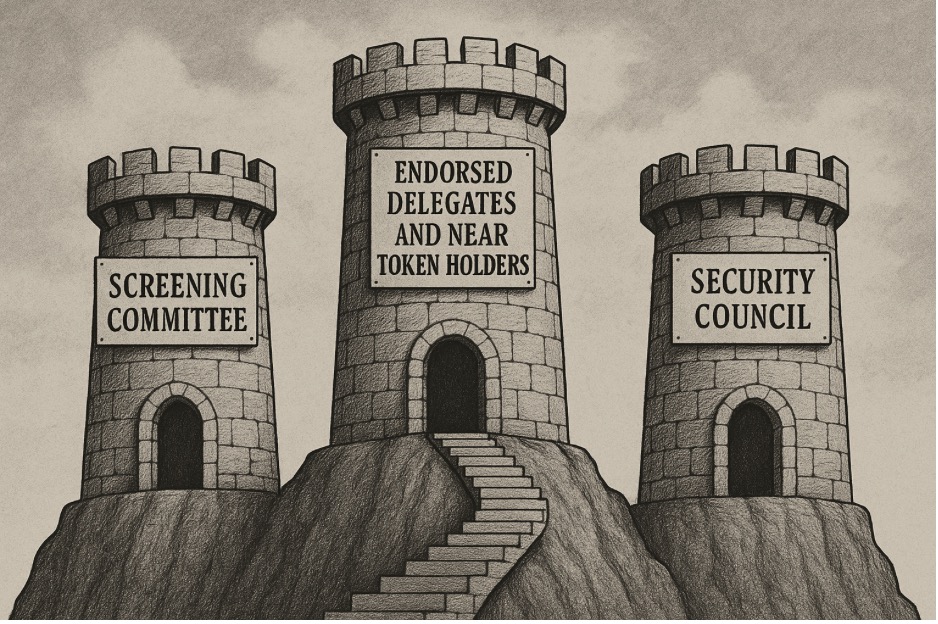
The House of Stake is envisioned as a community-driven governance body with checks and balances, taking lessons from NEAR’s previous experiment, the “NEAR Digital Collective” (NDC). It comprises three main groups with distinct roles:
-
Screening Committee: A small committee that initially vetted delegate applications and is supposed to pre-screen funding proposals. This group holds significant power as a gatekeeper for what gets to a vote and probably, even has budget execution authority (similar to the NDC’s former trustees) . However, its membership has not been fully disclosed.
-
Endorsed Delegates: An initial cohort of 11 delegates was announced in March. These individuals and organizations – ranging from NEAR contributors to outside ecosystems – will debate and vote on proposals. The delegate system is meant to make on-chain governance more efficient for everyday token holders , though any NEAR holder with “veNEAR” voting tokens can still vote directly on proposals without delegating, if they wish .
-
Security Council: A watchdog body (akin to an “enforcer”) that can veto proposals or take emergency action on security matters. This council is still being formed, but Bianca indicated it could serve as an additional check – for example, intervening if the Screening Committee or delegates approved something malicious or against the community’s interest . It’s comparable to similar oversight councils in other DAO frameworks (and in the previous NDC model). So, the community proposed a Due Diligence (DD) commission under the Security Council, but the proposal has not yet been reviewed (link). Additionally, not a single document has been shared with the community.
According to Bianca, the community will have ultimate control over these structures. In the AMA, she emphasized that the NEAR community has the power to appoint or remove directors, change the Screening Committee, replace accountants, and otherwise modify governance as needed . The intent is that HoS should not be a static, Foundation-imposed system, but an adaptable framework that the community can shape over time . All critical governance documents – such as the foundation’s bylaws and memorandum of association – are to be published openly so the community can review how everything is set up . Bianca assured that these legal documents would be shared imminently, underscoring that nothing is “secret” about the rules by which HoS will operate.
How a proposal will flow: Bianca described a process where a funding or governance proposal is first reviewed by the Screening Committee, then opened to community discussion and a token vote, and finally requires sign-off by the HoS Foundation’s director to release funds . This multi-step flow is meant to ensure due diligence (via the committee), broad stakeholder input (via token voting), and legal compliance (via the director’s formal approval). To make funding more efficient, she suggested the use of multi-signature wallets or sub-accounts under HoS control, so that approved budgets can be distributed without bottlenecks . This is a conscious move away from the previous NDC model, which saw operational delays in payments – something the Foundation is keen to avoid repeating .
Timeline: The initial launch of House of Stake governance is targeted for early August (with reports suggesting a go-live around August 7). At that point, the first set of proposals and votes can commence. In fact, NEAR ecosystem head Lane Rettig recently indicated in an AMA that the community is now invited to start submitting proposals on the forum, even before the final interface is live .
Transparency issues and community skepticism
Despite the positive strides, the rollout of House of Stake has not been without controversy. Community members are demanding greater transparency and voicing concerns about whether HoS will truly break from the past. A focal point of criticism is the Screening Committee. To date, the full composition of this committee remains opaque – an issue Bianca acknowledged. The community was told only that it consists of five individuals (reportedly including Lane Rettig, one member from NEAR One, one from Gauntlet, and two people affiliated with NEAR Foundation) . The Foundation has pointedly refused to disclose the identities of the latter two, which has raised eyebrows . This lack of transparency, coupled with the committee’s outsized role in both selecting delegates and filtering proposals, has led some to question its legitimacy. Calls to reorganize or even disband the Screening Committee have surfaced in the community, with arguments that its duties could instead be handled in the open by the delegates and token holders themselves . In other words, why have an unelected, behind-the-scenes committee at all, if HoS is meant to be community-driven?

Furthermore, while the initial delegate selection was framed as a careful vetting of candidates’ reputation and alignment , skeptics point out apparent conflicts of interest in the outcome. On NEAR’s governance forum, some outspoken community members criticized the list of endorsed delegates as being filled with insiders and NF favorites. One forum participant went so far as to label the selection “illegitimate”, noting that 3 out of 5 screening committee members were NEAR Foundation representatives, inherently biased toward picking their own . The same commenter alleged that several chosen delegates either work for the Foundation or rely on its funding, calling into question their independence .
Another point of contention is the actual engagement (or lack thereof) from some of the new delegates. Delegates representing organizations like Areta, Tane Labs, etc., have seldom posted updates or interacted with community proposals so far. This has fueled questions about whether some delegates are truly committed to NEAR governance or merely lent their names.
Together with Near Ai assistant and ChatGPT we have jumped deeper to analyze their work and commitments at Arbitrum Governance based on the data:
@areta’s Participation
-
Voting Record: Areta consistently voted on all formal proposals during the evaluated period. In both Snapshot (off-chain) and Tally (on-chain) votes, Areta maintained a 100% voting rate . This indicates reliability in casting votes to meet quorum. However, mere voting presence is only the baseline of delegate activity.
-
Proposal Authorship: The report shows no record of Areta authoring or sponsoring any governance proposals. There is no indication that Areta took initiative to draft or lead proposals on the forum or Snapshot. The absence of authored proposals suggests a lack of proactive leadership in governance, with Areta primarily acting as a voter rather than a proposer.
-
Feedback Activity: Areta’s engagement in discussions has been minimal. The DIP feedback metrics show that Areta earned only about 10 out of 40 possible points for delegate feedback in the April reporting period . This low score implies that Areta contributed little in the way of forum comments or substantive feedback on proposals during that month. In fact, Areta did not even meet the threshold for the smallest “presence in discussion” multiplier, indicating fewer than the minimum 2–3 comments required in the relevant discussions. In an earlier month, Areta had provided at most one or two high-quality comments (scoring ~24.9 points for feedback) but still fell short of a sustained engagement level (no multiplier for frequency) . Overall, Areta’s participation in deliberative discussions appears sporadic and limited to brief input rather than ongoing dialogue.
-
Commentary and Qualitative Notes: The feedback report does not highlight any notable commentary from Areta aside from the quantified scores. The data suggests Areta’s contributions beyond voting were confined to isolated remarks rather than continuous involvement. This pattern – voting on every proposal but rarely voicing opinions or initiating ideas – is a hallmark of passive participation. It signals that Areta has been largely inactive in qualitative governance roles, content to vote but not to drive debate or shape proposals.
In summary, Areta demonstrates passive delegate behavior. They fulfill basic voting duties but show little initiative: no proposals authored and very few comments given. This low-activity profile suggests that Areta is not an active contributor to Arbirum DAO’s governance beyond the bare minimum.
@Gauntlet’s Participation
-
Voting Record: Gauntlet has an impeccable voting record on Arbitrum governance proposals. The DIP report confirms Gauntlet voted in 100% of Snapshot polls and on-chain Tally votes during the measured periods . High voting turnout implies Gauntlet is reliably present for formal decisions, which is positive in terms of meeting quorum and representing delegators on paper.
-
Proposal Authorship: There is no evidence in the report of Gauntlet authoring any governance proposals. Gauntlet is a well-known organization in the ecosystem, but within Arbitrum DAO’s context, they did not spearhead or submit proposals for consideration (aside from contributing to external initiatives). The lack of authored proposals indicates Gauntlet has not taken a leading role in introducing changes or new initiatives in Arbitrum DAO’s governance; their involvement is mostly reactive (voting on others’ proposals) rather than proactive.
-
Feedback Activity: Gauntlet’s engagement in forum discussions and delegate feedback has been quite limited for much of the program. In the March feedback report, Gauntlet scored only 12.6 out of 40 points on the Delegate Feedback metric – a low score reflecting minimal commentary or insights shared. During that month Gauntlet did not attain any discussion multiplier, meaning they posted fewer than the required 3 comments in governance threads. By April, Gauntlet’s qualitative participation improved somewhat (feedback score ~23.2/40) , but this boost was largely due to a single initiative: Gauntlet received a one-time 10-point bonus for contributing a “Statement of Support” (SOS) submission . In other words, Gauntlet’s primary qualitative contribution was confined to that one-off activity. Outside of that, the data suggests Gauntlet rarely engages in debates or gives detailed feedback on proposals. They generally did the minimum to satisfy DIP requirements – and in fact were in the lowest reward tier (Tier 3) in earlier months due to low engagement , despite their full voting record.
-
Commentary and Qualitative Notes: The report does not quote Gauntlet providing extensive commentary on proposals. The pattern that emerges is a delegate with substantial voting power who participates in votes but seldom voices opinions publicly. Gauntlet’s rise to Tier 1 in April was driven by bonus points and slightly more feedback, but it’s noteworthy that this came after prior criticism of the DIP and likely to ensure eligibility; it does not erase the prior inactivity in discussions. In essence, Gauntlet has acted more as a silent voter than an interactive community member. This low-engagement approach is underscored by the fact that even with perfect voting, Gauntlet initially only achieved ~74% total participation score (barely missing the cutoff) because their contributions to discussion were so scant .
Gauntlet’s governance role exhibits limited active participation. While always present in votes, they have provided little in the way of discourse or leadership. The need to rely on bonus points to reach a top-tier score highlights that Gauntlet’s normal level of engagement was not sufficient to be considered a fully active delegate . Not initiating proposals and contributing few comments are clear signs of a predominantly passive governance role, despite the outward appearance of activity through voting.
@KlausBrave’s Participation
-
Voting Record: Klaus Brave’s voting record is technically complete for the proposals tracked – the data shows 100% participation in both Snapshot and Tally votes in recent months . However, it must be noted that Klaus’s delegated voting power was very low, and merely casting votes did not translate into meaningful influence or robust participation under DIP criteria.
-
Proposal Authorship: Klaus Brave did not author any proposals in the Arbitrum governance forum or on Snapshot during the evaluated period. There is no indication of Klaus taking a sponsor role for governance initiatives. This lack of authored content suggests no active initiative-taking on Klaus’s part within Arbitrum DAO’s governance – he did not propose changes, funding actions, or new policies.
-
Feedback Activity: Klaus Brave’s participation in discussions and feedback was virtually nonexistent. According to the feedback report, Klaus earned only around 12 out of 40 points for Delegate Feedback – indicating perhaps a single modest comment or a couple of very brief remarks at best. This level of engagement is insufficient to register any significant impact. He also accrued minimal bonus points (e.g. ~1 point from perhaps attending a call) . The result of such low activity is that Klaus failed to meet the minimum participation threshold for the DIP program. In both March and April, Klaus Brave’s total participation score hovered around 60–61%, below the 65% needed for the lowest incentive tier . In other words, despite voting on everything, Klaus’s lack of substantive contribution led to disqualification from rewards – a clear marker of inactivity. The report explicitly lists him with 0% reward (Tier X) due to not qualifying .
-
Commentary and Qualitative Notes: The feedback report offers little commentary on Klaus Brave aside from the numbers, likely because there was not much to comment on. The consistently low participation scores speak for themselves: Klaus has been present in name only. He did what requires minimal effort (pressing “yes/no” in votes) but did not engage with the community or proposals in any meaningful way. This passive stance is underscored by the fact that Klaus Brave’s profile had to be marked as not qualified for the delegate program, signaling a level of engagement falling short of the program’s basic expectations . Essentially, Klaus’s role in Arbitrum DAO governance has been inactive: no initiatives led, no influence on discussions, and barely any footprint beyond casting votes.
Klaus Brave is a prime example of an inactive delegate. He maintained nominal participation (voting attendance) but contributed no value-added input. The DIP report data shows two consecutive months of failing to reach even minimal performance cutoffs . This persistent low engagement marks Klaus as a largely dormant participant in governance – a delegate in title who is not effectively performing the role’s responsibilities.
@Tane’s Participation
-
Voting Record: Tané voted on all tracked proposals (100% participation in both Snapshot and on-chain votes) during the period, according to the DIP report . This indicates Tané was reliably present for every decision, similar to the other delegates examined. Voting diligence ensured that Tané met the baseline responsibility of a delegate in Arbitrum DAO’s governance.
-
Proposal Authorship: The report and forum records show no proposals authored by Tané. Tané did not emerge as a proposer or lead sponsor for any initiatives in the Arbitrum governance process. This suggests that, like the others, Tané has not taken a proactive role in setting the agenda or championing specific changes within the DAO.
-
Feedback Activity: Among the four delegates in this review, Tané showed relatively more discussion activity early on, but still at a moderate level. In March, Tané earned a substantial Delegate Feedback score (~32.8/40) by contributing to multiple discussions – enough to help achieve a Tier 2 reward at that time. This indicates Tané did provide some meaningful feedback or commentary (likely a handful of constructive posts on proposals) in that month. However, this engagement appears to have waned by April. The April report shows Tané’s feedback score dropped to 21.0/40 , and his overall participation fell to ~71.7%, just barely making Tier 3. Tané also did not secure any discussion multiplier in April (implying fewer than 3 comments that month), similar to Areta. The decreasing feedback contribution suggests that Tané’s initial burst of participation was not sustained. Moreover, Tané’s reliance on the program’s leniency for small delegates is evident: with a low voting power (under 100k ARB), Tané’s contributions needed to be qualitatively significant to count, yet in April he only achieved a borderline score . Tané did gain a couple of bonus points (likely from attending governance calls) but nothing beyond routine involvement.
-
Commentary and Qualitative Notes: The report does not cite any specific commentary from Tané by content, focusing instead on the numerical scores. From those, we infer that Tané has been somewhat active in providing feedback (more so than the other three delegates) but not to an exceptional degree. It engaged in discussions enough to be recognized, but did not emerge as a leading voice. Notably, Tané’s contributions, while present, did not drive major proposal edits or initiatives as far as the record shows. Its participation, though genuine, stayed within the scope of reacting to proposals rather than initiating them. The decline in his engagement metrics could indicate either burnout or a shift of focus away from Arbitrum governance over time.
While Tané is not completely inactive – it did participate in dialogues to a degree – there are still signs of diminishing and limited engagement. The lack of any authored proposals points to a non-leadership role. The drop from a higher feedback score to just barely above the threshold suggests that Tané’s activity level is inconsistent and possibly trending downward. In April, Tané contributed only what was necessary to remain eligible for incentives, with no extra involvement beyond that . This pattern implies that Tané, like the others, is not fully active in Arbitrum DAO’s governance in a broader sense; he participates, but does not go much beyond the minimum expected input.
This data raises significant concerns about the adequacy of the due diligence conducted in selecting these delegates.
The road ahead
As the House of Stake enters its launch phase, NEAR is at a crossroads in decentralizing its ecosystem governance. On the one hand, the pieces are in place for a groundbreaking experiment: a legally independent community foundation, a hybrid model of expert delegates and open tokenholder voting, and the promise of agile funding for grassroots projects. The changes were driven in part by hard lessons from the NDC’s struggles, and there is real hope that this iteration will succeed in empowering the NEAR community to drive the protocol’s evolution.
On the other hand, trust and transparency will be the make-or-break factors. In the coming weeks, the community will be looking for the NEAR Foundation to follow through on releasing all governance documents and for the HoS committees to conduct business openly. If the Screening Committee continues to operate in the shadows, or if delegates remain uncommunicative, skepticism will only grow. Success for HoS will likely require a cultural shift: the NEAR Foundation must let the community lead (even if that means sometimes relinquishing control or accepting criticism), and the community members in power must rise to the occasion with professionalism and openness.
Bianca’s AMA ended on an optimistic note: she promised more frequent updates and dialogue as HoS ramps up . The community, for its part, is not short on passion or ideas – as evidenced by lively debates on everything from inflation tweaks to social media strategy for NEAR . The stage is set for NEAR’s House of Stake to become a model of decentralized governance, if the talk of community control is earnestly implemented. The coming quarter will be crucial. As funds start to be disbursed and proposals acted upon, NEAR’s wider community will finally be able to judge: Is the House of Stake truly their house, or just another façade?
One thing is clear – all sides agree that transparency and accountability will determine the outcome. As one community blog put it, the HoS treasury “is community-owned, and it is the community that must shape and enforce governance norms” . Achieving that ideal will require continued pressure, good faith on both sides, and likely a few course-corrections along the way. All eyes in the NEAR ecosystem will be watching as this ambitious governance experiment unfolds.
Other Near Ecosystem governance updates
Meanwhile in the Aurora ecosystem – a Near Department of Effectively – the community is rallying behind a proposed update to the AURORA token economy. Aurora Labs CEO Alex Shevchenko revealed in a recent livestream that the “Aurora Token Economy 3.0” proposal has received an enthusiastic reception from community members. The plan outlines several changes to Aurora’s tokenomics and governance, including new revenue-sharing mechanisms and streamlined community treasury funding. According to Alex S., answer regarding plans for the next 6 monts on the last regular weekly updates stream on these ideas has been overwhelmingly positive, and a formal proposal is expected to be submitted to the Aurora DAO for an official vote in the near future.
Alex S. and his team have been notably open to community dialogue, actively discussing proposed changes and incorporating feedback. It’s a great example of how engaging the community early and often can lead to smoother implementation of significant governance reforms across blockchain projects.

If you wish to share concerns anonymously, feel free to use this inbox:
 hostip@proton.me

Disclaimer:
Some or all of the content in this document/message/publication was generated using AI language models, including Near AI agent and ChatGPT. While we aim for accuracy and objectivity, the information may contain errors and should not be considered expert or professional advice. The author assumes no responsibility for any outcomes resulting from the use of this information.